The Sourdough Math Cheat Sheet: Every Formula You Need on One Page
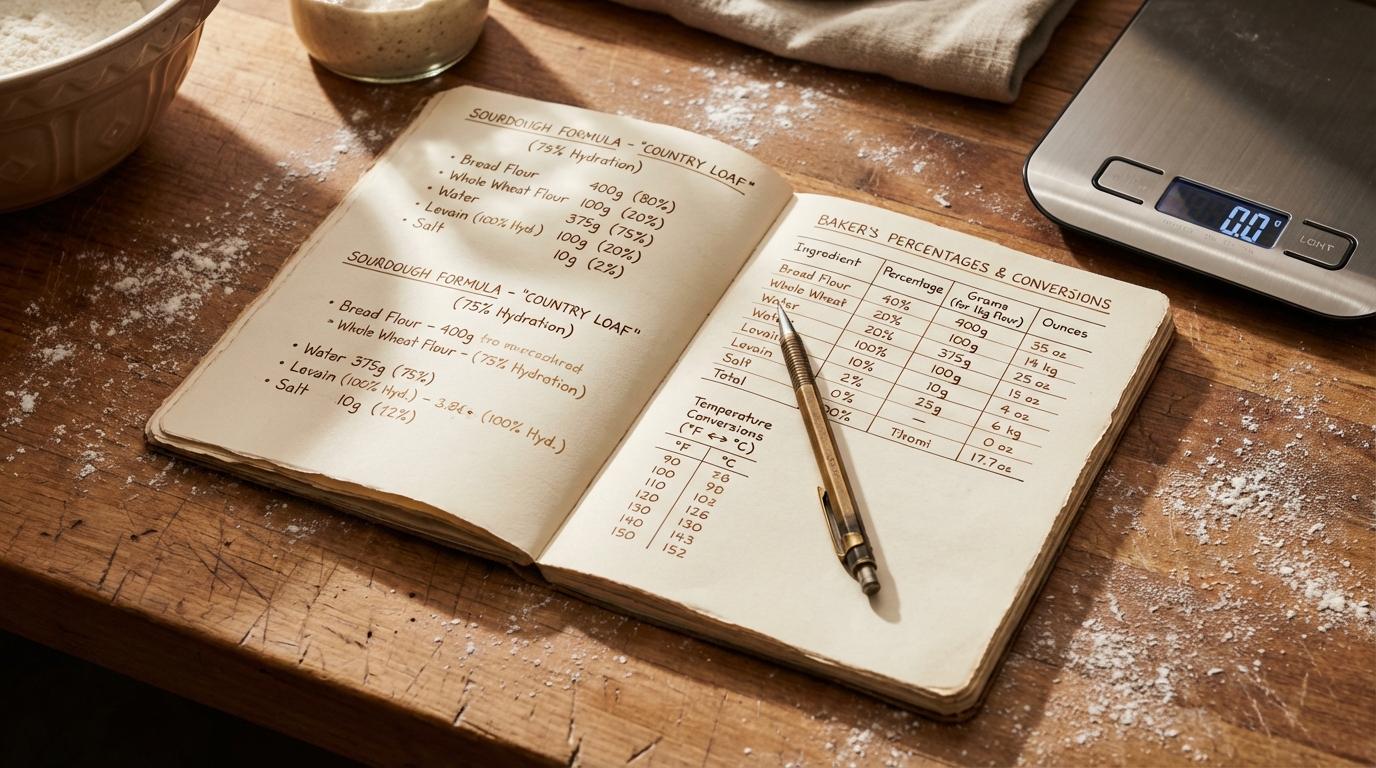
This is the page to bookmark. Every sourdough formula you’ll ever need, grouped by what they do, with examples plugged in. If you only remember one of our articles, this should be it.
The foundation: baker’s percentages
Every ingredient is a percentage of total flour weight, with flour itself as 100%.
This is the whole system. A recipe written in baker’s percentages can be scaled to any size, compared to any other recipe, and analyzed without doing arithmetic every time.
| Ingredient | % of flour | Notes |
|---|---|---|
| Flour | 100% | Always. This is your reference. |
| Water | 65–85% | “Hydration” — covers total water |
| Starter | 15–25% | At 100% hydration (half water, half flour) |
| Salt | 2.0% | 1.8–2.2% window |
| Olive oil (enriched doughs) | 2–5% | NY pizza, focaccia |
500 g flour, 75% hydration, 20% starter, 2% salt = 500 + 375 + 100 + 10 = 985 g dough. That’s it.
Our sourdough calculator runs this math for you automatically.
Hydration math
Basic formula
Hydration % = (total water ÷ total flour) × 100
Include starter water in the math
A 100%-hydration starter is half water by weight. So 100 g of starter = 50 g water + 50 g flour. Add those to your totals before calculating hydration.
Worked example
Recipe: 500 g flour, 350 g water, 100 g starter, 10 g salt.
- Total flour = 500 + 50 (from starter) = 550 g
- Total water = 350 + 50 (from starter) = 400 g
- Hydration = 400 ÷ 550 × 100 = 72.7%
See our hydration by flour type guide for when to adjust.
Scaling formulas (up or down)
Method 1: Scale by total weight
Multiplier = new total weight ÷ old total weight
Example: Recipe makes 900 g; you want 1,200 g. Multiplier = 1,200 ÷ 900 = 1.333. Multiply every ingredient by 1.333.
Method 2: Scale by flour weight
Multiplier = new flour weight ÷ old flour weight
Example: Recipe uses 500 g flour; you want 750 g flour. Multiplier = 1.5. Multiply every ingredient by 1.5.
Both methods give the same answer because every ingredient is proportional to flour. For worked examples with pizza, bread, and focaccia, see our scaling for dinner parties guide.
Starter percentage ↔ fermentation time
Rough rule at 24°C / 75°F room:
| Starter % | Bulk time | Best for |
|---|---|---|
| 10% | 7–10 h | Very long, cool bulks |
| 15% | 5–7 h | Standard overnight bulk |
| 20% | 4–6 h | Daytime bake |
| 25% | 3–5 h | Pizza night, same-day bakes |
| 30% | 2.5–4 h | Emergency fast bakes |
Shift about 30–45 minutes faster for every +5% starter. See our how much starter per loaf deep-dive.
Temperature ↔ fermentation time
Fermentation roughly doubles in rate for every 8°C / 15°F rise in dough temperature.
| Dough temp | Bulk time multiplier |
|---|---|
| 18°C (64°F) | 1.8–2.0× |
| 21°C (70°F) | 1.2–1.3× |
| 24°C (75°F) | 1.0× (baseline) |
| 27°C (81°F) | 0.7–0.8× |
| 30°C (86°F) | 0.5–0.6× |
See our proofing time by temperature guide and the DDT formula for precise control.
Desired dough temperature (DDT)
Water temp = (DDT × 3) − flour temp − room temp − friction factor
Friction factor for hand mixing: 2–3°C / 4–5°F. For stand mixer: 5–7°C / 9–13°F.
Target DDT for most sourdough: 24–26°C / 75–79°F.
Salt math
Always weigh. Measure by flour weight:
- 1.8% salt = 9 g per 500 g flour
- 2.0% salt = 10 g per 500 g flour (default)
- 2.2% salt = 11 g per 500 g flour
One teaspoon of fine sea salt ≈ 5.7 g; but teaspoons vary 2–3× across salt types — see our salt percentage guide.
Converting between starter hydrations
Stiff starter (50% hydration) ↔ liquid starter (100% hydration)
To swap 100 g of 100%-hydration starter for stiff starter, you need:
- 75 g stiff starter (50 g flour + 25 g water)
- Plus 25 g water added to the dough to compensate
The underlying math: both starters contain the same yeast density per gram of flour, so match by flour content, then top up water.
See our stiff vs. liquid starter guide.
Flour substitution math
Whole wheat / rye / spelt absorbs more water than bread flour. When swapping in whole grains:
- 10% whole wheat → add 1% hydration (mostly ignorable)
- 25% whole wheat → add 3–5% hydration
- 50% whole wheat → add 5–7% hydration
- 100% whole wheat → add 7–10% hydration
Rye is thirstier: add another 2–3% on top of the whole-wheat adjustment. See our rye percentages guide and whole wheat hydration adjustment.
Unit conversions
| Metric | Imperial |
|---|---|
| 1 g | 0.035 oz |
| 100 g | 3.53 oz |
| 500 g | 1.1 lb (17.6 oz) |
| 1 kg | 2.2 lb (35.3 oz) |
| 1 cup flour* | 125–130 g |
| 1 cup water | 236 g |
| 1 tsp fine salt | 5.7 g |
*Cup measures vary enormously. Never bake by volume. See our kitchen scale guide.
Quick checklist for every bake
- Weigh flour (100%). Everything else is a percentage of this.
- Pick hydration (65–85%). Lower for sandwich, higher for open crumb.
- Pick starter % (15–25%). Higher = faster bulk.
- Salt at 2.0%. Always weighed.
- Check room temp. Adjust bulk time from the table above.
- Mix, bulk, shape, proof, bake. Done.
Print this page and stick it to the inside of a cupboard. After about 15 bakes you’ll know every number by heart.
For the deep-dive on any one of these formulas, follow the linked articles — each one covers exactly one concept in depth. This cheat sheet is the map; those are the territory.