Sourdough for Dinner Parties: Scaling Math for 8, 12, and 20 People
The portion math nobody tells you
You’re hosting 12 for dinner. You want to serve your own sourdough. How many loaves?
Most bakers guess, bake two, and run out. Or they bake four and have a mountain of stale bread Monday. The math is surprisingly precise — and it starts with understanding how much bread each person actually eats at a dinner party.
Per-person portions
- Bread as a side (with butter/oil at the table): 80 g / 3 oz per person. That’s roughly 2–3 slices.
- Bread as a course (cheese board, charcuterie, soup): 150 g / 5 oz per person. 4–5 slices.
- Bread as the star (pizza, focaccia-focused meal): 200 g / 7 oz per person.
Heavy eaters and long dinners push the side number closer to 120 g. Wine-heavy dinners push it down to 60 g (guests fill up on cheese). Use your judgment on your crowd.
How much bread a dough makes (the 20% rule)
A 985 g dough (500 g flour, 75% hydration) does NOT produce 985 g of bread. During baking, you lose 15–25% of the mass to steam — most of it in the first 20 minutes while the crust is still forming.
Rule of thumb:
- 985 g dough → ~780 g baked loaf (20% loss)
- 1,500 g dough → ~1,180 g baked (20% loss)
- 2,000 g dough → ~1,570 g baked (~22% loss, larger loaves retain slightly less water)
Higher-hydration doughs lose more weight; whole wheat doughs lose slightly less (bran holds moisture).
Quick reference: loaves by headcount
Assuming bread-as-side (80 g per person) and standard 780 g baked loaves:
| Guests | Bread needed | Loaves | Suggested plan |
|---|---|---|---|
| 4 | 320 g | 0.5 loaf | Halve recipe or bake extra for leftovers |
| 6 | 480 g | 0.75 loaf | Standard single loaf |
| 8 | 640 g | 1 loaf | Standard single loaf |
| 10 | 800 g | 1.25 loaves | 1 large (+30%) or 2 standard |
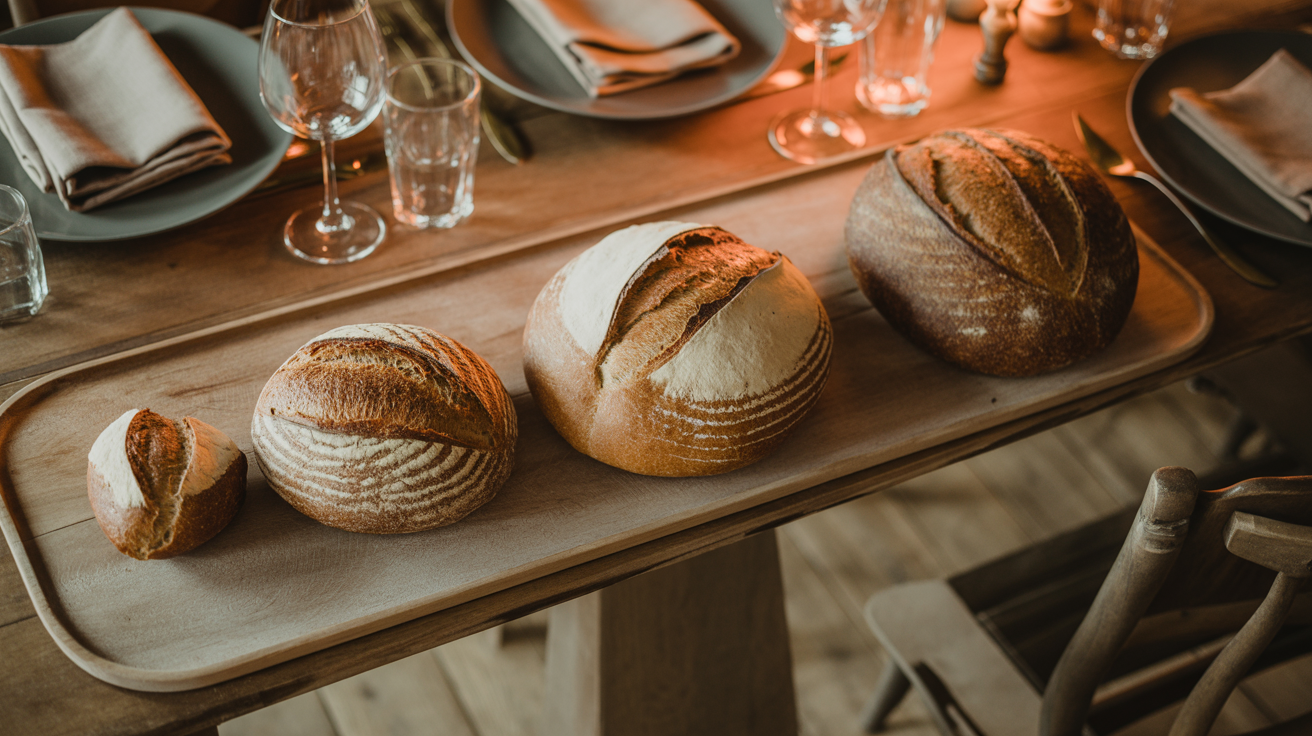
| 12 | 960 g | 1.5 loaves | 1 large + 1 small, OR 2 standard |
| 16 | 1,280 g | 1.75 loaves | 2 standard |
| 20 | 1,600 g | 2.25 loaves | 3 medium, or 2 standard + 1 purchased |
| 25 | 2,000 g | 2.75 loaves | 3 large loaves or 4 medium |
If bread is a course (cheese/charcuterie board, soup), multiply the loaf count by 1.8.
The 24-hour timeline (for 12–20 people)
Two-loaf minimum batch requires planning. Here’s what actually works:
- Thursday evening (24 h before Saturday dinner): Feed starter at 1:5:5 ratio so it’s peaking by 8 AM Friday.
- Friday 8 AM: Mix dough. Autolyse 1 hour.
- Friday 9 AM: Add starter, salt. Begin bulk.
- Friday 9 AM – 2 PM: Bulk fermentation (adjusted for batch size; see our doubling guide).
- Friday 2–4 PM: Divide, pre-shape, bench rest, shape into bannetons.
- Friday 4 PM – Saturday 4 PM: Cold retard in fridge (24 hours is fine; 36 hours is the safe upper bound).
- Saturday 4 PM: Preheat Dutch oven.
- Saturday 4:45 PM: Bake first loaf.
- Saturday 5:25 PM: Bake second loaf.
- Saturday 6 PM: Both loaves cooling. Guests arrive at 7.
- Saturday 7 PM: Slice 1 loaf for the table; keep the other whole for visual impact and slice it partway through dinner when the first empties.
Bread needs at least 1 hour to cool after baking (crust becomes crispy, crumb sets). Serving warm bread straight from the oven gives you a gummy center — counterintuitive, but true.
The serving strategy (how to not run out)
Three tactics:
- Pre-slice half, whole half: Put out pre-sliced bread in a basket. Keep a whole loaf on the board for drama. Mid-meal, slice the whole one.
- Stagger bread service: Serve bread with the first course only, then bring a second basket mid-meal. Prevents all the bread disappearing in the first 20 minutes.
- Pair with butter + one oil: Cultured butter and a peppery olive oil slow bread consumption. Guests linger.
When you can’t bake enough
Hosting 30+? One home oven and Dutch oven can realistically produce 3–4 loaves in a day. Beyond that, supplement with:
- Focaccia: Bakes in a sheet pan, no Dutch oven needed. A 9×13 pan yields the equivalent of 1 large loaf.
- Pull-apart rolls: 24 rolls from a 1× batch, baked in one 9×13 pan.
- One purchased baguette: Zero shame. Adds variety.
The leftover plan
Bake extra. Always. Here’s why:
- Running out of bread mid-meal is memorably embarrassing
- Sourdough is the gift that keeps giving — leftover half-loaves become Sunday French toast or Monday avocado toast
- Freeze within 4 hours of baking (wrap tightly) for perfect reheated bread up to 1 month later
Aim to bake 20% more than the portion math suggests. The leftover 20% is your Sunday breakfast or gifts for neighbors.
The 3-loaf Saturday (for 20 people)
This is the most ambitious home-baker dinner setup:
- Friday AM: Mix a tripled batch (1,500 g flour = ~2,955 g dough)
- Friday PM: Divide into three 985 g shapes, three bannetons, cold retard
- Saturday 3:30 PM: Start baking loaf 1
- Saturday 4:15 PM: Load loaf 2 (while loaf 1 cools)
- Saturday 5:00 PM: Load loaf 3
- Saturday 6:15 PM: Three warm loaves ready for 7 PM guests
Needs a stand mixer, a large fridge, and commitment. But the result — three fresh golden loaves on the table — is dinner-party theater nobody forgets.
Calculator shortcut
Use the sourdough ratio calculator to input total dough weight = (guests × 100 g) / 0.8. That formula bakes in the 20% weight loss and gives 25% margin. For 12 people: (12 × 100) / 0.8 = 1,500 g dough. That’s roughly a 1.5× recipe — perfect for one large + one small loaf, or two mediums.
Plan the math Monday, feed the starter Thursday, bake Saturday afternoon. Hosting anxiety drops 60% when the bread is already cooling on the rack.