Sourdough Focaccia Ratios: Why Great Focaccia Runs 80%+ Hydration
Why focaccia is nothing like other breads
Most sourdough breads live at 70–78% hydration. Push past 80% in a boule and you get a pancake. Yet great focaccia starts at 80% and stretches to 85% — and the dough holds. Why?
One word: oil.
Focaccia bakes in a well-oiled pan. The oil creates a barrier between the dough and the pan, traps steam for the first 15 minutes, and effectively does what a Dutch oven does for a boule: lets the crumb set in humidity before the crust hardens. That humidity is what enables radically open, tender crumb that’s nearly impossible without the pan.
Focaccia is a dough + pan + oil system. Change any element and the ratio changes.
The core sourdough focaccia ratio
| Ingredient | Baker’s % | For 500 g flour |
|---|---|---|
| Bread flour | 100% | 500 g |
| Water | 82% | 410 g |
| Starter (100% hydration) | 20% | 100 g |
| Olive oil (in dough) | 3% | 15 g |
| Salt | 2.2% | 11 g |
| Plus: olive oil (in pan) | — | 30–40 g |
Total dough weight: about 1,036 g. This fills a standard 9×13 inch pan with a 2.5 cm tall focaccia — the bakery gold standard.
Why 82%? Why not 85%?
82% is the practical sweet spot. Above this, the dough becomes genuinely difficult to handle even with stretch-and-folds, and the risk of pooling water in the pan increases. At 82%, the dough is pourable-thick and spreads on its own when it hits the oiled pan.
If you have very strong bread flour (13%+ protein, e.g., King Arthur Bread Flour or Manitoba), you can push to 85%. With typical AP flour, 78% is safer.
Hydration guide by flour:
- High-protein bread flour (13%+): 82–85%
- Standard bread flour (12%): 78–82%
- All-purpose (10–11%): 72–75%
- Whole wheat blend (20–30% whole wheat): 80%
The two-oil rule
Focaccia needs oil in two places and they serve different purposes:
- Oil IN the dough (3%): Tenderizes gluten, aids browning, and contributes flavor throughout the crumb. Add after autolyse and after salt.
- Oil IN the pan (30–40 g): Creates the steamed-bottom effect. Pour into the pan before dough; tilt to coat evenly. The pooling oil is what fries the bottom to crisp-yet-tender perfection.
Amateurs skip the pan oil or use just a spray. The result is dry focaccia with pale bottom and tough edges. Use good olive oil — the fat flavor carries through.
The stretch-and-fold schedule
At 82% hydration, you cannot knead. Mix briefly and do 4 sets of stretch-and-folds:
- Mix: Combine flour + water. Autolyse 30 min. Add starter, salt, 3% oil. Mix with wet hand until homogeneous (~1 min). Cover.
- Fold 1 (30 min after mix): Wet hand, grab underneath, stretch up and over. 4 quadrants.
- Fold 2 (30 min later): Same. Dough should feel stronger already.
- Fold 3 (30 min later): Coil fold this time — grab middle, lift, dough folds under itself. Easier at high hydration.
- Fold 4 (30 min later): Final coil fold. Bulk should continue 3–4 hours total at room temp.
Cold retard: why and how long
After bulk fermentation (dough shows 30–50% rise), transfer to oiled pan. Cover tightly. Into the fridge for 16–24 hours.
Cold retard does three things:
- Deepens flavor (sourdough tang, toasty nuttiness)
- Relaxes gluten (dough spreads to fill pan on its own)
- Makes scheduling sane (bake fresh focaccia any time within the next 24 hours)
24 hours is the sweet spot. Below 16 hours, flavor is less developed. Past 30 hours, dough starts over-proofing.
Room temp proof in the pan
Pull the pan from fridge 1.5–2 hours before baking. Leave covered. The dough warms, continues fermenting, and fills the pan corners as gluten relaxes.
Ready signs: visibly bubbled surface, jiggly when you shake the pan gently, dough has risen 30–50% in the pan. Not ready: surface still smooth, edges pulled away from pan sides.
If your kitchen is cold (<20 °C), extend to 2.5–3 hours. A warm oven with the light on creates a 24 °C microclimate — ideal for focaccia proofing.
The dimples: structure AND flavor
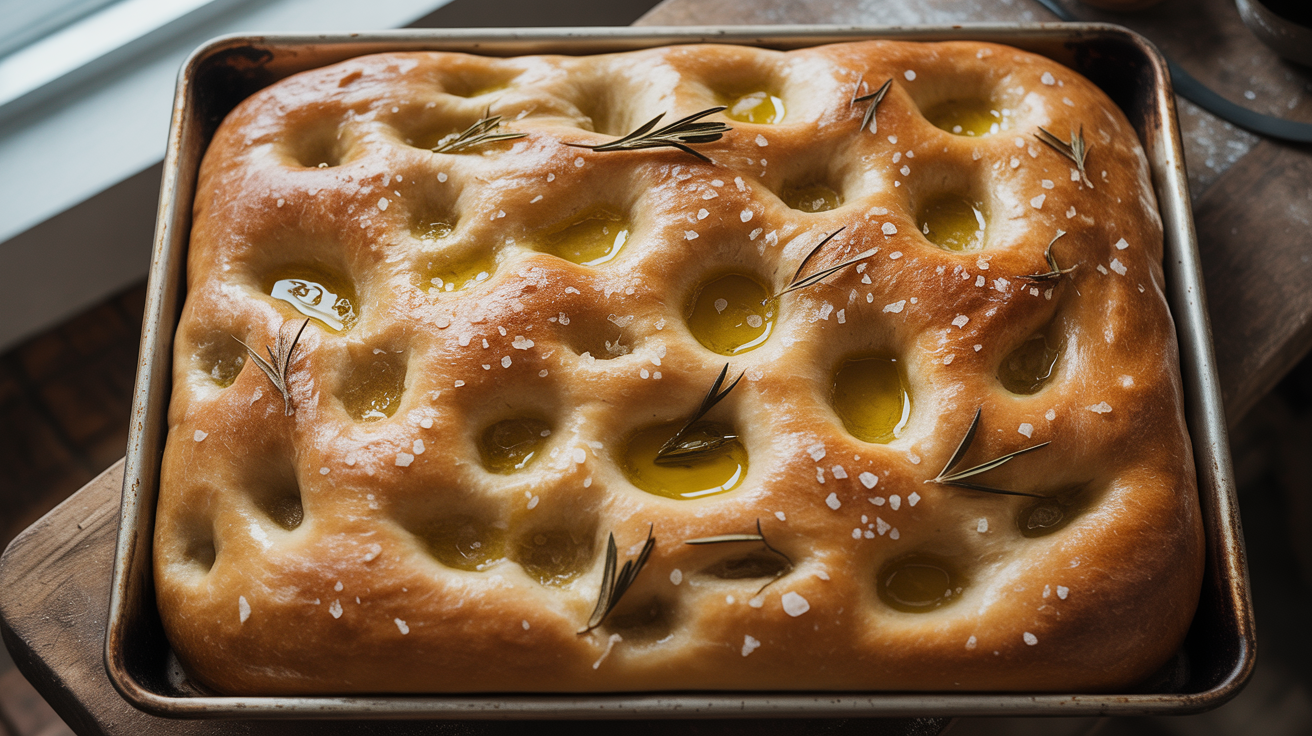
Just before baking, dimple the dough with oiled fingertips — push all the way through so your fingertips touch the pan bottom. Pockets should hold a visible puddle of oil.
Dimples do two things:
- Structure: Prevents the dough from doming up during bake. Without dimples, focaccia rises too much in the center and collapses on cooling.
- Flavor: Oil pools in dimples, concentrating flavor and creating those legendary crispy-oily divots.
Add flaky salt and rosemary to the wet, oiled surface. Optional toppings (halved cherry tomatoes, thin onion slices, olives) go on now too. Avoid wet toppings — they release water and ruin crumb.
Baking temperature and time
230 °C / 450 °F, center rack, 22–28 minutes. Rotate pan halfway through. Target: deep amber top, well-browned bottom (lift with a spatula and check — pale bottom = not done).
Internal temp target: 95 °C / 205 °F at the center. But honestly, color matters more than temp for focaccia. If the bottom is pale when the top looks done, drop the pan onto the oven floor (without pan) for the last 3 minutes.
Cool in the pan 5 minutes, then transfer to a rack — focaccia steams itself soggy if left in the pan too long.
Storage and reviving
Room temp, wrapped in a paper bag or open-topped on the counter: 24 hours of peak quality. After that, slice and freeze — reheat at 180 °C for 6 min for near-fresh texture. Never refrigerate focaccia (crust goes leathery).
Troubleshooting
- Dense, bready crumb: Under-proofed in pan. Extend room temp proof 30 min. Check dough jiggle.
- Flat, no oven spring: Over-proofed in pan, or bulk went too long. Reduce cold retard time.
- Pale bottom: Not enough oil in pan, or oven rack too high. Use 40 g oil; middle rack.
- Greasy/oily throughout: Dough oil too high. Keep at 3%; don’t exceed 5%.
- Sticky, unworkable dough: Drop hydration 3% and ensure 4 full stretch-and-folds.
Scaling for larger pans
Use the sourdough ratio calculator with total dough weight as your input. For a 13×18 inch half-sheet pan, target 1,400―00 g dough. For a 12” round cake pan, 800 g. Keep the 82% hydration and 3% oil ratios constant.
Once the base ratio becomes muscle memory, focaccia becomes the easiest weekly sourdough bake — one pan, one bake, 8 portions. Pair with a 24-hour cold retard on the workdays when you don’t have time for a full boule.
For a deep dive on why high-hydration dough behaves the way it does, see our 85% hydration technique guide.