How to Double a Sourdough Recipe Without Disaster
The “just multiply by two” trap
You nailed a standard loaf. Now you want two at a time — one to eat, one to gift. So you open the recipe, double every number, and set a timer for the same bulk fermentation as before.
Four hours later, your dough is flat, over-proofed, and deflating under its own weight. The math was correct. The timing was wrong.
Here’s what happens when you double a sourdough recipe — and the three things that don’t scale the way you expect.
What scales linearly (the easy part)
Ingredient weights scale exactly. Baker’s percentages are percentage-of-flour, so every ratio holds:
| Ingredient | Standard loaf | Doubled | Baker’s % |
|---|---|---|---|
| Bread flour | 500 g | 1,000 g | 100% |
| Water | 375 g | 750 g | 75% |
| Starter (100% hydration) | 100 g | 200 g | 20% |
| Salt | 10 g | 20 g | 2% |
| Total dough weight | 985 g | 1,970 g | — |
Use the sourdough ratio calculator — set total dough weight to 1,970 g and the percentages do the work for you.
What does NOT scale: bulk fermentation time
This is the single biggest mistake. Home bakers double the ingredients and double (or keep identical) the bulk time. Both are wrong.
A bigger dough mass retains more metabolic heat. Yeast respiration produces warmth; in a 500 g dough, that heat escapes quickly through the bowl surface. In a 2 kg dough, the core traps heat, temperature climbs, and fermentation accelerates.
Typical adjustment for doubling:
- Room temp 24°C / 75°F: bulk shortens from ~5 h to ~4–4.25 h (15–20% faster)
- Room temp 27°C / 81°F: bulk shortens from ~4 h to ~3–3.25 h (20–25% faster)
- Room temp 20°C / 68°F: bulk shortens only ~10% (cooler rooms leak heat faster)
The hotter your kitchen, the more aggressive the speedup. In summer, a doubled batch can finish bulk 90 minutes earlier than the recipe states.
What does NOT scale: shaping into one loaf
Tempting to make one giant 2 kg boule. Don’t.
Bread structure depends on the dough’s ability to hold gas. A 1 kg boule barely manages it; beyond 1.2 kg, the weight of the dough exceeds what the gluten can support. The loaf spreads, flattens, and produces a dense base with a thin dome — the opposite of tall open-crumb bread.
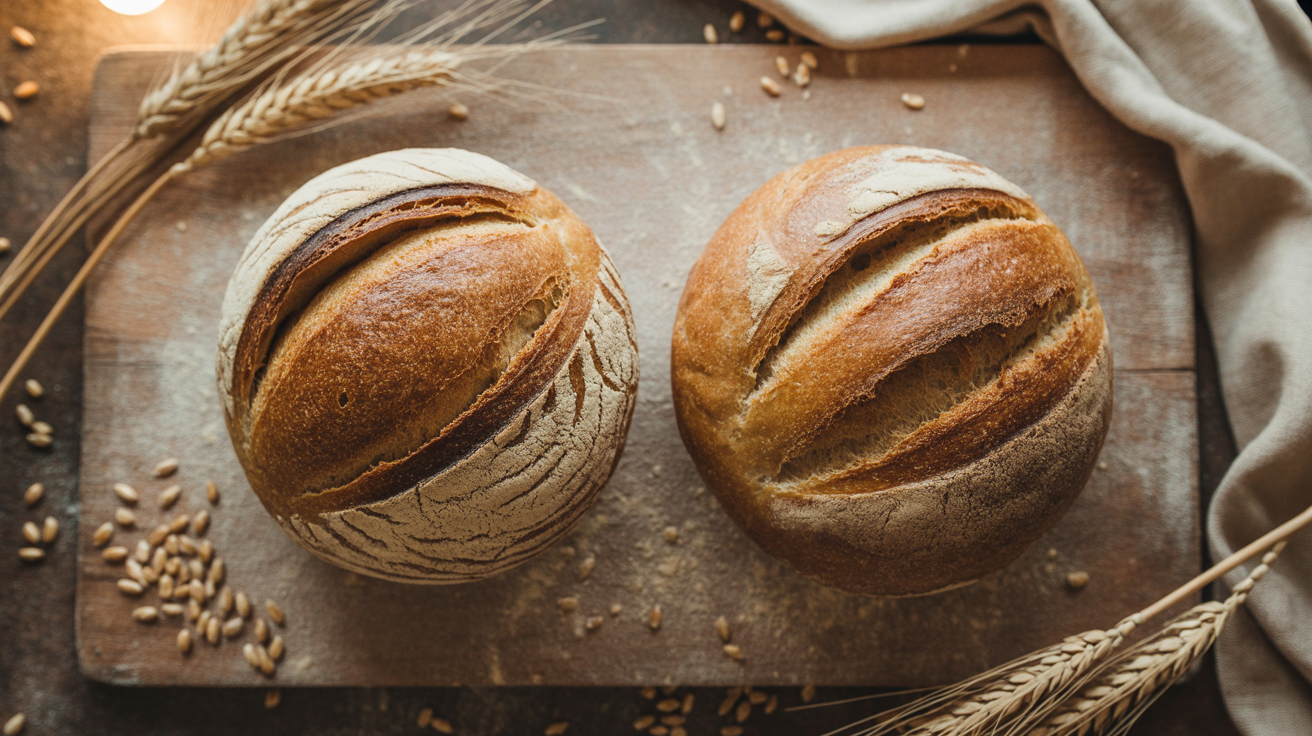
Always divide a doubled batch into two loaves. Even if you own a Dutch oven large enough, structure and oven spring win on two 985 g boules every time.
What does NOT scale: mixing
Hand-mixing 2 kg of 75% hydration dough is fundamentally harder than mixing 1 kg. The slap-and-fold becomes messy, bassinage takes longer, and the dough warms from your hands faster.
Three options:
- Use a stand mixer (KitchenAid-sized is fine for 2 kg; go lowest speed for 6–8 minutes)
- Reduce to 6 hours cold autolyse in the fridge — flour fully hydrates with minimal mixing required
- Split the mix into two bowls, rejoin during stretch-and-folds
The first stretch-and-fold in a 2 kg batch should happen in a wider bowl or straight-sided container — not a 3-quart mixing bowl where dough climbs the sides.
Starter percentage: keep it the same
Home bakers sometimes think, “bigger dough = needs more starter.” They bump from 20% to 25% or 30%.
This is wrong for two reasons:
- Baker’s percentages already scale perfectly — 200 g starter (from 100 g) is proportionally the same inoculation
- Adding extra starter combined with faster bulk fermentation creates massively over-proofed dough
Keep your starter percentage identical. If anything, on a hot day, reduce to 15% to buy back some bulk time.
The doubling workflow that actually works
- Mix: Use a 5-quart or larger bowl. Flour + water autolyse 1 h. Add starter and salt. Slap-and-fold or mixer speed 1.
- Bulk: In a 6-quart straight-walled container so you can track rise by volume. Start with 50% rise target (not 75%) and check at the earliest time estimate, not the middle.
- Stretch-and-folds: 4 sets, 30 min apart, first 2 hours only. Dough is heavier — use wet hands and go under the mass.
- Divide: When bulk hits 50% rise, pre-shape into two 985 g rounds. Bench rest 30 min.
- Shape: Into two separate bannetons.
- Cold retard: Both bannetons together in fridge for 8–16 h.
- Bake: Bake one at a time if you have one Dutch oven, or both at once if you have two. Baking two at the same temperature in the same oven does NOT require adjusting the bake time significantly — add 2–3 minutes to the covered phase.
Signs your doubled bulk is done (not time)
Time is unreliable when you scale up. Watch these signs instead:
- Aliquot jar: 50% rise (not 75% — remember, heat retention accelerates)
- Volume check: 50–60% increase in a straight-walled bulk container
- Poke test: Springs back slowly but fully
- Surface: Domed, smooth, bubble edges just visible
For a deep dive on bulk signs, see our five reliable signs bulk fermentation is done guide.
When you have TWO Dutch ovens (the upgrade)
If doubling is now routine, invest in a second Dutch oven. Bake both loaves simultaneously at 250 °C / 475 °F covered for 20 min, then 230 °C / 450 °F uncovered for 20–25 min. Rotate positions halfway through the uncovered phase.
Two loaves from one bake is the home-bakery Nirvana. Both identical. Fresh bread Saturday, sliced and frozen Sunday.
The three most common doubling mistakes
- Same bulk time as single batch. Shorten by 15–25%.
- Shaping one giant boule. Always divide into two.
- Extra starter “to compensate.” Keep the percentage the same, or reduce it.
What about tripling or quadrupling?
Beyond 3×, the rules compound:
- Bulk shortens 25–35% for a 3× batch
- Stand mixer becomes essential
- Divide into three or four loaves — always equal-weight
- Fridge space becomes the hard limit (two full bannetons = two fridge shelves)
Most home kitchens max out at a 2× batch. Good news: that’s exactly the sweet spot for gifting a loaf to a neighbor each week.
Ready to scale? Enter your doubled total dough weight into the sourdough ratio calculator — percentages do the rest. Keep an aliquot jar on the counter, watch the 50% rise mark, and trust the visual signs over the clock.