Signs Bulk Fermentation Is Done: The 7-Point Visual Checklist
Why “4 Hours” Is the Worst Answer
Every beginner recipe says something like “bulk ferment 4–6 hours.” That range is fine as a rough expectation, but it’s catastrophically misleading as a signal for readiness. A 4-hour bulk at 20°C is drastically different from a 4-hour bulk at 28°C. A weak starter at 24°C ferments slower than a peak starter at the same temperature. Whole wheat doughs ferment faster than white. Shaping the wrong side of the readiness window — under or over — ruins your loaf.
The fix: stop watching the clock and start reading the dough. Bulk is done when your dough looks, feels, and smells right. Here’s exactly what to look for.
The 7-Point Bulk Fermentation Checklist
1. Volume Rise: ~70–80%
Use a straight-sided container marked with a rubber band at the start. For most recipes, you want the dough to rise 70–80% above its initial volume. Higher-hydration doughs (>80%) and whole-grain doughs tolerate more rise (up to 100%). Lean, low-hydration doughs are done at the lower end (60–70%).
- White bread flour, 75% hydration → rise 75%.
- 50% whole wheat, 78% hydration → rise 60–65%.
- 85%+ hydration white → rise 90–100%.
Why these numbers? The faster the fermentation, the less risen dough needs to shape well. Under-risen = tight crumb. Over-risen = slack dough that won’t hold shape.
2. Side-Wall Bubbles
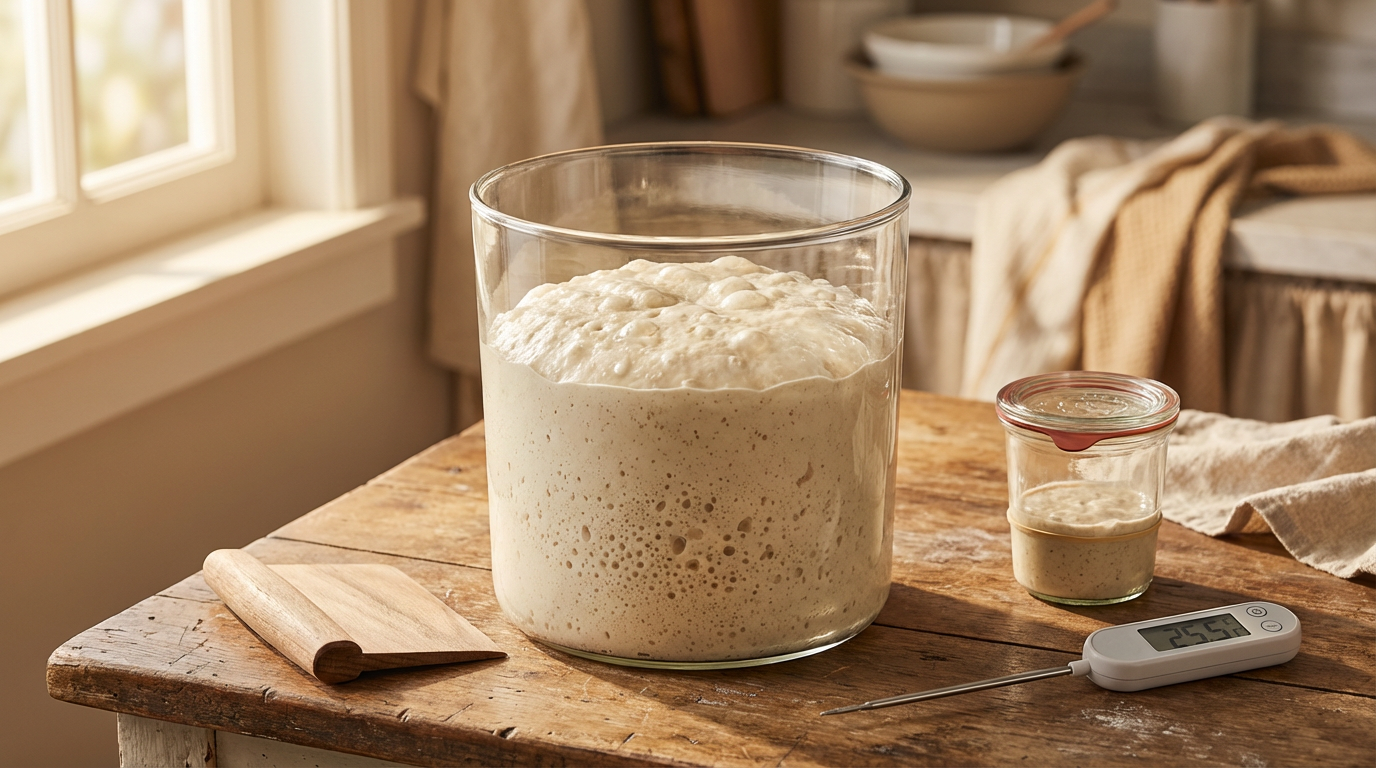
Look through the side of your glass or clear plastic container. You want to see medium-sized bubbles pressed against the walls throughout the dough — not just at the top. A dense, bubble-free base means you’re under-fermented even if the top looks risen.
Pro tip: bubbles near the bottom are the last to form. When you see them reliably, bulk is ready.
3. Domed, Jiggly Surface
The top of your dough should be gently domed (not flat, not collapsing) and jiggle like set jelly when you lightly tap the container. A flat top means you haven’t risen enough; a wobbly, collapsing top means you’re over-fermented.
4. Smooth, Unbroken Skin
The surface should be smooth with small bubbles visible just beneath, like a fine-grained leather. If you see large torn bubbles or a mottled, disrupted surface, the gluten network has started to break down — shape immediately before more strength is lost.
5. Tension and Airiness
Pick up the side of the dough with lightly wet hands. It should feel airy and full — you should feel bubbles pop quietly as you lift. The dough should hold its edge and slowly slump rather than pour like batter.
Doughs that feel heavy, wet, and pour straight down are under-fermented. Doughs that seem torn and slack when lifted are over-fermented.
6. The Poke Test
Dip your finger lightly in water or flour, then press gently into the dough about 1cm (½ inch) deep.
- Springs back completely in under 1 second: under-fermented. Wait 30–60 min.
- Rebounds slowly leaving a small dimple: ready. Shape now.
- Dent stays fully, dough feels slack: over-fermented. Shape immediately with minimal tension.
The poke test works best at 22–26°C dough temperature. Cold dough (<20°C) springs back regardless of fermentation state.
7. Smell
Healthy bulk smells pleasantly yeasty and slightly tangy, with maybe a whisper of acetic vinegar or lactic yogurt. If it smells harshly sour, vinegary, or has an alcoholic burn — you’re past the window. Reset and start the shape with less tension.
The Aliquot Jar Method: Foolproof Rise Tracking
If reading dough is hard, use the aliquot jar:
- After mixing, take a small golf-ball-sized piece of dough (about 40g).
- Place it in a clear glass jar. Level the top with a wet finger.
- Mark the starting height with a rubber band.
- Mark the 75% rise target with a second rubber band (for 40g = target at about 70g volume).
- Store the jar next to your main bulk container at the same temperature.
- When the aliquot hits 75%, your main dough is done.
This works because small doughs and large doughs ferment at identical rates when temperature-matched. It’s the gold standard for professional bakeries.
Reading Dough at Different Hydrations
Low hydration (60–68%)
- Rise target: 60–70%.
- Poke test rebounds slowly. Dough holds crisp edges when folded.
- Minimal side-wall bubbles — mostly top-centred.
Standard hydration (70–78%)
- Rise target: 70–80%.
- Clear side-wall bubbles. Domed top. Classic jiggle.
- Poke test classic 1-second rebound.
High hydration (80%+)
- Rise target: 85–100%.
- Large visible bubbles throughout. Dough feels pillowy.
- Poke test leaves a deeper dimple that recovers in 2–3 seconds.
For 85%+ technique, see our wet dough handling guide.
Signs You’re Over-Fermented
- Dough has collapsed after rising (domed, then flattened).
- Large torn bubbles visible on the surface.
- Slack pour when tipped out — no structural edge.
- Smell is sharp, vinegary, or alcoholic.
- Poke leaves a dent that doesn’t rebound.
What to do: shape immediately with the lightest possible touch. Skip the bench rest. Proof in fridge 8–10 hours. Expect a shorter, denser loaf, but still an edible one.
Signs You’re Under-Fermented
- Rise below 50%.
- Dough feels dense and heavy when lifted.
- No side-wall bubbles visible.
- Flat top, no jiggle.
- Poke test springs back instantly.
- Smell is still only yeasty, no tang.
What to do: wait another 30–60 minutes and re-check. Warmer room temperature (27–28°C) speeds the recovery.
Temperature Still Matters
The signs above happen faster at warmer temperatures and slower at cooler ones. As a rough guide:
- 28°C (82°F): 3.5–4 hours to readiness.
- 26°C (78°F): 4–5 hours.
- 24°C (75°F): 5–6 hours.
- 22°C (72°F): 6.5–8 hours.
- 20°C (68°F): 8–10 hours.
These are baselines, not rules. Always defer to the visual/feel signs.
FAQ
Can I check bulk by stirring the dough?
No — stirring degases the dough and resets your visual cues. Only lift gently to check airiness.
How do I know if side-wall bubbles are “enough”?
Count 6–10 visible bubbles in a 1-inch band near the bottom of the container. If fewer, keep waiting.
What if my top is domed but I see no bubbles?
Usually means the container walls are fogged or the dough is too dark (whole wheat). Wait another 30 minutes and check airiness by lifting.
How far past 75% is “too far”?
At 90%+ rise with a white flour dough you’re at the edge. Past 100% (double) = over-fermented territory.
Next Steps
Practice with the aliquot jar for 3–4 bakes until the visual cues become second nature. Combine this article with our bulk fermentation timing guide and temperature guide for full fermentation confidence. Use the sourdough ratio calculator to set up your next bake with proper baker’s percentages.