Underproofed vs Overproofed Sourdough: The Diagnostic Guide
The Two Most Common Sourdough Failures
Ask any sourdough baker about their worst loaves and you’ll hear the same two complaints: “it’s dense and gummy” or “it collapsed into a flat disc.” Both are fermentation issues, and learning to diagnose them quickly is the fastest path to consistent results.
This guide walks through the exterior signs, interior crumb patterns, and recovery strategies for each problem — with enough specificity that you can match your own loaf to the description and know what went wrong.
Underproofed Sourdough: The Full Diagnostic
Exterior signs
- Loaf looks small, squat, did not spring tall.
- Scoring ripped or tore instead of opening cleanly — the dough wasn’t ready for steam expansion.
- Large “blowout” bursts at the side or bottom where gas forced through weak spots.
- Crust thick and pale brown, not deeply caramelised.
- Weight heavy for its size.
Interior signs
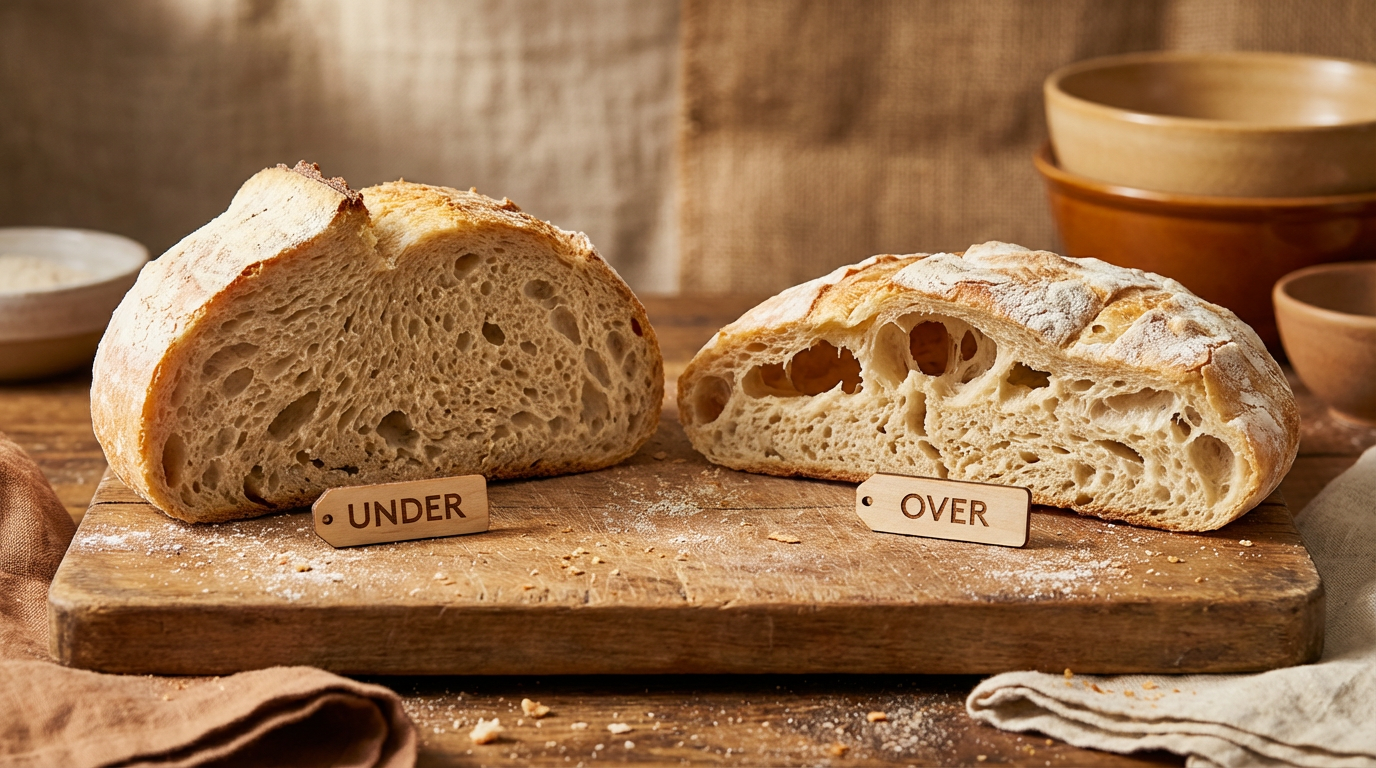
- Crumb dense, tight, small irregular holes clustered near the top.
- Lower half of the loaf often denser than upper half.
- Slightly gummy or “pasty” texture in the centre when pressed.
- Flavour mild, slightly yeasty, no complex sour.
- Crumb tears apart rather than sliding cleanly under a knife.
What caused it
- Bulk fermentation too short.
- Room temperature too low (below 20°C without timing adjustment).
- Starter too young or sluggish.
- Inoculation percentage too low for your timeline.
- Cold retard ended before the dough caught up.
The fix
- Extend bulk 30–60 minutes. Use visual signs: 75% rise, side-wall bubbles.
- Warm the environment. Place dough on top of fridge, near oven, or in a proofing box.
- Increase inoculation 20→25%.
- Verify starter is at peak when used — float test should pass consistently.
- Add final bench rest (1 hour at 25°C) before cold retard.
Overproofed Sourdough: The Full Diagnostic
Exterior signs
- Loaf flat or disc-like, no dome, spread outward.
- Very little oven spring.
- Scoring closed up and disappeared during bake.
- Crust pale, wrinkled, leathery.
- Sour, sometimes alcoholic smell when cooling.
Interior signs
- Crumb has large torn holes with visible thin walls between them.
- Crumb collapses or compresses easily when pressed.
- Bread feels light for its size, airy but structurally weak.
- Flavour sharp, acidic, sometimes vinegary.
- Crumb elastic rather than tender — can feel rubbery.
What caused it
- Bulk fermentation too long.
- Room temperature too warm (above 26°C without timing adjustment).
- Inoculation percentage too high for timeline.
- Cold retard too long (over 30 hours with high pre-bulk).
- Forgotten bulk — started then distracted for 2 extra hours.
The fix
- Shorten bulk 30–60 minutes. Watch for 60–70% rise instead of 80%.
- Cool the environment. Move dough to a basement or use chilled mixing water.
- Decrease inoculation to 15–20%.
- For retard: bulk to only 55–60% rise if retarding 24+ hours.
- Shape immediately on detecting over-proof, with minimum tension. Bake promptly.
Side-by-Side Crumb Comparison
Cross-section indicators
| Trait | Underproofed | Good | Overproofed |
|---|---|---|---|
| Shape | Tall, narrow, ripped side | Tall, round, open ear | Flat, spread, closed score |
| Crumb holes | Small, tight, irregular | Medium, even, varied | Large, torn, thin-walled |
| Crumb texture | Gummy, dense | Tender, springy | Rubbery, collapsed |
| Crust | Thick, pale brown | Golden, crackly | Pale, wrinkled |
| Flavour | Mild, yeasty | Balanced, complex | Sharp, sour, alcoholic |
| Oven spring | Small, ripped | Strong, clean | Minimal, closed |
The “Gummy” Trap: Underproof vs Under-bake
A gummy crumb isn’t always underproofing — sometimes it’s under-baking. Check internal temperature at the end of the bake with a probe thermometer:
- Below 93°C (200°F): under-baked. Keep baking 5–10 min longer.
- 96°C (205°F): perfect.
- 98°C (208°F): slightly over, still fine.
If your loaf hits 96°C and is still gummy, you’re dealing with underproof, not under-bake.
The Cold-Retard Exception
A loaf taken directly from 12–24 hour cold retard can look mildly overproofed externally — slightly flattened skin, condensation on top. This is normal. As long as the bulk was appropriate, the bake will be fine. The cold retard firms structure even when the surface appears soft.
True overproofing from cold retard shows as: collapsed body, not just soft skin, and the dough pouring out of the banneton rather than holding shape.
The Most Common Mistake: Assuming Overproof When It’s Underproof
Home bakers often stop bulk too early because they’re scared of over-fermenting. Result: dense, gummy bread 90% of the time. The rule of thumb: if you’re unsure, go 30 minutes longer. A slightly over-fermented loaf is still tasty; a significantly under-fermented loaf is barely edible.
Recovery Strategies
When you realise mid-bulk that you’ve already over-fermented
- Shape immediately with the absolute minimum tension.
- Skip the bench rest.
- Cold retard 6–8 hours to firm the skin for scoring.
- Bake hotter and shorter: 260°C lidded Dutch oven for oven spring.
- Accept a shorter, denser loaf but with full flavour.
When you realise mid-bulk that you’re way under
- Move the dough to a warmer spot (25–27°C).
- Wait another 90–180 minutes.
- Re-check with visual signs before shaping.
- Proceed as normal.
FAQ
Can a loaf be both underproofed AND overproofed?
Only through under-proofing during bulk + over-proofing in final proof — uncommon. Usually it’s one or the other.
Does higher hydration make proofing trickier to read?
Yes. Wet doughs hide underproof under slack texture and hide overproof under natural bubbly appearance. Use the aliquot jar method for objective measurement.
Does underproofing affect digestion?
Yes. Fully-fermented sourdough is easier to digest due to broken-down gluten and phytic acid. Underproofed bread retains more of both.
Can I salvage a dense, gummy loaf?
Toast it. Serious toasting dries the gummy centre and crisps the whole slice. Also makes great bread pudding or croutons.
Next Steps
Save a photo of your next crumb. Compare it to this guide. Adjust one variable — bulk time, temperature, or inoculation — and bake again. Pair this with our bulk fermentation signs guide and proofing time chart. Use the sourdough ratio calculator to dial in inoculation percentage.