Sourdough Proofing Time by Temperature: The Complete Reference Chart
Why Temperature Rules Sourdough
If you change only one variable between bakes and watch your bread transform, make it temperature. More than hydration, more than flour choice, more than even inoculation, temperature controls how fast your dough ferments and how the final loaf tastes.
The underlying science: yeast and lactic-acid bacteria activity follows a simple rule in the 15–32°C range — a 5°C (9°F) temperature change roughly doubles or halves their metabolic rate. That’s why a dough that takes 5 hours to bulk at 24°C needs 10 hours at 19°C, or just 2.5 hours at 29°C.
Every chart below assumes 20% inoculation, 75% hydration, and bread flour. Adjustments for other recipes follow after.
Bulk Fermentation Chart (Baseline)
Cool Environment (18–20°C / 64–68°F)
- 18°C (64°F): 10–12 hours.
- 19°C (66°F): 9–11 hours.
- 20°C (68°F): 8–10 hours.
Best for: overnight bulks in unheated spaces, long-flavour baking, deep-sour profiles.
Comfortable Room (21–24°C / 70–75°F)
- 21°C (70°F): 7–9 hours.
- 22°C (72°F): 6–8 hours.
- 23°C (73°F): 5.5–7 hours.
- 24°C (75°F): 4.5–5.5 hours (recipe baseline).
Best for: weekend daytime bakes, typical Western home kitchen.
Warm Kitchen (25–27°C / 77–80°F)
- 25°C (77°F): 4–5 hours.
- 26°C (78°F): 3.5–4.5 hours.
- 27°C (80°F): 3–4 hours.
Best for: summer baking, tropical climates, faster turnaround.
Hot Environment (28–32°C / 82–90°F)
- 28°C (82°F): 2.5–3.5 hours.
- 30°C (86°F): 2–3 hours.
- 32°C (90°F): 1.5–2.5 hours.
Best for: Singapore, Hong Kong, Mumbai, Miami. Above 30°C, fermentation becomes difficult to control — consider AC, chilled water, or retarding earlier.
Final Proof Chart (Baseline)
Final proof is always shorter than bulk because the dough starts with more active yeast and tighter gluten structure. Expect final proof to run 25–40% of bulk time at the same temperature.
At 24°C (75°F)
- Bulk 5 hours → final proof 1.5–2 hours.
At 21°C (70°F)
- Bulk 8 hours → final proof 2.5–3 hours.
At 27°C (80°F)
- Bulk 3.5 hours → final proof 1–1.5 hours.
Cold Retard (3–5°C / 38–41°F)
- Bulk fully at room temp (75% rise), then:
- 12 hours → well-developed flavour, easy scoring.
- 24 hours → deeper tang, firm skin (bulk 60–65% rise first).
- 36 hours → maximum flavour, risk of sharp acidity (bulk 55–60%).
See our cold retard comparison for details.
Adjusting for Inoculation
The baseline assumes 20% inoculation. Every doubling or halving of inoculation inversely changes bulk time.
- 5% inoculation: bulk time × 4.
- 10% inoculation: bulk time × 2.
- 20% inoculation: baseline (×1).
- 40% inoculation: bulk time ÷ 2.
Example: 5.5-hour bulk at 24°C with 20% starter becomes 11 hours with 10% starter, or 2.75 hours with 40% starter.
Adjusting for Flour Type
- 100% white bread flour: baseline (×1).
- 20% whole wheat blend: ×0.9 (10% faster).
- 50% whole wheat: ×0.8 (20% faster).
- 100% whole wheat: ×0.7 (30% faster).
- 20% rye blend: ×0.85 (15% faster).
- 50% rye: ×0.6–0.7 (30–40% faster — watch closely).
- Spelt (any %): ×0.85 (faster due to fragile gluten).
Reason: whole grains contain more enzymes and nutrients for yeast; rye contains amylases that break starches quickly.
Measuring Dough Temperature (DDT)
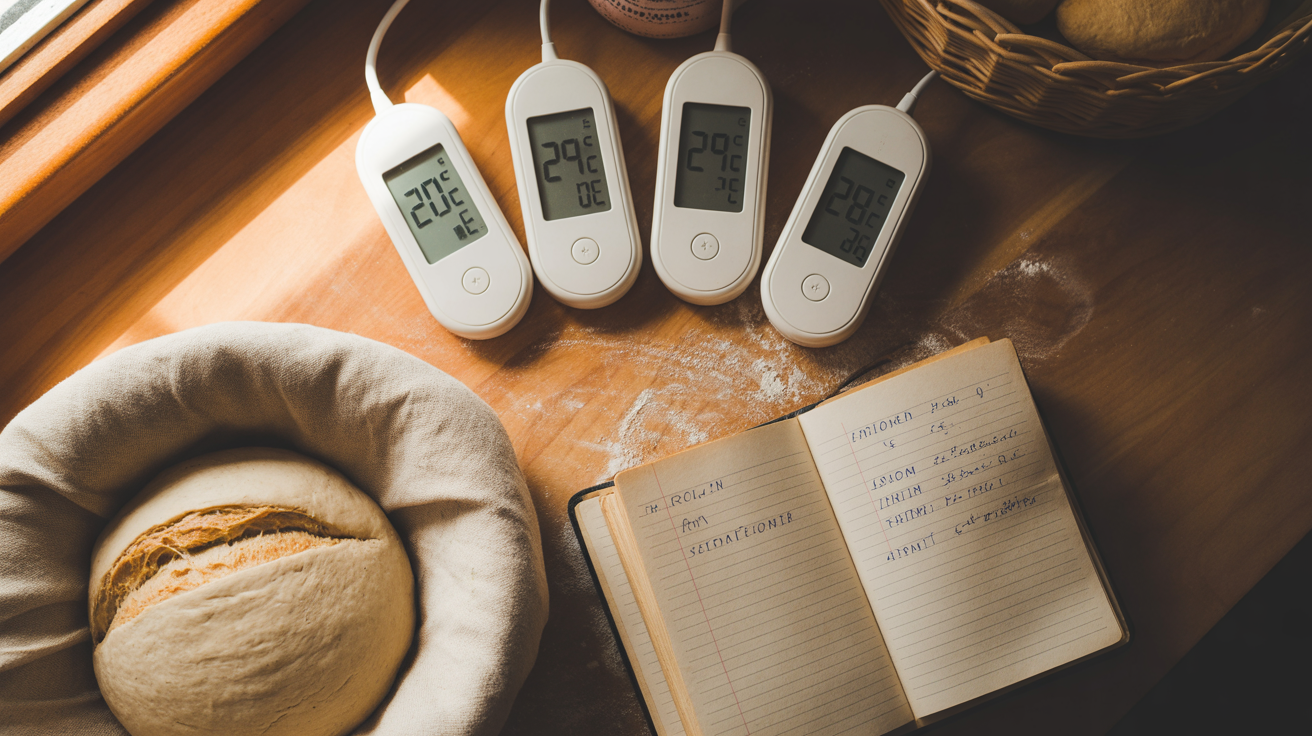
The charts above use dough temperature, not room temperature. Measure your dough with a digital probe thermometer after mixing. Targets:
- Cool bake: 21–22°C (70–72°F).
- Standard bake: 24–25°C (75–77°F).
- Warm bake: 26–27°C (78–80°F).
Adjusting water temperature to hit DDT
Simplified formula:
Water temp = (3 × target DDT) – (flour temp + room temp + friction factor)
- Friction factor: 0–2°C for hand mixing, 3–5°C for stand mixer.
- Flour temp: usually close to room temp if stored in the kitchen.
Example: target DDT 25°C, flour 22°C, room 22°C, hand mix (friction 1) → water temp = 75 – (22+22+1) = 30°C.
The Dough Temperature ≠ Room Temperature Trap
Most bakers set the thermometer in their kitchen, see 22°C, and plan a 6-hour bulk. Then the dough sits under bright afternoon sun or next to a warm oven and finishes in 4.5 hours — they shape at 75% rise instead of 55% and wonder why the loaf collapsed. Always measure the dough itself or its immediate environment, not the far wall thermostat.
Humidity and Air Flow
These affect surface drying more than fermentation speed. Keep dough covered to avoid skin. Humidity above 70% can slow surface evaporation, but doesn’t change core fermentation much.
Worked Examples
Example 1: Cool basement (19°C), 10% starter, all white flour
- Baseline at 24°C, 20%: 5 hours.
- Temp adjustment (19°C): ×2 → 10 hours.
- Inoculation adjustment (10%): ×2 → 20 hours.
- Flour adjustment: ×1 (white).
- Total bulk: 20 hours. Too long — either increase starter or warm the space.
Example 2: Summer kitchen (28°C), 20% starter, 40% whole wheat
- Baseline: 5 hours.
- Temp (28°C): ×0.5 → 2.5 hours.
- Inoculation: ×1.
- Flour (40% WW): ×0.82.
- Total bulk: 2 hours. Watch closely — summer bakes move fast.
Example 3: Comfortable room (23°C), 25% starter, 20% rye
- Baseline: 5 hours.
- Temp (23°C): ×1.15.
- Inoculation (25%): ×0.8.
- Flour (20% rye): ×0.85.
- Total bulk: 3.9 hours.
Always Verify with Visual Signs
Charts give great starting points, but dough doesn’t read charts. Cross-check with our bulk fermentation signs guide — 75% rise, domed jiggle, side-wall bubbles, poke-test rebound. If visual signs disagree with the clock, trust the dough.
FAQ
Can I proof faster than these charts?
Above 32°C, yes, but structure and flavour suffer. Fermentation gets uncontrolled, acids dominate, and gluten degrades. Stick to 28°C ceiling for quality.
My kitchen is 19°C — do I need a proofing box?
Not necessarily. Either plan long bulks (8–10 hours), use higher inoculation (25–30%), or place dough on top of the fridge or near a warm appliance.
Does starter strength matter?
Yes. The charts assume a peaked, active starter. A sluggish starter takes 30–50% longer. See our starter feeding guide.
What about final proof in the fridge?
Cold proof runs at ~10–15% of room-temp speed. A 1.5-hour room-temp proof becomes ~12 hours cold.
Next Steps
Screenshot the charts above and keep them in your kitchen. Pair with the sourdough ratio calculator for ingredient quantities, and the aliquot jar method for objective rise measurement.