How Often Should You Feed Your Sourdough Starter?
The Short Answer
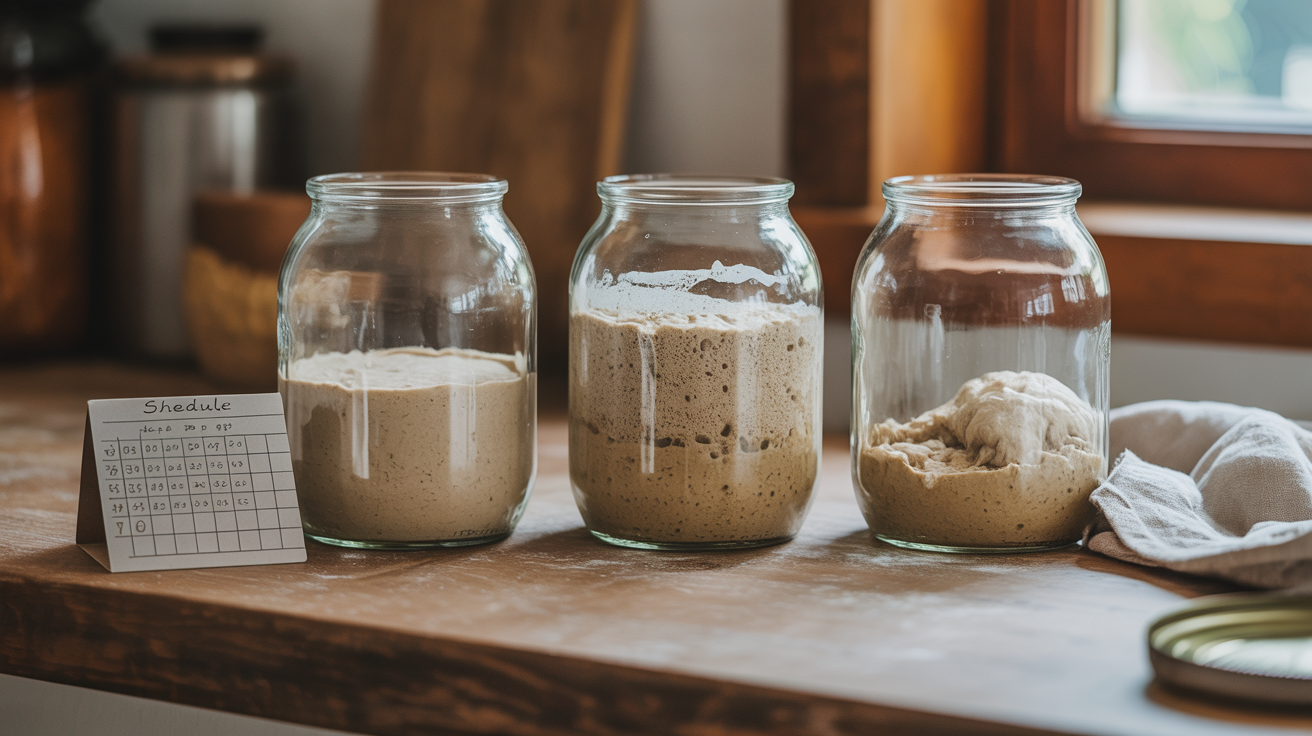
Feed a room-temperature starter once every 12–24 hours. Feed a refrigerated starter once every 5–7 days. The exact cadence depends on how often you bake, the ambient temperature, and the feeding ratio you use. This guide gives you the full decision tree so you can match the schedule to your life — not the other way around.
Feeding Frequency at a Glance
The tables below assume a 100% hydration starter fed with equal weights of flour and water. If you are feeding at a different ratio, see the 1:1:1 guide or the 1:5:5 guide to translate.
Counter Starter (Room Temperature)
- Bake daily: 1:1:1 every 12 hours (morning + evening).
- Bake 2–4× per week: 1:2:2 once every 24 hours.
- Bake weekly: 1:5:5 once every 24 hours, or move to the fridge between bakes.
Fridge Starter
- Weekly bakers: one feed every 7 days, refrigerate after it peaks.
- Occasional bakers: one feed every 10–14 days — feed before it develops more than 1 cm of hooch.
- Always let the starter warm on the counter for 2 hours before feeding so it wakes up.
Why the 12-Hour Rule Exists
At 72°F (22°C), a 1:1:1 starter reaches its peak roughly 4–6 hours after feeding and then begins to fall. Around the 12-hour mark, the yeast have exhausted most of the available sugars and the bacteria have driven the pH down to the point where further activity slows dramatically. Feeding at 12-hour intervals catches the starter just as it needs fresh food — keeping the yeast population stable and the flavour balanced between sweet and tangy.
Skip past 18 hours and the starter starts to smell vinegary or acetone-like. That is still fixable (see reviving a neglected starter), but the yeast population takes several feeds to bounce back.
Temperature Changes the Math
Fermentation roughly doubles for every 10°C rise in temperature, so ambient temperature is the single biggest lever on feeding frequency.
| Kitchen Temp | 1:1:1 peak time | Feeding interval |
|---|---|---|
| 65°F / 18°C | 8–12 hours | 16–20 hours |
| 72°F / 22°C | 4–6 hours | 12 hours |
| 78°F / 26°C | 3–4 hours | 8–10 hours |
| 85°F / 29°C | 2–3 hours | 6–8 hours |
If summer heat is pushing peak time under 3 hours, switch to a higher-dilution ratio like 1:5:5 so the starter has more food to work through. See our fermentation temperature guide for the full lookup.
The Pre-Bake Refresh Protocol
The day before you bake, your starter deserves extra attention. The goal is to hand the dough a starter that is freshly peaked, populated with healthy yeast, and at the right pH. Here is the protocol that works across nearly every recipe:
- Evening before bake (~12 hours out): Take the starter from the fridge (or last feed). Discard all but 10 g. Feed 1:5:5 (10 g starter + 50 g flour + 50 g water). Leave at room temperature overnight.
- Morning of bake (∼8–10 hours later): The starter should be peaked or just past peak. Take 10 g of it and feed 1:5:5 again. This second feed is your levain.
- Use when peaked: 4–6 hours later, when the levain has doubled and shows a domed top, it is ready to go into your dough.
Why two feeds? The first feed wakes the yeast; the second feed gives you a young, sugar-rich levain with maximum leavening power. Your bread will have better oven spring and less sourness than a starter that went straight from fridge into dough.
What Goes Wrong When You Under-Feed
- Hooch layer: A grey or brown liquid on top means the yeast have run out of food. Stir it in (for a tangier bake) or pour it off. Then feed immediately.
- No rise: If a fresh feed does not double in 12 hours at 72°F, the population is weak. Do two 1:1:1 feeds back-to-back to rebuild.
- Vinegar smell: Acetic acid buildup from underfeeding. Switch temporarily to 1:5:5 feeds to dilute the pH back to normal.
- Sluggish dough: Your loaf fails to rise in bulk even though the starter passed the float test. The cause is usually a tired starter — give it three 1:1:1 feeds in 36 hours before baking.
What Goes Wrong When You Over-Feed
Over-feeding is rarer but not impossible. If you feed before the previous feed has peaked, you dilute the microbe population faster than they can reproduce. Signs include:
- A starter that takes more than 8 hours to show any visible rise.
- A thin, watery texture with no gluten strands when you stir.
- A mild, almost beer-like smell instead of pleasant tang.
The fix: skip one feed, let the starter mature fully (maybe 12 hours past peak), and then resume a normal cadence.
Fridge Starters: The 7-Day Default
Most home bakers overcomplicate fridge maintenance. The default that works for 95% of bakers is:
- Feed your starter 1:1:1 or 1:2:2.
- Let it sit on the counter for about 2 hours — just enough for the yeast to start eating.
- Lid on, into the fridge. Don’t wait for it to peak before fridging.
- One feed per week is fine. Two if you want a perkier starter.
The fridge slows activity by roughly 8× versus 72°F, so a weekly feed in the fridge approximates 1–2 room-temperature feeds per week. Plenty to keep the colony alive and ready.
Travel and Extended Breaks
Going on holiday? Your starter will survive longer than you think:
- Up to 2 weeks: Feed and fridge normally. You may come home to hooch — stir it in and feed. Two feeds to bounce back.
- 2–6 weeks: Do a stiff feed (50% hydration) before leaving. Stiff starters last up to 3× longer in the fridge.
- 6 weeks to 3 months: Dry a portion on parchment paper, store the flakes in a sealed jar. Rehydrate with warm water and 3 consecutive 1:1:1 feeds on your return.
- 3+ months: Freeze a portion in a small bag (it survives surprisingly well) or dry, as above.
Minimum Viable Feeding (for Busy Bakers)
If life is chaotic and you just want to keep a starter alive without fuss, here is the lowest-effort schedule that still produces good bread:
- Keep 20 g of starter in a small jar in the fridge.
- Feed 1:2:2 (20 g + 40 g + 40 g) once a week. Let sit on counter 1–2 hours, then fridge.
- When you want to bake, use the pre-bake protocol above the day before.
Total commitment: 2 minutes per week. That is enough to keep a starter healthy for years.
Frequently Asked Questions
Is it okay to skip a feeding?
Yes — a mature starter easily survives an extra 12 hours on the counter or an extra week in the fridge. It may smell stronger, but stirring in the hooch and feeding normally will reset it.
Do I need to discard before every feed?
Yes, unless you want the jar to grow exponentially. Discarding keeps the flour-to-starter ratio correct so the yeast have enough food to peak. You can save discard in the fridge for discard recipes like pancakes and crackers.
Can I just keep topping up instead of discarding?
Not really. Without discarding, the effective feeding ratio drops each time, and the starter becomes sluggish and sour within a few days. Discard and feed fresh.
How do I know my feeding schedule is correct?
A well-fed starter doubles or triples in height 4–8 hours after feeding, smells faintly sweet-tangy (not vinegary), passes the float test, and leaves webs of bubbles when stirred. If any of those are off, nudge the feeding frequency higher.
Next Steps
Once your schedule is dialled in, plug your starter percentage into the sourdough ratio calculator to scale your recipes. If you want to convert between a counter-kept and fridge-kept starter, see our guide on fridge vs counter storage (coming soon).