Fridge vs Counter Sourdough Starter: Which Is Right for You?
The Short Answer
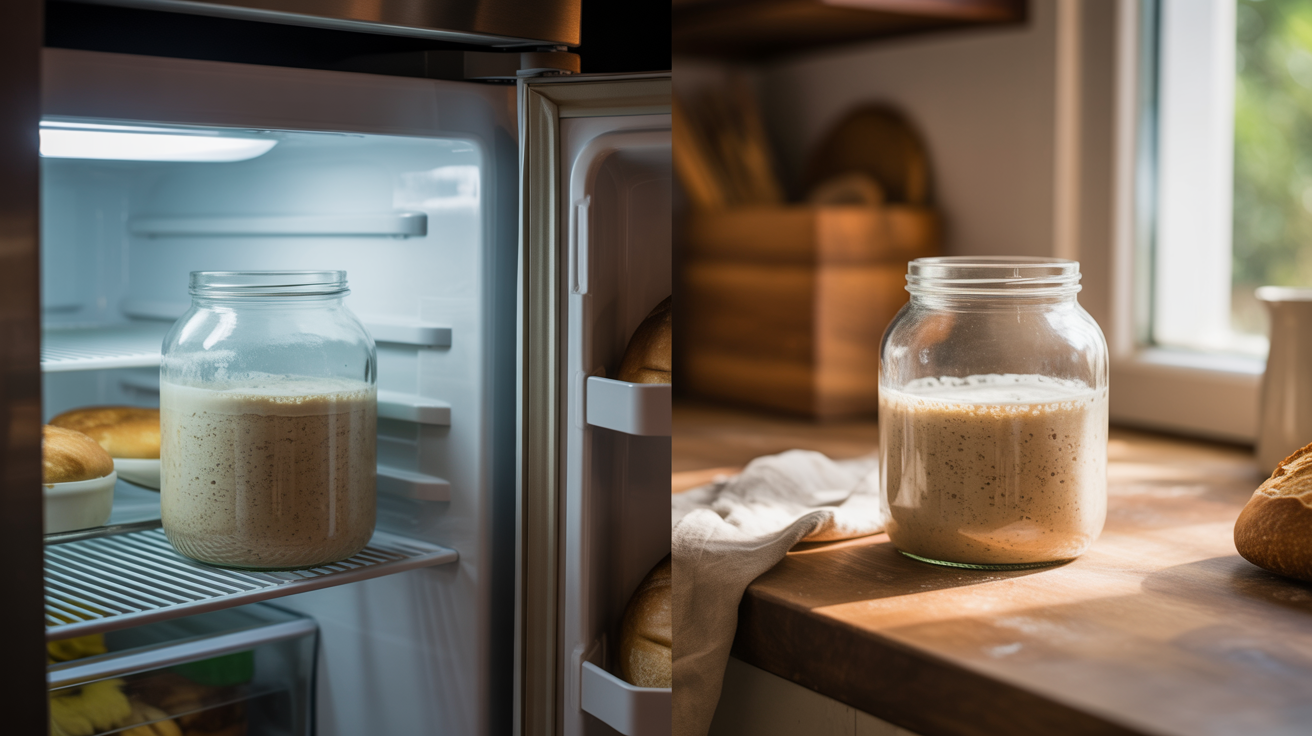
Store your sourdough starter on the counter if you bake three or more times a week. Store it in the fridge if you bake once or twice a week. The counter gives you a bake-ready starter every day; the fridge saves you 80% of the flour and most of the maintenance effort, at the cost of one overnight revival feed before each bake.
Neither option is better — they are simply tuned to different baking rhythms. This guide walks through the exact tradeoffs, the transition protocols, and the schedule for each so you can pick confidently.
The Real Differences at a Glance
| Counter (72°F / 22°C) | Fridge (38°F / 3°C) | |
|---|---|---|
| Feed frequency | Every 12–24 hours | Every 5–7 days |
| Ready-to-bake state | 4–6 hours after last feed | After 1 revival feed (12+ hours) |
| Monthly flour use | ~400 g | ~80 g |
| Discard produced | ~300 g per month | ~60 g per month |
| Flavour profile | Mild, sweet-tangy, fruity | Deeper, more complex tang |
| Yeast activity | Consistently high | Dormant until revived |
| Best for | 3+ bakes/week | 1–2 bakes/week |
Counter Starter: Always Ready, Always Hungry
A counter starter lives at room temperature in a kitchen that averages 68–78°F. At that temperature the yeast and bacteria are fully active, which means the starter needs food every 12–24 hours or it starts consuming itself (producing hooch and drifting toward sourness).
Counter Schedule
- Daily bakers: feed 1:1:1 every 12 hours. See our 1:1:1 guide.
- 3–4× per week bakers: feed 1:2:2 every 24 hours. See our 1:2:2 vs 1:3:3 comparison.
- Pre-bake: take 10 g of peaked starter and feed 1:5:5 the night before. Use at peak the next morning.
Counter Pros
- Always bake-ready — just wait for peak.
- More yeast-dominant flavour (mild, sweet, fruity notes).
- No revival step, no guessing whether it’s strong enough.
Counter Cons
- Produces 4–6× more discard than a fridge starter.
- Needs attention every day, even when you are not baking.
- Forgot to feed for 36 hours? You will need a recovery feed before it’s usable.
Fridge Starter: Slow, Efficient, Slightly Tangier
A fridge starter lives at around 38°F (3°C). At that temperature both yeast and bacteria become sluggish — roughly 8× slower than at room temp. The yeast goes nearly dormant; the lactic acid bacteria continue at a trickle, which is why cold-stored starters taste slightly sharper over time.
Fridge Schedule
- Maintenance feed: once every 5–7 days. Take out, discard to 10 g, feed 1:2:2, leave on counter 1–2 hours, then back to the fridge (lid tight).
- Pre-bake revival: 24 hours before you bake, pull the jar from the fridge and feed 1:5:5. Leave on counter. Within 12 hours you will see bubbles. Do one more 1:5:5 feed and use at peak.
Fridge Pros
- Uses ~80% less flour and produces ~80% less discard.
- Forgive and forget — skip a week and it is still fine.
- Slightly more complex, deeper flavour thanks to slow acid buildup.
- Great for bakers who travel or have busy periods.
Fridge Cons
- Needs 24 hours of warming plus 2 feeds before it is bake-ready.
- Can produce a vinegary edge if left unfed for more than 2 weeks.
- Requires remembering to revive the night before, which catches many weekend bakers off guard.
How to Switch Between the Two
Switching is easy. You do not need a multi-day transition.
Counter → Fridge
- Wait until your starter is roughly 2–4 hours after feeding (just started rising but not peaked). This is the “young” stage and transitions best.
- Secure the lid. Move straight to the fridge.
- Feed once in the next 5–7 days on the usual fridge schedule.
Why not at peak? Yeast at peak have exhausted their food, so cold storage causes them to starve faster. A young starter goes dormant with food still in the system.
Fridge → Counter
- Pull from fridge, warm on counter for 1–2 hours.
- Discard to 10 g, feed 1:1:1.
- After it peaks and falls (8–10 hours), feed 1:1:1 again. You are now in a normal counter schedule.
Flavour and Crumb Differences
Bakers often ask whether the storage location affects the final bread. It does — subtly but noticeably.
- Counter starters tend to produce breads with a cleaner, sweeter flavour and slightly more oven spring. The yeast population is vigorous and produces strong leavening.
- Fridge starters produce breads with a deeper, more complex tang and a slightly chewier crumb. Because the bacteria dominate during cold storage, there is more lactic and acetic acid carryover into the dough.
Neither is “better” — pick the one that matches your taste. Many experienced bakers keep two starters: a counter starter for fast weekday bakes and a fridge starter for tangier weekend loaves.
Cost Comparison (Home Baker)
| Counter | Fridge | |
|---|---|---|
| Flour/month | ~400 g | ~80 g |
| Flour/year | 4.8 kg | ~1 kg |
| Cost/year @ $1.50/kg | $7.20 | $1.50 |
| Discard/year | 3.6 kg | ~750 g |
The monetary difference is small, but the discard difference matters: counter starters produce nearly 5 kg of discard per year. Put it in pancakes, crackers, or pizza dough — or save the environment a bit by going fridge.
Common Mistakes
- Putting a hot-from-feeding starter into the fridge. The thermal shock stresses the yeast. Always wait 1–2 hours.
- Trying to use a fridge starter directly without revival. It will leaven dough, but slowly and weakly. Give it 24 hours of warming and feeding first.
- Storing a fridge starter in an airtight jar for weeks without venting. Gas builds up and can push the lid off. Crack the lid once a week or use a fermentation lid.
- Never feeding the fridge starter. Past 3 weeks it gets acidic enough to slow down yeast. Feed weekly; at most every 2 weeks.
Frequently Asked Questions
Can I keep my starter on the counter if my kitchen is very warm?
Yes, but use a higher-dilution ratio. If your kitchen sits above 78°F (26°C), feed 1:5:5 instead of 1:1:1 so the starter has more food to work through before it peaks. See our 1:5:5 guide for details.
Does the fridge kill my starter?
No. The fridge only slows the yeast to near-dormancy. Even after 3–6 weeks of neglect, a healthy starter bounces back with 2–3 feeds. See our reviving guide if it has been longer.
Should I use a plastic or glass jar in the fridge?
Either works. Glass lets you see bubbles and hooch layers easily; plastic is lighter. Crucial point: never screw the lid on fully airtight — fermentation gas needs to vent.
Can I freeze my starter instead of fridging it?
You can, for vacations or extended absences. Freeze a small portion flat in a zip bag. Thaw in the fridge for 8 hours, let sit on the counter 2 hours, then follow the revival protocol. Do not make freezing your default — frequent freeze/thaw cycles stress the microbe population.
My fridge starter has grey liquid on top. Is it ruined?
No. Grey hooch is alcohol and water that separate when the starter is hungry. Stir it in (for more tang) or pour it off (for a milder loaf), then feed normally.
Next Steps
Once you have picked a storage strategy, calibrate your pre-bake schedule with our feeding frequency guide. Then plug the details into the sourdough ratio calculator for your next bake.