1:2:2 vs 1:3:3 Sourdough Starter Feeding Ratios
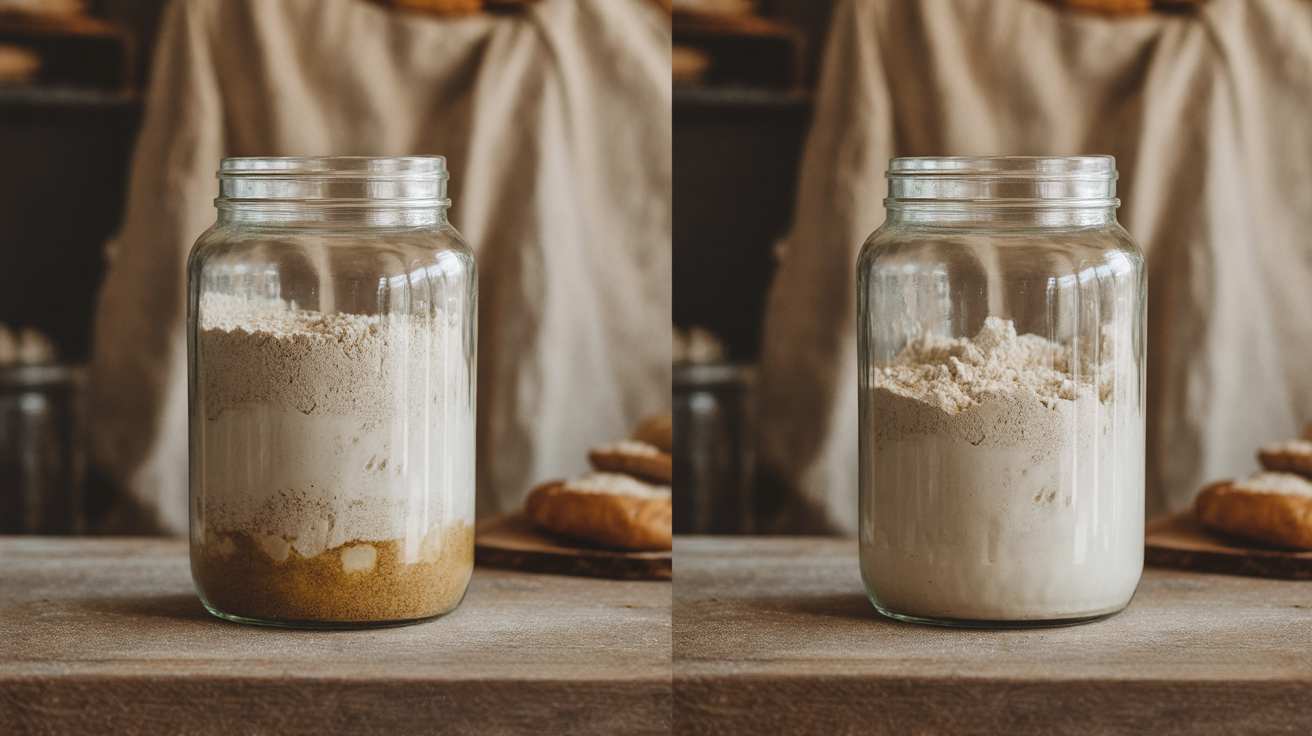
Quick Comparison: 1:2:2 vs 1:3:3
1:2:2 and 1:3:3 are both diluted feeding ratios that give your starter more food per feed than the classic 1:1:1 ratio. The only difference between them is how much flour and water you add for every unit of starter. That small change has a big effect on peak time, flavour, and how forgiving the window of use is.
| Ratio | Example (grams) | Peak @ 72°F | Peak @ 78°F | Flavour |
|---|---|---|---|---|
| 1:2:2 | 20 + 40 + 40 | 6–8 h | 5–6 h | Balanced, gently tangy |
| 1:3:3 | 20 + 60 + 60 | 8–10 h | 6–7 h | Mild, slightly sweet |
What Does 1:2:2 Mean?
A 1:2:2 feed doubles the flour and water relative to the starter. So if you start with 20 g of mature starter, you add 40 g of flour and 40 g of water. The new mixture weighs 100 g total and finishes at 100% hydration.
1:2:2 is the most common scaling ratio in bakery texts like Flour Water Salt Yeast and The Rye Baker. It’s a sweet spot between the quick-rise 1:1:1 and the slower 1:5:5 overnight build.
What Does 1:3:3 Mean?
A 1:3:3 feed triples the flour and water. From 20 g starter you’d build to 20 g starter + 60 g flour + 60 g water = 140 g total. Triple dilution means more food, more residual room for yeast to multiply before acidity builds up, and a noticeably milder flavour.
Peak Time: How They Compare
Peak time is the moment the starter hits maximum rise before collapsing. Both ratios should be used at peak, not after. Here’s what to expect by temperature:
1:2:2 Peak Times
- 65°F (18°C): 9–11 h
- 72°F (22°C): 6–8 h
- 78°F (26°C): 5–6 h
1:3:3 Peak Times
- 65°F (18°C): 12–14 h
- 72°F (22°C): 8–10 h
- 78°F (26°C): 6–7 h
As a rule of thumb, 1:3:3 adds roughly 2 extra hours to the peak window versus 1:2:2 at the same temperature.
When to Choose 1:2:2
Pick 1:2:2 when:
- You feed in the morning and plan to bake in the afternoon.
- Your kitchen sits around 70–75°F.
- You want a medium-tangy loaf — less sour than 1:1:1 but more complex than 1:5:5.
- You’re building a levain for a same-day bake.
When to Choose 1:3:3
Pick 1:3:3 when:
- You feed in the morning and want flexibility to mix dough any time between lunch and dinner.
- Your kitchen runs warm (78°F+) and 1:2:2 peaks too fast.
- You’re building a larger levain for family-size loaves.
- You prefer a mild, almost buttery flavour.
Flavour Differences You Can Actually Taste
Both ratios produce a cleaner flavour than 1:1:1, but they differ subtly:
- 1:2:2: Balanced. Lactic acid (yogurt-like) notes with a soft tang. Works for everything from country loaves to baguettes.
- 1:3:3: Milder, almost sweet at peak. Acid develops more slowly, so the crumb reads as wheaty rather than sour. Great for high-hydration open-crumb boules where you don’t want acid to mask the flour flavour.
How to Scale Your Ratios
Both ratios scale linearly. To build 300 g of starter using:
- 1:2:2: Divide 300 by 5 = 60. So 60 g starter + 120 g flour + 120 g water.
- 1:3:3: Divide 300 by 7 = ~43. So 43 g starter + 129 g flour + 129 g water.
Or use our sourdough calculator and it handles the arithmetic for any size levain.
Common Mistakes
Feeding a Tired Starter at 1:3:3
If your starter has been languishing in the fridge, jumping straight to 1:3:3 can under-feed the already-depleted yeast. Refresh with 1:1:1 first for 2–3 cycles, then scale up.
Confusing Ratio Order
The order is always starter : flour : water, never the other way around. Some sources write it as “1:2:2” and others as percentage notation — both refer to the same math.
Not Adjusting for Temperature
A 1:2:2 feed at 80°F will peak in 5 hours, not 7. Always account for ambient temperature; see the fermentation temperature guide for exact windows.
FAQ
Is 1:2:2 or 1:3:3 better for bread flavour?
1:2:2 gives a more noticeably tangy, complex loaf. 1:3:3 tastes milder and sweeter. Which is “better” is a matter of preference, but 1:2:2 is the standard for artisan country loaves and 1:3:3 is common for whole-wheat or lighter breads.
Can I combine ratios in one week?
Yes. Many bakers run 1:1:1 during the week for quick feeds and switch to 1:3:3 on Friday night to build a big overnight levain for Saturday baking.
Will 1:3:3 make my starter weak over time?
No, as long as you use it at peak. If you miss the peak by several hours, acidity stresses the yeast — but that happens at any ratio, not just diluted ones.
Ready to Bake?
Build your levain at 1:2:2 or 1:3:3, then plug the total weight into our free sourdough calculator to get precise dough ingredients for your loaf.