1:1:1 Sourdough Starter Feeding Ratio Explained
What Is a 1:1:1 Sourdough Feeding Ratio?
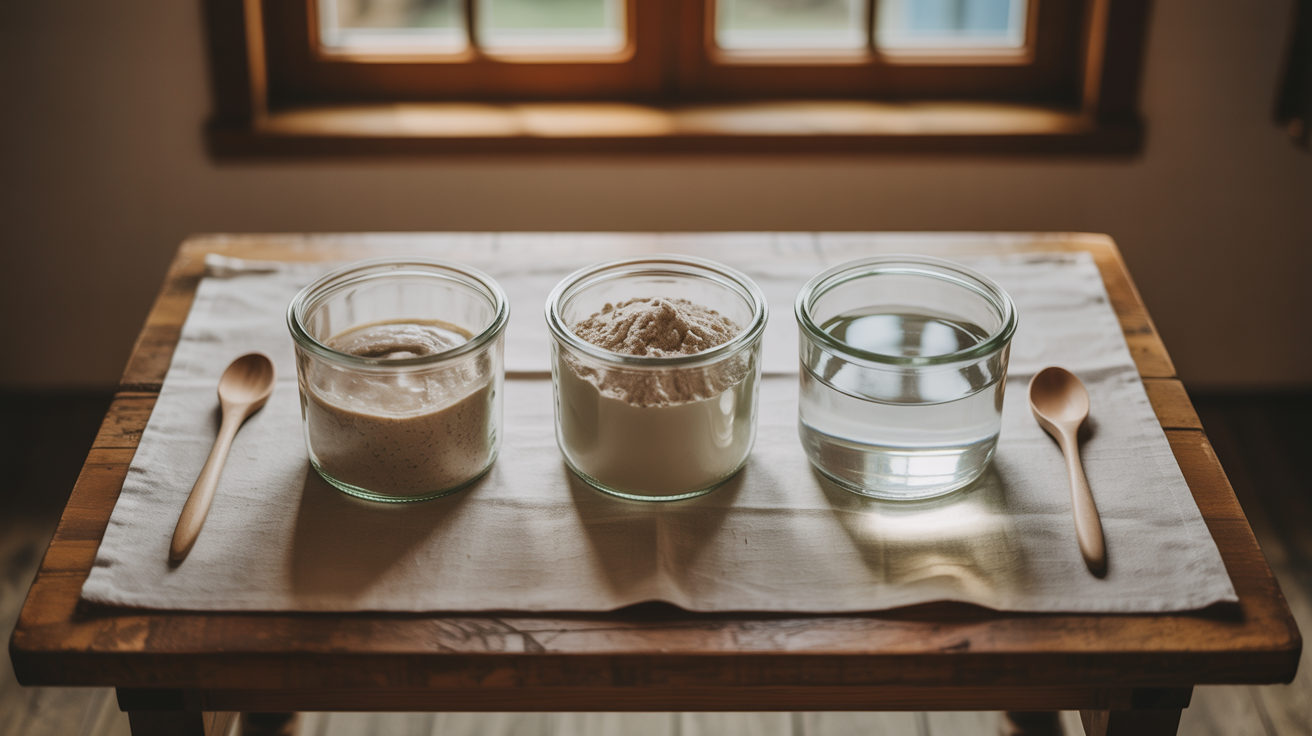
A 1:1:1 feeding ratio is when you feed your mature starter with an equal weight of flour and an equal weight of water. The first number is always the starter, the second is always the flour, and the third is always the water. So 30 g starter + 30 g flour + 30 g water is a classic 1:1:1 feed.
Because flour and water are added in equal weights, a 1:1:1 starter finishes at 100% hydration — the same baseline our hydration calculator uses as its default.
When to Use 1:1:1
Pick 1:1:1 when any of the following is true:
- You bake at least every 1–2 days. The fast peak means your starter is ready quickly.
- Your kitchen sits between 68–75°F (20–24°C). It will double in 4–6 hours — a predictable window.
- You like a slightly tangy loaf. Less dilution means more residual acidity.
- You’re rescuing a sluggish starter. Frequent 1:1:1 feeds rebuild yeast populations faster than diluted ratios.
If you’re not sure which ratio fits your schedule, our starter feeding frequency guide walks through the decision tree in detail.
How to Feed Using 1:1:1 — Step by Step
- Weigh 30 g of mature, active starter into a clean jar. Discard the rest (or save it for sourdough discard recipes).
- Add 30 g of room-temperature water and stir until the starter dissolves into a loose slurry.
- Add 30 g of flour — typically bread flour or a 50/50 bread-to-whole-wheat blend — and stir until no dry pockets remain.
- Mark the jar at the level of the fresh mixture with a rubber band or erasable marker so you can see when it has doubled.
- Loosely cover and leave at room temperature until the starter has at least doubled and shows a domed, bubbly surface.
How Long Does a 1:1:1 Starter Take to Peak?
At typical room temperature, expect these peak times:
- 65°F (18°C): 7–9 hours
- 72°F (22°C): 4–6 hours (the reference window)
- 78°F (26°C): 3–4 hours
- 82°F+ (28°C+): Under 3 hours
Temperature roughly halves or doubles the peak time for every 10°F change. For a deeper breakdown see the fermentation temperature guide.
Pros and Cons of 1:1:1
Pros
- Fastest of the common ratios. Perfect for same-day baking.
- Simple math. Easy to remember; easy to scale to any jar size.
- More residual yeast carries into the next feed, so it recovers quickly from fridge storage.
Cons
- Peaks fast, falls fast. Miss the window and acidity builds up, weakening gluten in your dough.
- More frequent discard. Because feeds happen often, so does throwing starter away.
- Tangier loaf. Not everyone wants a pronounced sour note.
1:1:1 vs 1:2:2 vs 1:5:5
Higher dilution ratios (more flour and water per unit of starter) slow fermentation, produce a milder flavour, and extend the peak window. A 1:2:2 or 1:3:3 feed doubles or triples the food supply, which is helpful if you can’t bake within 6 hours. A 1:5:5 feed stretches the peak to 10–14 hours, which is ideal for overnight levains.
Troubleshooting 1:1:1 Feeds
My Starter Peaks Too Fast and Collapses
This is almost always a warm kitchen problem. Switch to 1:2:2 or move the jar to a cooler spot (top of the fridge, a cool cupboard). Our desired dough temperature guide covers how temperature drives fermentation speed.
My Starter Is Sluggish on 1:1:1
Possible causes: starter is too young (under 2 weeks), kitchen is below 65°F, or your flour is low-protein. Try warming the kitchen to 75°F, using bread flour, and feeding every 12 hours for 3–4 consecutive cycles.
It Looks Active but My Bread Is Dense
You’re likely using the starter past its peak. 1:1:1 at 75°F+ can peak and begin collapsing inside 4 hours. Use it right at the dome, not after it deflates. Mark the jar so you can see the exact peak line.
FAQ
Is 1:1:1 the same as 100% hydration?
Yes for the finished starter. Because you add equal weights of flour and water, the resulting starter is 100% hydration by baker’s percentage.
Can I use 1:1:1 by volume instead of weight?
No. Flour and water have very different densities — 1 cup of flour is about 125 g, but 1 cup of water is 240 g. Always use a kitchen scale for accurate ratios.
How much starter do I need for a typical loaf?
Most recipes use 20% starter as a percentage of flour. For 500 g flour, that’s 100 g starter — which you can build from a 30 g 1:1:1 feed plus a levain build.
Should my starter always be 1:1:1?
Not necessarily. 1:1:1 is fast and convenient; diluted ratios like 1:5:5 are better for overnight fermentation or cooler kitchens. Many bakers keep a 1:1:1 maintenance starter and build a 1:5:5 levain off it the night before baking.
Ready to Bake?
Once your 1:1:1 starter is peaked and domed, plug it into our free sourdough calculator to get precise flour, water, starter, and salt weights for any loaf size.