Rye Percentages in Sourdough: 10%, 30%, 50%, 100% Explained
Rye flour is the most transformative ingredient in sourdough. A little adds nutty depth; a lot fundamentally changes how the dough behaves, bakes, and tastes. But most recipes just say “add 20% rye” without explaining what actually changes — or why the handling suddenly feels different.
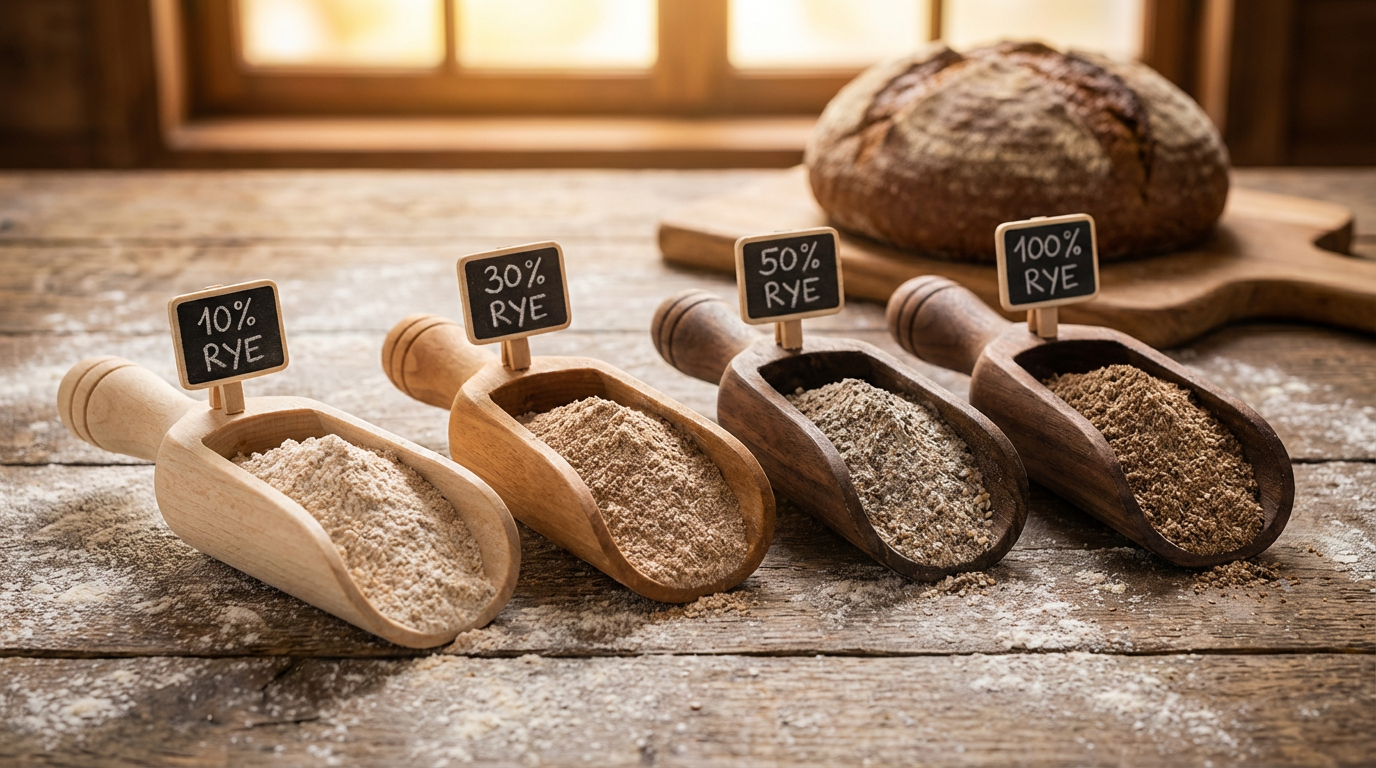
This guide maps four common rye percentages (10%, 30%, 50%, 100%) to their real-world outcomes: flavor, crumb, handling, hydration, and fermentation. Use our sourdough ratio calculator to dial in the exact flour weights once you’ve chosen your percentage.
Why Rye Behaves Differently From Wheat
Rye is chemically and structurally distinct from wheat in three critical ways:
- It forms almost no gluten. Rye has glutenin and gliadin, but very little. Structure in rye bread comes from pentosans — carbohydrate chains that absorb massive amounts of water.
- It absorbs 15–20% more water. Pentosans swell dramatically, so rye doughs need much more hydration.
- It ferments faster. Rye’s natural enzymes (amylases) are highly active, accelerating fermentation — and making overproofing easier.
This is why every rye percentage demands its own recipe adjustments. Don’t just swap flour and hope.
10% Rye: The Flavor Hint
Best for: Your first rye bake. Adding depth without changing handling.
Recipe profile: 90% bread flour + 10% rye, 75% hydration, standard bulk and cold retard.
At 10%, rye adds a subtle earthy, nutty note without changing dough behavior meaningfully. Hydration stays the same as your all-wheat recipe. Bulk fermentation timing, stretch-and-folds, shaping — all the same. The dough feels identical to 100% bread flour.
What changes:
- Slight flavor complexity — a whisper of rye
- Very marginally more tender crumb
- Crust color slightly darker
This is the “I want to try rye” percentage. You get the flavor benefit with zero technical adjustments. Recommended for beginners.
30% Rye: The Country Loaf
Best for: Classic “campagne”-style country loaves with noticeable rye character.
Recipe profile: 70% bread flour + 30% rye, 78% hydration, shortened bulk (about 20% less time than all-wheat).
This is arguably the sweet spot for hybrid rye-wheat sourdough. You get pronounced rye flavor and color but still have enough wheat gluten to build structure, produce open crumb, and shape into a free-form boule.
What changes at 30%:
- Hydration up to 77–80% (from 75%)
- Dough feels slightly stickier and tackier — less elastic pull
- Bulk fermentation 20–25% faster
- Crumb open but slightly more tender and closer-grained
- Distinct rye tang, deeper flavor, darker color
Tip: use a strong bread flour (12.7%+ protein) for the wheat portion. The rye will “tax” your gluten budget and you’ll want all the strength you can get.
50% Rye: The Dense, Deeply Flavored Loaf
Best for: Dense-crumb rye lovers, sandwich rye, tartines, open-faced toppings.
Recipe profile: 50% bread flour + 50% rye, 80–82% hydration, pan-baked or tightly shaped boule.
At 50/50, you’re in traditional Central European territory — the classic “Roggenmischbrot” of German bakeries. Free-form shaping becomes tricky; most bakers use a loaf pan or a strongly floured banneton.
What changes at 50%:
- Hydration jumps to 80–82%
- Dough is sticky enough that stretch-and-folds need wet hands
- Bulk fermentation significantly faster (3–4 hours at 24°C / 75°F instead of 5)
- Crumb moderately open but denser than 30%
- Deep, complex flavor — sharp tang, caramelized notes
- Keeps significantly longer than wheat sourdough (4–5 days)
For best results, use a stiff rye starter (1:1:1 or even stiffer) rather than a liquid starter. See stiff vs liquid starter for when each works best.
100% Rye: Traditional Vollkornbrot
Best for: Authentic German dense ryes, pumpernickel-style pan loaves, long-keeping bread.
Recipe profile: 100% whole grain rye, 90–100% hydration, pan-baked, no kneading, extended cold retard.
At 100% rye, you’re no longer making bread in the familiar sense — there’s essentially no gluten. The dough is a thick, wet paste that you spoon into a loaf pan. Traditional German Vollkornbrot or Russian Borodinsky follows this pattern.
What’s different with 100% rye:
- Hydration 90–100% of total flour
- No stretch-and-folds or shaping — mix, pour into pan, proof, bake
- Extended fermentation: often 8–12 hours cold retard after 2–3 hour bulk
- Long bake: 90–120 minutes in a covered pan at 180°C / 350°F
- Very dense, moist crumb — almost custardy
- Extremely long shelf life: 7–10 days, often better on day 3 than day 1
- Must rest 24 hours before slicing (structure sets overnight)
Tip: scald a portion of the rye flour (pour boiling water over part of the rye and let it gelatinize) — this creates the soft, moist crumb traditional Vollkornbrot is famous for.
The Hydration Rule: +5% Per 25% Rye
A simple scaling rule that works remarkably well:
| Rye % | Suggested hydration | Shape |
|---|---|---|
| 0% | 72–75% | Free-form boule |
| 10% | 75% | Free-form boule |
| 25% | 77–79% | Free-form boule |
| 50% | 80–82% | Pan or tight boule |
| 75% | 85–88% | Pan only |
| 100% | 90–100% | Pan only, batter style |
Use the calculator to translate these percentages into exact gram weights for your target dough mass.
Fermentation Timing With Rye
Rye ferments faster — this is the biggest trap for wheat-sourdough bakers trying rye for the first time. Guidelines:
- 10% rye: Same timing as all-wheat (5 hours bulk at 24°C / 75°F)
- 30% rye: 20% faster (about 4 hours bulk)
- 50% rye: 30–35% faster (3 hours bulk)
- 100% rye: 2–3 hours bulk, then direct to pan for proofing
Watch for the dome and bubble pattern rather than the clock. For help reading the signs, see our signs bulk fermentation is done guide.
Common Mistakes
1. Not increasing hydration. Using 70% hydration with 50% rye gives you a brick. The pentosans need their water.
2. Overproofing. Rye looks “not quite done yet” longer than wheat — then suddenly collapses. Bake a bit earlier than you think.
3. Expecting wheat crumb. High-rye loaves will never have wild open crumb. Embrace density as a feature, not a bug.
4. Using white rye. For flavor and behavior, use whole rye (dark or medium rye). White rye has the germ and bran removed and behaves more like AP flour.
Final Word
Rye percentages aren’t a linear scale — they’re a dial with distinct personalities. 10% is a flavor boost, 30% is the country-loaf sweet spot, 50% is dense-crumb territory, and 100% is an entirely different craft. Pick the percentage that matches your goal and adjust hydration and timing accordingly. Our calculator gets the gram weights right — your experience dials in the rest.
For a full walkthrough of the 100% rye process, see rye sourdough hydration.