Rye Sourdough Hydration: The Complete Guide to Pentosans, Water, and Timing
Rye Is Not Wheat (and Doesn’t Pretend to Be)
Every beginner sourdough recipe assumes wheat flour. Gluten structure, stretch-and-folds, open crumb, tall oven spring — all of that is wheat-specific behaviour. Rye plays by different rules.
Rye contains almost no gluten. Its proteins are different from wheat’s, and they don’t form the same elastic network. Instead, rye doughs are held together by pentosans — water-soluble plant gums that give rye dough its characteristic paste-like, almost porridge-ey texture.
Work with pentosans, not against them, and you’ll make beautiful rye breads. Fight them — expecting open crumb and stretch-and-folds — and you’ll bake dense bricks all day long.
How Pentosans Change Everything
- Water absorption: pentosans hold 8× their weight in water. One gram of rye pentosans = eight grams of water locked into dough.
- Stickiness: pentosan-hydrated dough is tacky and pasty, not smooth and elastic. This is normal.
- Slow hydration: pentosans hydrate over 2–4 hours, not 30 minutes. Rye needs much longer autolyse.
- Enzyme activity: rye has high amylase activity, which breaks down starches fast — hence quicker fermentation.
- No windowpane: don’t look for gluten windowpane in rye dough. It doesn’t develop one.
Rye Percentage Changes the Recipe Completely
How much rye you blend into a dough drastically changes the technique. Here’s what to expect at each level:
10–20% rye (“touch of rye”)
- Hydration: bread flour + 2–3% (so 75% → 77–78%).
- Technique: treat exactly like a wheat sourdough.
- Autolyse: standard 30–45 minutes.
- Crumb: open artisan crumb, slightly denser than 100% wheat.
- Flavour: subtle earthy/tangy note.
30–40% rye (“country rye”)
- Hydration: 78–82%.
- Technique: stretch-and-folds work, but dough stays tackier; use wet hands.
- Autolyse: extend to 60–90 minutes.
- Crumb: semi-open, denser than full wheat.
- Flavour: distinct rye notes, still wheat-dominant.
50% rye (“half-and-half”)
- Hydration: 80–85%.
- Technique: coil-folds instead of stretch-and-folds; dough is paste-like.
- Autolyse: 90 min minimum, 120 min better.
- Bake: in a pan or bannetons that support slack dough.
- Crumb: dense, even, slightly moist — perfect for thick slicing.
- Flavour: rye-forward, complex.
70–80% rye (“German dark rye”)
- Hydration: 85–90%.
- Technique: no folds — mix, bulk in the pan, proof, bake.
- Autolyse: skip — use a sour/sponge method instead.
- Bake: lidded Pullman pan or loaf pan, long slow bake.
- Crumb: tight, chewy, very moist.
100% rye (“vollkorn”)
- Hydration: 90–100% (yes, water equal to flour weight).
- Technique: this is closer to polenta than bread. No folds, no shaping — scoop into a greased pan.
- Bulk: 2–3 hours at 26°C (warm).
- Proof: 1 hour in pan, top the dough with water for a glossy finish.
- Bake: long — 60–90 minutes at 200°C (390°F) with steam for 15 min.
- Cure: wrap in a clean cloth for 24 hours before slicing. This is critical.
Worked Example: 40% Rye Country Loaf
- 300g bread flour (60%)
- 200g medium rye flour (40%)
- 410g water (82%)
- 10g salt (2%)
- 100g ripe starter (20%)
Method:
- Autolyse 90 min — flour + 390g water only.
- Add starter, salt, remaining 20g water. Mix 5 min by hand.
- Bulk 4 hours at 24°C, 4 coil-folds at 30-min intervals in hour 1–2.
- Shape into batard, into floured banneton.
- Cold retard 12–16 hours in fridge.
- Bake at 250°C (480°F) lidded Dutch oven 20 min, 230°C (450°F) uncovered 20 min.
The 100% Rye Challenge
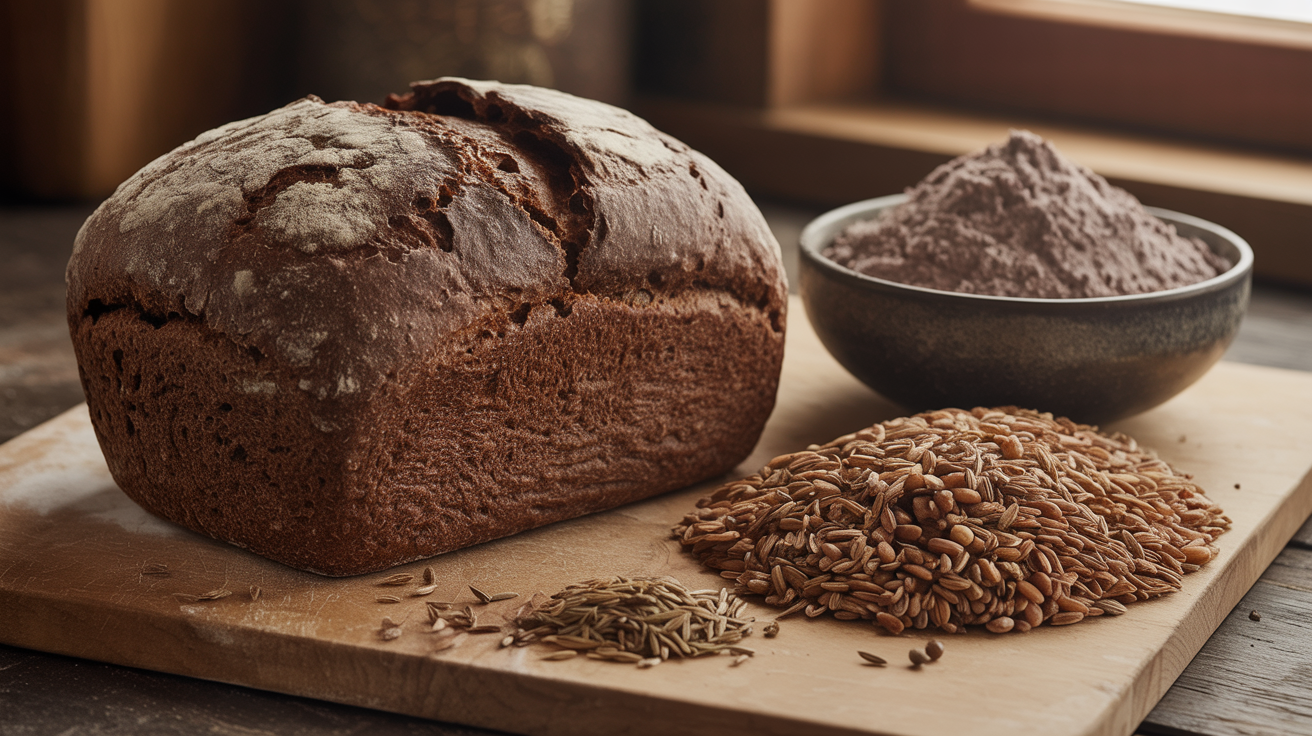
100% rye sourdough isn’t bread as most bakers think of it — it’s Northern European “vollkornbrot”. Dense, tall-slabbed, sliced thin, topped with butter and cheese or smoked fish. Complete recipe:
- 500g whole rye flour (100%)
- 500g water (100%)
- 10g salt (2%)
- 200g rye sourdough starter (40% — yes, a lot)
- Optional: 30g molasses, 15g caraway seeds, 10g coriander
Method:
- Mix everything at 28°C (82°F). The dough will be like wet mortar. Mix 5 min.
- Scoop into a greased Pullman pan.
- Wet your hand and smooth the top.
- Sprinkle extra seeds on top.
- Bulk + proof in pan: 3–4 hours at 28°C until surface cracks form.
- Bake 20 min at 200°C (390°F) covered, 50–70 min uncovered.
- Cool 30 min in pan, then unmould. Wrap in cloth for 24 hours before slicing.
Cutting before it cures = gummy slices. Cutting after = firm, tight, sliceable bread.
Why Rye Ferments Faster
Rye flour contains high amylase enzyme levels — these break starch into sugars that yeast feeds on. Result: rye doughs ferment 30–50% faster than wheat. If your wheat loaf bulks 5 hours at 24°C, a 50% rye loaf will bulk 3–4 hours at the same temperature.
Watch for signs, not the clock. See our bulk fermentation timing guide.
Salt Is Non-Negotiable
Rye doughs without enough salt go gummy and bland. Run 2% baker’s percentage minimum. Some traditional rye breads use 2.2–2.5% — it balances the earthy/sour flavour perfectly.
Common Rye Mistakes
- Expecting wheat-like dough: rye never feels like bread flour. Stop trying to make it.
- Using stretch-and-folds at 50%+ rye: dough tears because there’s no gluten to stretch.
- Cutting before curing: 100% rye needs 24 hours rest before slicing.
- Too little water: under-hydrated rye doesn’t activate pentosans — loaf is dry and crumbly.
- Over-proofing: rye’s fast fermentation catches bakers off guard.
Rye Flour Types
- Light/white rye: lowest bran, mildest flavour. Behaves most like wheat.
- Medium rye: moderate bran. The most versatile — great for 20–50% blends.
- Dark/whole rye: full bran and germ. Strongest flavour, thirstiest.
- Pumpernickel flour: coarsely ground whole rye. Used for traditional German rye breads.
FAQ
Can I use my regular (wheat) starter for rye bread?
Yes. It works perfectly at any blend percentage. Some bakers maintain a separate rye starter for flavour, but it’s not required.
Why is my 100% rye gummy after 24 hours?
Under-fermented or under-baked. Check internal temp hits 96°C (205°F) and let it rise fully in the pan before baking.
Can I make open-crumb rye?
At 10–25% rye, yes. At 40%+ rye, no — the structure can’t support big holes.
Does rye need caraway?
Traditional Northern European rye includes caraway, coriander, or fennel. Modern bakers often skip them. Try one bake each way.
Next Steps
Start with a 20% rye blend in your standard sourdough recipe — it’s the easiest on-ramp. Once you’re comfortable, jump to 40% country rye. Only attempt 100% rye once you understand the non-gluten approach. Use the sourdough ratio calculator to scale quantities, and pair this with the whole wheat hydration guide for other grain blends.