French Flour Types Explained: T45, T55, T65, T80, T110, T150 for Sourdough
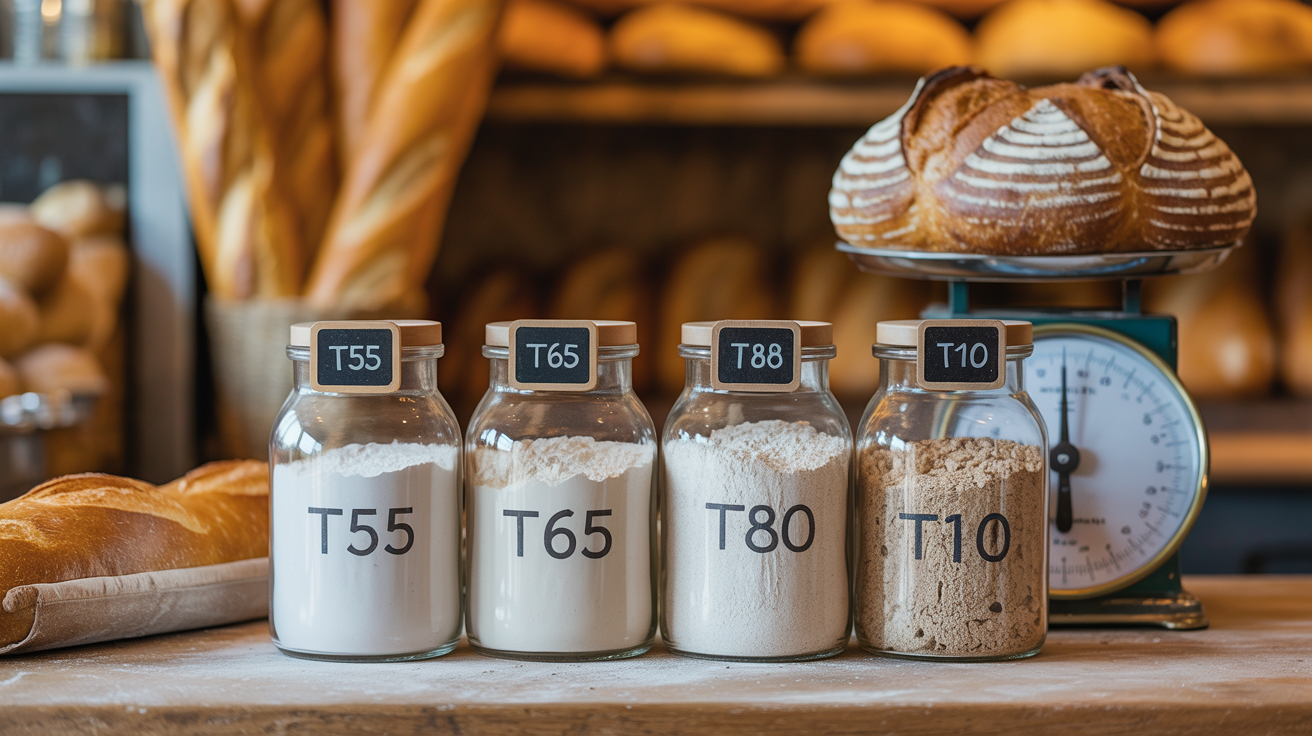
If you’ve ever looked at a French flour bag and seen “T55” or “T65” and wondered what it actually means — you’re not alone. Many English-speaking sourdough bakers misinterpret T-numbers as protein grades. They’re not. French flour types measure ash content — essentially, how much bran and germ the flour contains.
This guide decodes the T-system, matches each type to its best use, and shows the classic blends French bakers use for pain de campagne, baguettes, and sourdough. Use our sourdough ratio calculator for exact weights once you’ve chosen your flours.
The T-Number System
French flour is graded by ash content — the mineral residue left after burning 100g of flour at high temperature. Minerals are concentrated in the bran, so higher ash means more bran, more whole-grain character, darker flour.
| Type | Ash content (%) | Equivalent | Color |
|---|---|---|---|
| T45 | 0.50 | Pastry/cake flour | Pure white |
| T55 | 0.60 | All-purpose/baguette flour | White |
| T65 | 0.75 | Bread flour / stone-ground white | Off-white, cream |
| T80 | 0.90 | Semi-whole (bise) | Pale tan |
| T110 | 1.20 | Semi-whole wheat | Tan |
| T150 | 1.80 | Whole wheat (intégrale) | Brown |
Important: T-numbers measure minerals, not protein. You can have a T55 at 11% protein or a T55 at 13% protein — the T-number tells you about the bran, not the gluten potential.
T45: Pastry Flour
Best for: Croissants, brioche, pastries — not sourdough.
T45 is finely milled, nearly pure endosperm, very white. It’s designed for enriched doughs (with butter and eggs) where you want softness and tenderness. For sourdough, T45 produces a disappointingly tight, pale, flavorless loaf.
Skip T45 for sourdough entirely.
T55: The French All-Purpose
Best for: Baguettes, beginner sourdough, pizza, enriched doughs.
T55 is France’s workhorse baking flour — roughly equivalent to good US all-purpose at 11–11.5% protein. It’s what most French bakeries use for baguettes and traditional white breads.
For sourdough, T55 works but lacks flavor complexity. Typical hydration: 72–75%. Expect tighter, more uniform crumb than bread-flour versions. Good for baguette-style sourdough or beginners wanting a tender crumb.
T65: The Country Sourdough Staple
Best for: Pain de campagne, classic sourdough boules, everyday rustic bread.
T65 is where French sourdough starts getting interesting. Stone-ground or carefully milled, T65 retains slightly more bran than T55, adding flavor depth and better fermentation performance. Protein typically 11.5–12.5%.
This is the default for serious French home bakers. For pain de campagne, many recipes call for 100% T65 or T65 blended with small amounts of T80/T110. Hydration: 72–77%.
T65 is arguably the most forgiving, flavor-packed white-ish flour for sourdough. If you can only choose one French flour, choose T65.
T80: The “Bise” Sweet Spot
Best for: Rustic country loaves with pronounced flavor, 40–50% blends for modern artisan bakers.
T80 is often called “farine bise” — semi-whole flour with visibly more bran than T65. Roughly 85–88% extraction, compared to T65’s ~78–80%. Flavor complexity jumps significantly, and so does water absorption.
For T80 sourdough:
- 100% T80: hydration 76–80%, noticeably stickier dough, tighter crumb than T65
- 50% T65 + 50% T80: hydration 76–78%, excellent balance of flavor and open crumb
- 75% T65 + 25% T80: classic “pain de campagne” profile, 74–76% hydration
T80 is trending among modern French bakers (think Poilâne-style). If you want maximum flavor without going full whole wheat, T80 is the answer.
T110: Semi-Whole Wheat
Best for: Flavor accent in blends, 20–30% additions to T65-based recipes.
T110 is semi-whole wheat flour — about 90–95% extraction. Too bran-heavy to be the sole flour in a loaf with open crumb, but outstanding as 10–30% of a blend.
Classic French blends using T110:
- 80% T65 + 20% T110: artisan country loaf, 77–79% hydration
- 70% T65 + 30% T110: pronounced whole-grain flavor, still open crumb, 78–80% hydration
- 40% T65 + 40% T110 + 20% rye: classic dark rustic loaf, 80% hydration
T150: Full Whole Wheat (Intégrale)
Best for: Dense whole-grain loaves, 10–20% additions for flavor depth.
T150 is the French equivalent of US whole wheat flour — all the bran and germ retained. Behavior is similar to whole wheat anywhere: high water absorption, weaker gluten, faster fermentation.
For tips on working with whole wheat, see our whole wheat ratios guide.
The Classic Pain de Campagne Formulas
Real French country sourdough typically uses one of these formulas:
Formula 1: Pure T65 (clean, classic)
- 100% T65, 75% hydration, 20% starter, 2% salt
- Open crumb, balanced flavor, ideal everyday loaf
Formula 2: Poilâne-inspired (darker, rustic)
- 75% T80 + 15% T110 + 10% whole rye
- 80% hydration, 20% starter, 2.5% salt
- Deep flavor, tighter but open crumb, long-keeping
Formula 3: Modern artisan blend
- 80% T65 + 20% T110
- 78% hydration, 20% starter, 2% salt
- Open crumb, great flavor complexity, everyday versatile
Use the calculator to convert these percentages into exact gram weights for your target loaf size.
US Equivalents When You Can’t Find French Flour
Not everyone has access to T-flour. Reasonable US substitutes:
- T55 → King Arthur AP (11.7% protein)
- T65 → King Arthur Bread or Central Milling Organic Bread Flour
- T80 → “Type 85 extraction” flour from Central Milling, or 80% bread flour + 20% whole wheat
- T110 → 70% bread flour + 30% whole wheat
- T150 → Any US whole wheat
For a full comparison of protein types, see bread flour vs all-purpose.
Buying French Flour in the US
If you want authentic T-flour in North America:
- Francine: Most common retail brand (online and in specialty stores)
- Grands Moulins de Paris: Higher-end bakery-quality T65 and T80
- Central Milling: US millers who produce French-style T-flours
- Bona Furtuna: Italian-milled but France-style T-flours
Common Mistakes With French Flour
1. Treating T55 as bread flour. T55 is closer to US AP — adjust your recipe accordingly.
2. Assuming higher T = stronger. Protein varies independently of T-number. Check the spec.
3. Going straight to 100% T80 without adjusting hydration. T80 needs 2–3% more water than T65.
4. Ignoring brand variance. Francine T65 and Grands Moulins T65 are noticeably different. Experiment.
Final Word
The T-system is a different language for flour, but once you know it, it unlocks a world of authentic French sourdough. T65 is your everyday; T80 and T110 are your flavor accents; T150 is your whole-grain anchor. Blend them the way French bakers do for loaves that taste genuinely different from anything made with generic “bread flour.”
For the broader context on flour types and their impact on hydration, see hydration: bread flour vs AP.