Einkorn Sourdough: The Ancient Grain That Plays By Different Rules
Einkorn is the oldest cultivated wheat on Earth — domesticated 10,000 years ago in the Fertile Crescent. It has just 14 chromosomes (modern wheat has 42) and an entirely different protein structure. This makes einkorn sourdough extraordinary in flavor but challenging in technique. If you treat einkorn like bread flour, you’ll end up with a flat, sticky disaster.
This guide covers what actually works with einkorn: hydration, fermentation timing, handling, and blending. Use our sourdough ratio calculator to dial in exact flour and water weights for your chosen einkorn percentage.
Why Einkorn Is Different
Einkorn (Triticum monococcum) is a diploid wheat — modern bread wheat is hexaploid. This matters because:
- Weaker gluten: Einkorn has gliadin but very little glutenin, the stretchy protein. Gluten networks form — they’re just fragile.
- Lower water absorption: Einkorn absorbs 10–15% less water than modern wheat at the same weight.
- More carotenoids: This is why einkorn crumb is golden-yellow, not white — similar to durum.
- Different starch: The starch profile digests more slowly, contributing to the grain’s reputation for being “easier” to tolerate.
- Slightly less phytic acid: Combined with long sourdough fermentation, nutrient availability is exceptional.
The Hydration Shock
Most einkorn failures come from using modern-wheat hydration numbers. If your go-to recipe is 75% hydration, your einkorn equivalent is 60–65%.
| Einkorn percentage | Target hydration | Notes |
|---|---|---|
| 100% einkorn | 60–65% | Paste-like, requires lots of bench flour |
| 75% einkorn + 25% bread flour | 65–68% | Manageable if you’ve done 100% before |
| 50% einkorn + 50% bread flour | 70% | The sweet spot for first-time einkorn bakers |
| 25% einkorn + 75% bread flour | 73–75% | Slight einkorn flavor hint with full bread flour structure |
When in doubt, start drier. You can always add a splash of water during mixing if the dough feels too stiff — but you can’t recover from a too-wet einkorn dough.
Handling: Less Is More
Einkorn gluten is fragile. The classic sourdough techniques — aggressive slap-and-fold, 4–6 rounds of stretch-and-folds, vigorous shaping — destroy einkorn structure rather than build it.
What works:
- Gentle initial mix: Combine flour, water, starter, and salt until just shaggy. Do not knead.
- One set of stretch-and-folds maximum. Usually 30 minutes after the initial mix.
- Skip slap-and-fold entirely. Too aggressive.
- Shape minimally. Pre-shape and final shape with very light hands — you’re suggesting a shape, not forcing one.
- Use a banneton. The dough needs support during its final proof.
Think of einkorn like a delicate pie crust dough: respect it, handle it sparingly, and let time do the work.
Fermentation Timing
Einkorn’s shorter protein network and high enzymatic activity make fermentation 30–40% faster than modern wheat. If your 100% bread flour recipe takes 5 hours at 24°C / 75°F, your 100% einkorn will be done in 3–3.5 hours.
Warning signs for overproofing with einkorn (watch closely):
- Dough flattens and spreads rather than domes
- Surface tension disappears; dough feels gloopy
- Bubbles on the surface start to pop and go flat
- Dough volume increase beyond 50–60% (vs 75–80% for bread flour)
Err on the side of underproofed. An underproofed einkorn still rises in the oven; an overproofed one collapses.
Crumb Expectations: Golden, Tender, Closed
100% einkorn sourdough will never have the wild open crumb of a high-hydration tartine. Accept this upfront — the bread is exceptional for different reasons.
Expect:
- Smaller, more uniform bubbles
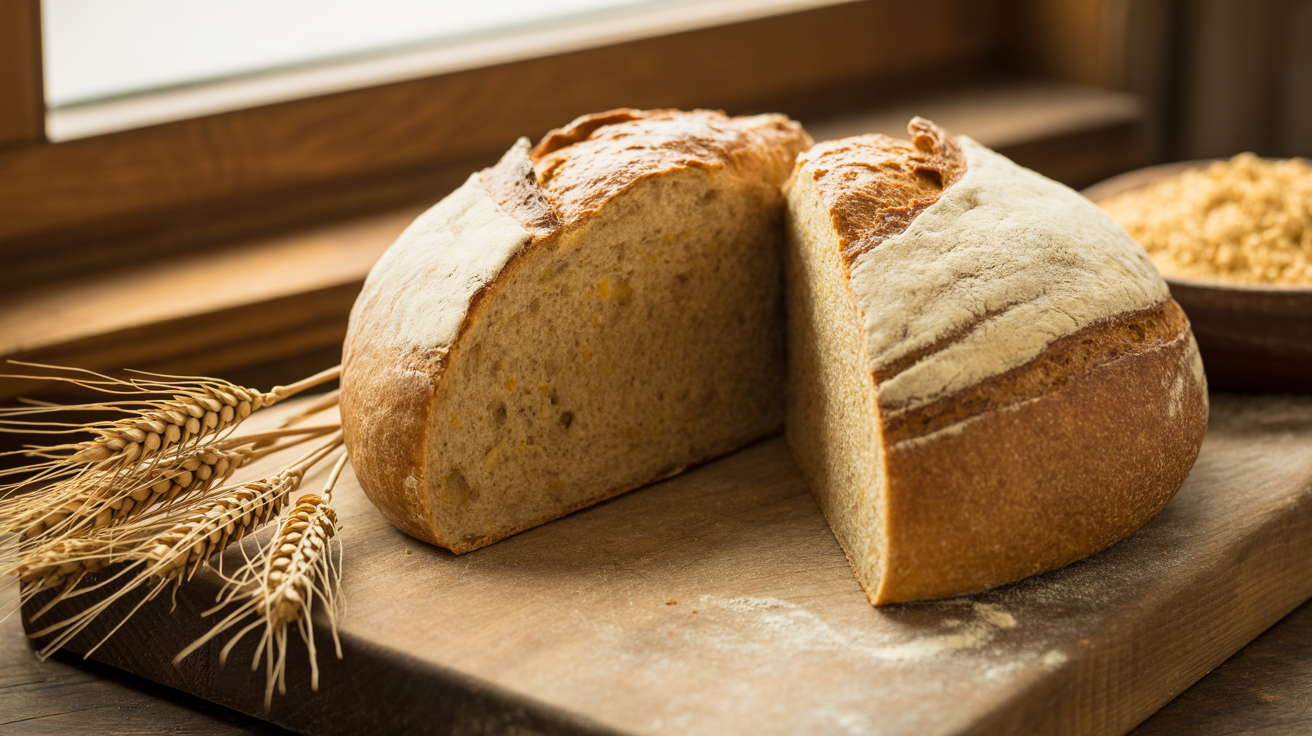
- Beautifully golden-yellow color (natural carotenoids)
- Tender, almost cake-like bite
- Distinctive nutty, honeyed flavor with hints of sweetness
- Better shelf life than modern wheat — stays soft 3–4 days
If you want open crumb with einkorn flavor, use a 25–50% blend with bread flour. The bread flour provides structure; einkorn provides flavor and golden color.
Starter Recommendations for Einkorn
You don’t need a dedicated einkorn starter — a regular bread-flour starter works fine. However:
- Use a stiff starter (1:1:1 or 1:2:2) rather than liquid. Stiff starters produce less acid, which helps einkorn’s fragile gluten. See stiff vs liquid starter.
- Use starter at peak — fully doubled but not past its peak. See 1:1:1 feeding ratio.
- 15–20% starter inoculation is ideal (not the usual 20–25%). See how much starter per loaf.
The 50/50 Recipe That Actually Works
For your first einkorn bake, don’t attempt 100%. Try this:
- 250g einkorn flour (50%)
- 250g strong bread flour (50%)
- 350g water (70% hydration)
- 100g active starter (20% inoculation)
- 10g salt (2%)
Process:
- Mix flour and water, rest 30 minutes (autolyse).
- Add starter and salt. Mix gently for 2 minutes — no slapping.
- One set of stretch-and-folds at 30 minutes.
- Bulk ferment 4 hours at 24°C / 75°F.
- Gentle pre-shape, rest 20 minutes.
- Final shape, into banneton.
- Cold retard 12 hours.
- Bake in Dutch oven at 240°C / 465°F, 20 min covered, 20 min uncovered.
Use our ratio calculator to scale this recipe for any target dough weight.
100% Einkorn: For the Committed
Once you’ve made a successful 50/50 einkorn loaf, attempting 100% einkorn is the natural next step. Key adjustments:
- Drop hydration to 60–63%
- Skip stretch-and-folds entirely — just do an initial mix and let it rest
- Use pan-baking rather than free-form boule
- Shorter bulk: about 3 hours at 24°C / 75°F
- Shorter final proof: 1 hour at room temp, then into the oven (no cold retard needed)
The result is dense, moist, deeply flavored sandwich-style bread — not an artisan boule.
Common Einkorn Mistakes
1. Using bread flour hydration. 75% hydration einkorn dough is a disaster. Start at 65% and adjust from there.
2. Overworking the dough. Each stretch-and-fold damages einkorn gluten. Less is more.
3. Following bread flour fermentation times. You’ll overproof. Watch the dough, not the clock.
4. Expecting open crumb. Einkorn crumb is naturally tighter. Celebrate tender rather than airy.
5. Shaping aggressively. Tight boule shaping destroys einkorn structure. Go gentle.
Why Einkorn Is Worth It
Despite the technical demands, einkorn rewards you with:
- Unmatched nutty, honey-sweet flavor
- Stunning golden-yellow crumb
- Better digestibility for many people
- Higher protein and mineral content
- Connection to a 10,000-year-old grain tradition
Einkorn is the bread you make when you want something truly different — not just a modern wheat sourdough with a slightly different flavor. Embrace the rules that apply, and you’ll bake one of the most memorable loaves of your life.
For other alternative grains, see spelt sourdough hydration.