How Much Sourdough Starter Do I Need Per Loaf? (10% / 20% / 30%)
The Short Answer
Most single-loaf sourdough recipes use 20% starter relative to flour weight. For a typical 1000 g dough with 600 g flour, that means 120 g of active starter. This gives you a 4–6 hour bulk fermentation at 76°F with balanced flavour — the sweet spot for most home bakers.
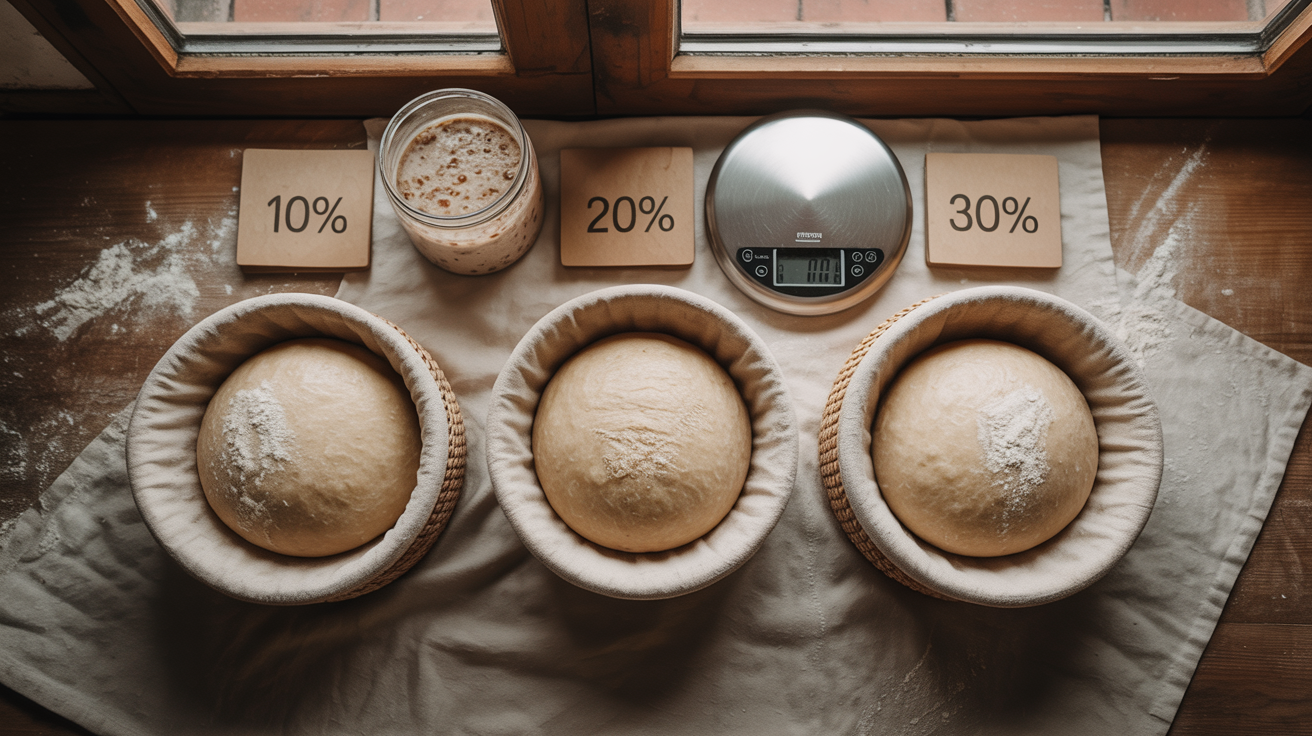
But 20% is just the default. Shift to 10% or 30% depending on your schedule and how much tang you want. Below is the complete decision tree plus the math for any loaf size.
Why Starter Is Measured as a Percentage
Baker’s percentages express every ingredient relative to flour weight. Flour = 100%, everything else scales from there. Starter percentage tells the yeast population how much “head start” the dough has:
- More starter = more microbes, faster rise, milder flavour (less time for acids to develop).
- Less starter = fewer microbes, slower rise, deeper flavour (more time for acids to develop).
If this terminology is new, start with our baker’s percentage guide and sourdough starter ratio overviews.
The Three Standard Ratios
10% Starter — Slow and Deep
- Bulk time at 76°F: 10–12 hours
- Flavour: tangiest, most complex
- Schedule: mix at 8 PM, bulk overnight, shape in the morning
- Oven spring: excellent if managed well; risk of over-fermentation if bulk goes too long
Use 10% when you want the classic country-loaf flavour with a deep crust and complex acidity. It is also the default for bakers who prefer overnight bulk followed by a cold retard.
20% Starter — The Everyday Default
- Bulk time at 76°F: 4–6 hours
- Flavour: balanced — enough tang, not harsh
- Schedule: mix after breakfast, bulk through the afternoon, bake in the evening
- Oven spring: consistently strong; most forgiving for beginners
This is the percentage in most published sourdough recipes including Tartine-style country loaves. Dials in well at temperatures from 70–78°F without adjustment.
30% Starter — Fast and Mild
- Bulk time at 76°F: 2.5–3.5 hours
- Flavour: mild, sweet-wheat forward, minimal tang
- Schedule: mix after lunch, bulk to dinner, bake same evening
- Oven spring: good but less dramatic; tighter crumb structure
Use 30% when you are short on time or baking enriched loaves (brioche, milk bread) where you want leavening without much sourness. Also common in pizza dough and focaccia.
The Complete Starter-Per-Loaf Table
If your recipe specifies total flour, here is how much starter to use. (All numbers assume a 100% hydration starter.)
| Flour | 10% | 15% | 20% | 25% | 30% |
|---|---|---|---|---|---|
| 300 g | 30 g | 45 g | 60 g | 75 g | 90 g |
| 400 g | 40 g | 60 g | 80 g | 100 g | 120 g |
| 500 g | 50 g | 75 g | 100 g | 125 g | 150 g |
| 600 g | 60 g | 90 g | 120 g | 150 g | 180 g |
| 800 g | 80 g | 120 g | 160 g | 200 g | 240 g |
| 1000 g | 100 g | 150 g | 200 g | 250 g | 300 g |
How Temperature Shifts the Math
Fermentation roughly doubles for every 10°C (18°F) rise in dough temperature. That means the same starter percentage leads to very different bulk times:
| Dough temp | 10% bulk | 20% bulk | 30% bulk |
|---|---|---|---|
| 68°F / 20°C | 14–16 hours | 7–9 hours | 4–6 hours |
| 72°F / 22°C | 12–14 hours | 6–8 hours | 3.5–5 hours |
| 76°F / 24°C | 10–12 hours | 4–6 hours | 2.5–3.5 hours |
| 80°F / 27°C | 8–10 hours | 3–5 hours | 2–3 hours |
If you target specific temps, see our desired dough temperature guide.
Worked Examples
Example 1: Weekday Country Loaf
- Flour: 500 g bread flour
- Hydration: 75%
- Salt: 2% (10 g)
- Starter: 20% = 100 g
- Water: 500 × 0.75 − 50 (flour-half of starter) = 325 g
- Bulk at 76°F: 4–5 hours
Example 2: Overnight Cold-Retard Loaf
- Flour: 500 g (400 g bread + 100 g whole wheat)
- Hydration: 78%
- Salt: 2% (10 g)
- Starter: 10% = 50 g
- Water: 500 × 0.78 − 25 = 365 g
- Mix 8 PM, bulk until 9 AM (72°F), shape, retard in fridge, bake next evening.
Example 3: Pizza Dough (Friday Night)
- Flour: 400 g 00-style pizza flour
- Hydration: 65%
- Salt: 2.5% (10 g)
- Starter: 30% = 120 g
- Water: 400 × 0.65 − 60 = 200 g
- Mix 2 PM, bulk until 5:30 PM, shape into balls, short proof, bake.
Adjusting Starter to Fit Your Schedule
Instead of letting bulk time dictate your evening, work backwards from when you need the dough ready:
- Decide your bake time.
- Subtract 30–45 minutes for shaping + final proof (or 12–24 hours if cold-retarding).
- Subtract the bulk time you want.
- Pick the starter percentage that gives you that bulk duration at your dough temperature.
Example: you want to bake at 6 PM. Final proof: 45 min → 5:15 PM shaping. You want to mix at 10 AM, so bulk = 7h 15m. At 72°F that maps to roughly 18–22% starter. Round to 20%.
Common Mistakes
- Calculating starter as a percentage of dough weight, not flour weight. It is always flour-based. Double-check with the ratio calculator.
- Using a sluggish or fridge-cold starter at 10%. 10% assumes a vigorous, peaked starter. If yours is weak or cold, start at 15–20%.
- Adding 30% starter without shortening bulk time. You will over-ferment. Set a kitchen timer or use an aliquot jar.
- Forgetting the starter contributes flour and water. 100 g of 100% starter = 50 g flour + 50 g water. The calculator accounts for this automatically.
Frequently Asked Questions
Is 40% or 50% starter ever appropriate?
Yes — for very fast, mild doughs (thin-crust pizza, same-day focaccia) or commercial production where oven time is the bottleneck. Bulk will finish in 90–120 minutes at room temp. Flavour will be noticeably mild.
Can I use less than 10%?
You can go as low as 5% with a strong, peaked starter — bulk will take 16–20 hours at 72°F. This is the territory of classic Italian biga and poolish preferments. Works beautifully for crusty boules if you can manage the long timing.
Does starter hydration matter?
Yes. The tables above assume 100% hydration (liquid) starter. If you use a stiff starter (50% hydration), you deliver less water to the dough, so raise dough water by ~5–8%. See our stiff vs liquid comparison.
What about levain versus starter?
A levain is just a portion of starter fed specifically for one bake. Percentages in this guide apply to whatever ripe sourdough culture (starter or levain) goes into your dough.
Next Steps
Plug your numbers into the sourdough ratio calculator — it handles the starter/flour/water math automatically. If you want to dial your fermentation schedule tighter, pair this with the bulk fermentation timing guide.