Whole Wheat Sourdough Ratios: The Right Blend for Every Purpose
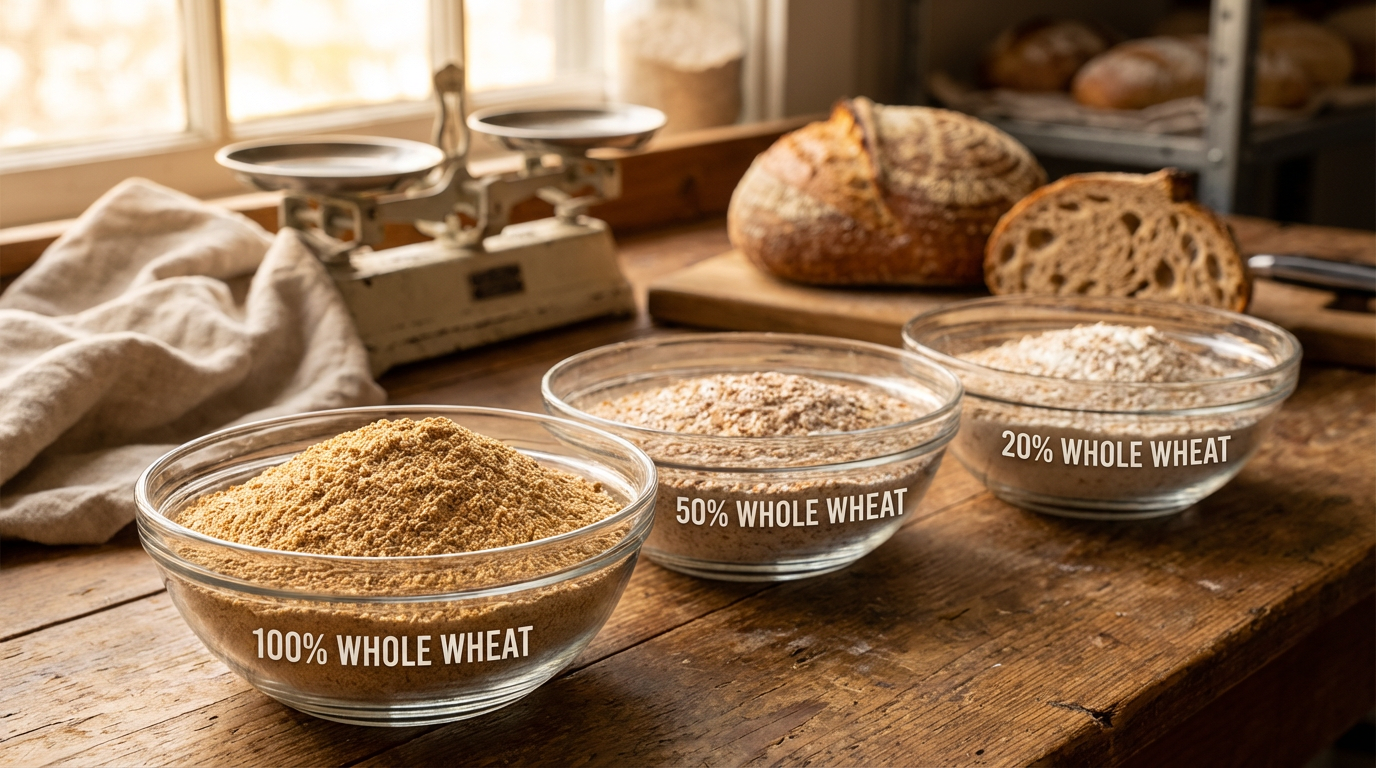
Whole wheat sourdough isn’t a single bread — it’s a family of breads defined by ratio. 10% whole wheat is a white loaf with more flavor. 50% whole wheat is a hearty country loaf. 100% whole wheat is a dense, nutritious, entirely different baking challenge. Each ratio demands different hydration, handling, and fermentation timing.
This guide breaks down what each whole wheat percentage actually delivers, when to use which, and how to adjust your recipe. Plug your numbers into the sourdough ratio calculator to get exact gram weights, then use these guidelines to tune the rest.
Why Whole Wheat Behaves Differently
Whole wheat flour contains the germ, bran, and endosperm — not just the endosperm like white flour. This changes three key things:
- Higher water absorption. The bran is fibrous and hydrophilic. Whole wheat absorbs 5–10% more water than white bread flour at the same weight.
- Weaker gluten network. Bran physically cuts gluten strands like tiny shards. More whole wheat = weaker structure = tighter crumb.
- Faster fermentation. The germ is full of natural yeasts, enzymes, and nutrients that jump-start fermentation. Expect 15–30% shorter bulk.
These three factors scale with whole wheat percentage, which is why the recipe needs to change as the ratio goes up.
10% Whole Wheat: The Flavor Boost
Best for: First whole wheat bake, daily-bake white sourdough with added flavor.
Recipe profile: 90% bread flour + 10% whole wheat, 75% hydration, standard timing.
At 10%, whole wheat is invisible technically — the dough handles identically to all-white. You don’t need to adjust hydration (75% still works), fermentation timing, or shaping. But the flavor jumps noticeably: nuttier, deeper, less flat than pure white.
Benefits at 10%:
- Noticeably deeper flavor without technical complexity
- Slightly better shelf life (whole wheat adds moisture)
- Small nutrition uplift: more fiber and micronutrients
- Crumb remains fully open
For beginners who want whole wheat character without risk: start at 10%.
20% Whole Wheat: The Everyday Sweet Spot
Best for: Regular-rotation country loaves with meaningful whole grain flavor.
Recipe profile: 80% bread flour + 20% whole wheat, 76–78% hydration, slightly shortened bulk.
This is arguably the most popular ratio for serious home bakers. It delivers clear whole wheat flavor and color without compromising on open crumb or handling much. The classic Tartine country loaf uses roughly this ratio.
What’s different from 10%:
- Hydration nudges up to 76–78%
- Dough slightly stickier during stretch-and-folds
- Bulk fermentation 10–15% shorter
- Slightly more tender crumb, still open
- Distinctly nutty, complex flavor
This is where most professional bakers land for their standard country loaf.
30% Whole Wheat: The Classic Country Loaf
Best for: Hearty artisan loaves, pronounced whole wheat flavor with open crumb still possible.
Recipe profile: 70% bread flour + 30% whole wheat, 78–80% hydration, bulk shortened ~20%.
At 30%, whole wheat becomes a defining feature rather than an accent. This is classic “country loaf” territory — the kind of bread you see in artisan bakeries labeled “pain de campagne” or similar.
Adjustments:
- Hydration at 78–80% — noticeably wetter dough
- Stretch-and-folds need confident hands
- Bulk about 20% faster than all-white
- Crumb still open but cells slightly tighter
- Deep, complex, nutty flavor — the whole wheat is fully present
Tip: use a strong bread flour (12.7%+ protein) for the white portion. Whole wheat taxes your gluten, so you want maximum strength from the wheat you do use.
50% Whole Wheat: The Dense Heartier Loaf
Best for: Rustic rural-style breads, sandwich loaves with heavy whole-grain character.
Recipe profile: 50% bread flour + 50% whole wheat, 80–82% hydration, shorter bulk, often pan-baked.
At 50/50, the crumb noticeably closes up and the dough becomes trickier to shape freeform. Many bakers switch to a loaf pan here for sandwich use, though a well-shaped boule is still achievable.
What changes at 50%:
- Hydration 80–82% (minimum)
- Dough very sticky during mixing; use wet hands for stretch-and-folds
- Bulk fermentation 25% faster than all-white
- Crumb moderately open but clearly denser than 30%
- Strong nutty, earthy flavor dominant
- Keeps 4–5 days compared to 2–3 for all-white
Consider using a small percentage of rye (say 5–10% of total flour) to add flavor complexity and improve extensibility.
100% Whole Wheat: A Different Bread
Best for: Maximum nutrition, dense nutritious loaves, sandwich pan bread for whole-grain devotees.
Recipe profile: 100% whole wheat, 85–90% hydration, extended autolyse, gentle handling, pan-baked.
100% whole wheat sourdough is a fundamentally different bread — denser by nature, with its own handling logic. Expect:
- Hydration 85–90% (counterintuitive — you need the water)
- Extended autolyse: 60–90 minutes minimum to soften the bran
- Gentle mixing — aggressive mixing shreds gluten strands on the bran
- Short bulk: 3–4 hours at 24°C / 75°F
- Shape gently — the dough can’t take much tension
- Often pan-baked for reliable shape
- Dense, moist, tight crumb — almost cake-like when done well
- Profound nutty, earthy, sweet flavor
Tip: a long autolyse is non-negotiable at 100% whole wheat. The bran needs time to soften and absorb water before you add salt and starter — otherwise you get a tough, dense brick. See autolyse timing guide for details.
The Hydration Cheat Sheet
| Whole wheat % | Hydration target | Crumb | Shaping |
|---|---|---|---|
| 0% | 72–75% | Most open | Free-form boule easy |
| 10% | 75% | Very open | Free-form |
| 20% | 76–78% | Open | Free-form |
| 30% | 78–80% | Open but tighter | Free-form with care |
| 50% | 80–82% | Moderate-tight | Free-form or pan |
| 75% | 83–85% | Tight | Pan recommended |
| 100% | 85–90% | Dense, moist | Pan only |
Use our ratio calculator to translate these percentages into exact flour and water weights for your target loaf size.
Fermentation Timing Adjustments
Whole wheat contains more natural enzymes and yeasts, so fermentation accelerates:
- 10% whole wheat: Same timing as all-white (5 hours bulk at 24°C / 75°F)
- 30% whole wheat: 15–20% faster (about 4 hours)
- 50% whole wheat: 25% faster (3.5 hours)
- 100% whole wheat: 30–40% faster (3–3.5 hours)
Watch the dough, not the clock. Our signs of bulk fermentation done guide shows what to look for.
The Hidden Variables
Fineness of milling: Freshly milled flour absorbs less initially but catches up after longer autolyse. Store-bought whole wheat (finer) absorbs faster.
Red vs white whole wheat: Hard white whole wheat tastes milder, less bitter — good entry point. Hard red is nuttier and more traditional.
Bran size: Coarser bran cuts gluten more aggressively. Look for finely milled whole wheat for better structure.
Blending With Rye or Spelt
Many professional bakers blend whole wheat with small amounts of other grains:
- 25% whole wheat + 5% rye + 70% bread flour: Classic “seeded country loaf” profile with extra flavor depth
- 30% whole wheat + 10% spelt + 60% bread flour: Exceptional flavor, slight extensibility boost from spelt (see spelt hydration)
Common Mistakes
1. Not increasing hydration. 70% hydration with 50% whole wheat gives a dense brick.
2. Overproofing. Whole wheat ferments 20–30% faster — if you use wheat timing, you’ll overshoot.
3. Skipping autolyse. Above 30% whole wheat, autolyse becomes essential. Below that, optional.
4. Expecting identical crumb. Whole wheat closes the crumb — that’s normal. Celebrate density as a feature above 50%.
Final Word
Whole wheat percentage is a dial, not a binary. 20–30% is the sweet spot for most home bakers — real flavor, real nutrition, still open crumb. 50% is the line where crumb structure changes definitively. 100% is a different bread entirely — rewarding, but demands its own technique.
Our ratio calculator makes the math trivial; this guide makes the decision clearer. For detailed hydration math at specific whole wheat percentages, see whole wheat hydration adjustment.