Sourdough Hydration: Bread Flour vs All-Purpose Flour (The 3–5% Rule)
The “Same Recipe, Different Dough” Problem
You follow a sourdough recipe that calls for 500g bread flour at 75% hydration. Perfect crumb. Next week you’re out of bread flour and grab the all-purpose bag. Same 500g, same 375g water, same 75% hydration. And yet — the dough is slacker, stickier, and the final loaf is shorter with a denser crumb.
What happened? The number 75% didn’t change. But the flour did. Here’s why hydration is relative to flour, and exactly how to adjust when you switch.
Why Protein Content Matters
Hydration percentage in baker’s math is just water divided by flour. But flour isn’t a single substance — it’s mostly starch with a smaller fraction of protein (gluten precursors). That protein is what traps water and builds dough structure.
- Bread flour: 12–14% protein. Strong, elastic, high absorption.
- All-purpose flour: 10–12% protein. Moderate, less absorbent.
- Cake / pastry flour: 8–9% protein. Weak, low absorption — unsuitable for sourdough.
Every extra 1% of protein can hold roughly 1.5–2% more water at the same dough feel. That’s why a 75% bread-flour dough feels like a 78–80% AP dough.
Side-by-Side: What Actually Happens at 75%
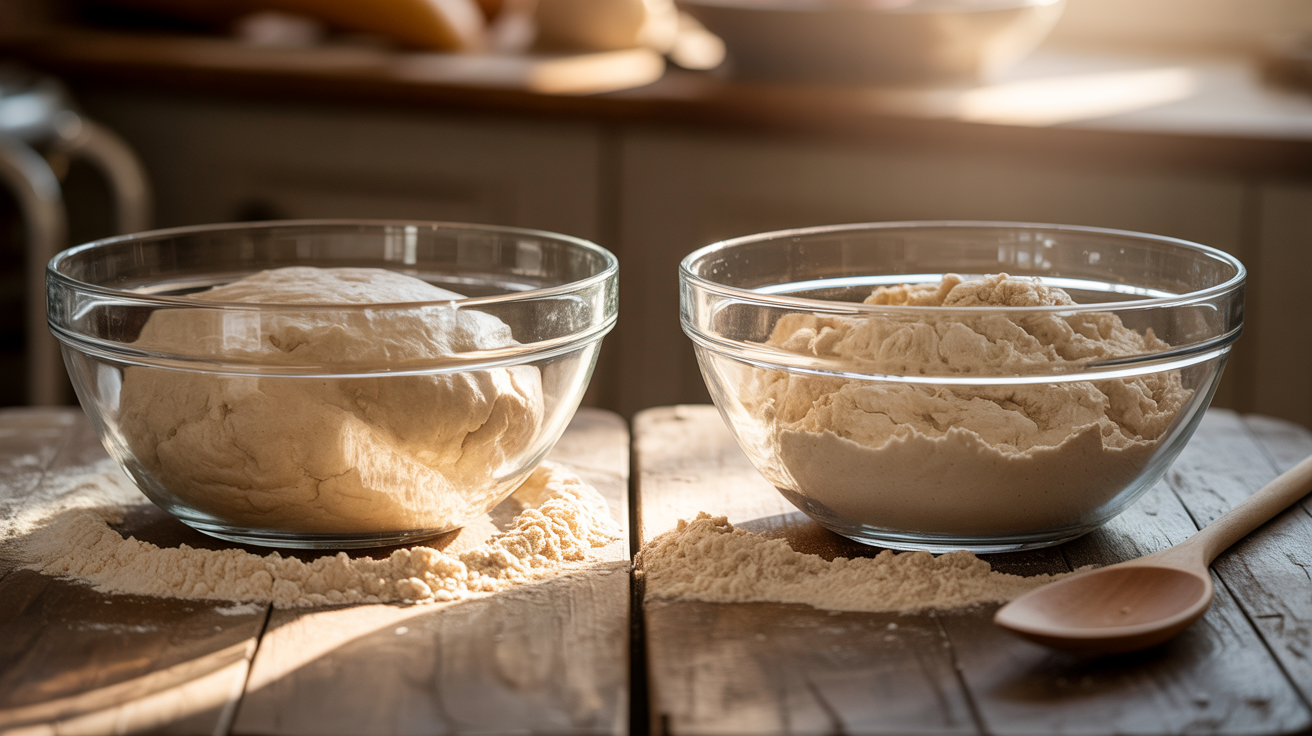
If you mix identical 500g + 375g recipes with bread flour and AP side by side, here’s what you’ll observe at the 45-minute mark:
- Bread flour dough: smooth, cohesive, slightly tacky. Windowpane forms after 2 stretch-folds.
- AP dough: slack, sticky, pools slightly. Windowpane needs 3–4 stretch-folds.
- Bulk ferment: bread flour holds its shape; AP spreads.
- Final loaf: bread flour = taller, open crumb. AP = flatter, tighter crumb.
The recipe percentages are identical. The outcome is not.
How to Convert Recipes (The 3% Rule)
Bread flour → all-purpose
Reduce water by 3% of flour weight to match dough feel. Example:
- Original: 500g bread flour + 375g water (75%)
- Converted: 500g AP + 360g water (72%)
Your dough will feel like the original did — not a 72% dough in bread flour, but a 75% dough in bread flour. The percentage doesn’t capture the feel.
All-purpose → bread flour
Increase water by 3–5%. Example:
- Original: 500g AP + 375g water (75%)
- Converted: 500g bread flour + 390–400g water (78–80%)
Without the bump, your bread flour dough will feel too dry and the crumb will come out tight.
Why You Might Deliberately Choose AP
AP flour isn’t “worse” than bread flour — it’s different. Some breads are actually better with AP:
- Focaccia / ciabatta: the softer, stretchier crumb of lower-protein flour suits these.
- Baguettes: traditional French loaves use medium-protein flour (~11%).
- Pan de cristal / pizza: softer crumb, more open.
See our hydration % explainer for which bread styles pair with which hydration target.
Brand Variability: A Hidden Gotcha
“Bread flour” isn’t standardised. King Arthur bread flour runs about 12.7% protein; Gold Medal bread flour is ~12.5%; Bob’s Red Mill Artisan Bread Flour is ~11.5%. Same label, 1%+ protein difference. That’s enough to change the feel of a 75% dough.
When you switch brands, treat it like a flour change. Test with a 3% lower hydration for the first bake, then adjust.
All-Purpose Hydration Sweet Spots
- 65–68%: sandwich sourdough — easy to shape, soft crumb.
- 70–72%: everyday boule — best all-purpose sweet spot.
- 74–76%: open-crumb artisan — hard without strong gluten; use only with extra autolyse.
Push AP above 75% and you’re fighting the flour. That’s where bread flour is the right tool.
Bread Flour Hydration Sweet Spots
- 68–72%: sandwich loaves with tender crumb.
- 73–78%: standard artisan boule / batard.
- 78–82%: open-crumb “artisan” style with good ear.
- 82–90%: ciabatta, focaccia, rustic wet doughs.
Converting a Recipe — Worked Example
Your favourite recipe calls for 500g bread flour, 375g water, 10g salt, 100g starter. You only have AP. Here’s the conversion:
- Original hydration: 375 ÷ 500 = 75%.
- Target feel: reduce water by 3% of flour → 15g less.
- New recipe: 500g AP + 360g water + 10g salt + 100g starter.
- New calculated hydration: 360 ÷ 500 = 72%.
The dough will behave like the 75% bread flour version did — even though the number says 72%. Use the ratio calculator to convert full recipes in seconds.
FAQ
Can I mix bread flour and AP?
Yes. A 50/50 blend behaves like 11.5–13% protein flour. Target hydration: split the difference (about 73–75%).
What about “high-gluten” or “strong” flour?
High-gluten flour (~14%+) handles 80–85% hydration easily. If you’re converting from bread flour, add another 2–3% water.
Why does my dough feel different even with the same flour brand?
Ambient humidity, flour age, and temperature all change absorption. Older flour absorbs more. Summer-stored flour absorbs less. Adjust by 1–2% as needed.
Does the 3% rule apply to whole wheat too?
No — whole wheat follows a different absorption curve because of bran. See our whole wheat hydration guide.
Next Steps
Know your flour, not just your percentages. When you convert recipes across flour types, use the 3% rule, start conservative, and adjust by feel over 2–3 bakes. Pair this with the hydration math guide and the ratio calculator to make flour swaps without losing your best bake.