Salt Percentage in Sourdough: Why 2% Is the Sweet Spot (and When to Adjust)
Of all the variables in sourdough — flour, water, starter, temperature, time — salt is the one bakers most often get wrong or skip past. People weigh their flour to the gram and then throw in “a teaspoon or so” of whatever salt is on the counter. That teaspoon is, depending on the salt, somewhere between 4 g and 12 g — which in a loaf with 500 g of flour is the difference between 0.8% and 2.4%.
Those two numbers produce completely different bread.
The 2% baseline
Professional bakeries converge on 2.0% salt by flour weight for good reason. At this ratio:
- Fermentation proceeds at a rate that matches typical bulk schedules (4–6 hours at 24°C / 75°F)
- Gluten feels properly taut without being stiff
- Crust browns deeply in a 250°C / 480°F oven
- You taste seasoning, not saltiness
Plug your recipe into our sourdough calculator and you’ll see 2% as the default. That’s not arbitrary — it’s the consensus across King Arthur, Tartine, Poilane, Modernist Bread, and most competitive bakers.
What salt actually does in dough
1. Slows yeast and bacteria
Salt is mildly osmotic — it pulls water out of microbial cells, which slows their metabolism. Yeast and bacteria keep fermenting, but 15–20% more slowly than in unsalted dough. This is a feature, not a bug: it gives you a more predictable timeline and better flavor development.
2. Tightens gluten
Sodium ions strengthen the hydrogen bonds in gluten, making the dough feel less sticky and more elastic. Dough mixed without salt is noticeably looser and tears more easily during folds. Dough with too much salt (over 2.5%) feels tight and resists extensibility.
3. Enhances Maillard browning
In the oven, salt draws moisture to the crust surface, helping those sugars and amino acids brown. Low-salt loaves bake paler at the same temperature and time — which affects perceived flavor as much as the salt taste itself.
4. Balances and amplifies flavor
Bread below 1.7% salt tastes distinctly flat. Not bland — flat, as in the flavors don’t pop. This is the same reason unsalted butter tastes different from “no-salt” butter: the salt isn’t just adding saltiness, it’s sharpening every other flavor molecule.
The 1.8% to 2.2% window — what changes
Most home bakers should stay inside this window. Here’s what moves as you adjust:
| Salt % | Bulk time (24°C) | Crust color | Flavor profile |
|---|---|---|---|
| 1.8% | −5% (faster) | Slightly pale | Mild, slightly flat |
| 2.0% | Baseline | Deep mahogany | Balanced, nutty |
| 2.2% | +5–7% (slower) | Deep but less color | Slight saltiness detectable |
For most recipes, 2.0% is the right call. Adjust if you have a specific reason.
When to adjust down (1.8–1.9%)
- Hot kitchens (28–30°C). Fermentation is already racing — don’t slow it further with extra salt. See our summer fermentation guide for the full adjustment.
- Whole-grain dominant loaves (>50% whole wheat/rye). Whole grains have their own bitterness that 2% salt amplifies. Dropping to 1.8–1.9% keeps the seasoning in balance. Our rye percentages guide covers this for rye-heavy doughs.
- Sweet or enriched doughs with honey, sugar, or fruit. The sweet counterbalances perceived saltiness, so you can pull back.
When to adjust up (2.1–2.2%)
- Cold retard schedules over 36 hours. Long cold holds extract extra sour flavor; a little more salt balances the acidity. Cap at 2.2% — past that you’re in crust-color trouble.
- Very low-hydration doughs (<62%) like bagels or pretzels — the tighter dough tolerates and often needs more salt for flavor contrast.
- Salt-forward regional styles like Pugliese or some Italian ryes. These are stylistic choices; 2.2% is the absolute ceiling for bread that still tastes like bread.
Which salt to use
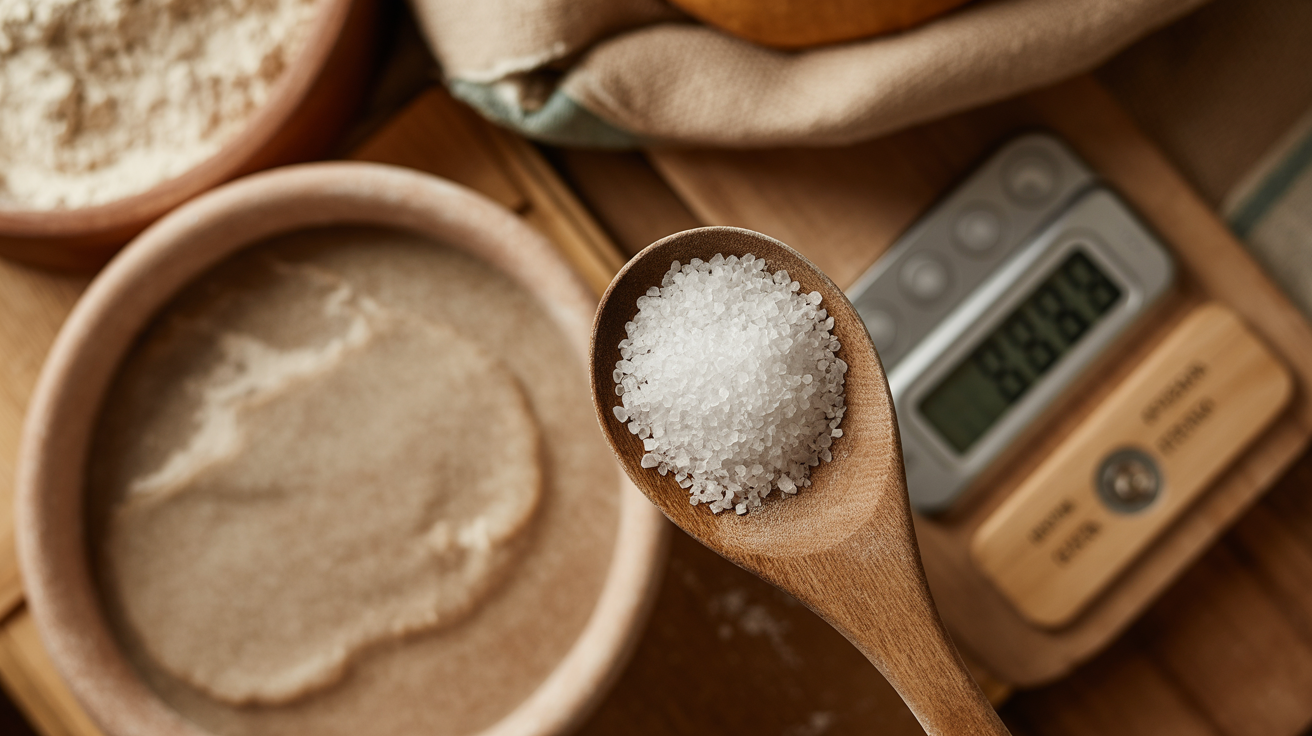
Fine sea salt is the standard. It dissolves quickly, distributes evenly, and tastes clean. Himalayan pink and kosher salt both work fine — just measure by weight, not volume, because their flake sizes differ by 2–3×.
Avoid iodized table salt. Iodine is a mild antimicrobial and in sensitive starters can measurably slow fermentation. The iodine content in modern table salt is low enough that healthy starters shrug it off, but if your starter is struggling or new, swap to non-iodized sea salt as your first intervention.
Avoid fleur de sel or Maldon flakes in the dough. They’re expensive and the flake structure gets lost when mixed. Save finishing salts for the top of focaccia, not for the bulk recipe.
Weighing salt — why volume is dangerous
One level teaspoon of:
- Fine sea salt = ~5.7 g
- Morton kosher = ~4.8 g
- Diamond Crystal kosher = ~2.8 g
- Maldon flakes = ~2.2 g
If a recipe calls for “1 teaspoon of salt” without specifying the type, you’re in trouble. Weight is the only reliable unit. Our scale guide recommends models accurate to 0.1 g for exactly this reason.
When to add salt
Add salt when you mix in your starter — or 30 minutes after autolyse if you’re autolysing flour and water separately. Sprinkle it over the top, add a small splash of reserved water if needed, and pinch it through.
Old advice said to keep salt away from starter to avoid inhibiting it. This mostly doesn’t matter at 2% — the starter is surrounded by 99%+ non-salty dough. What does matter: don’t add salt last-minute before shaping. Gluten needs to reform around the salt during bulk; late additions produce rubbery patches.
The quick rule
2.0% salt, weighed, fine sea salt, added with the starter. Adjust up 0.1–0.2% for long retards, down 0.1–0.2% for hot kitchens or whole-grain loaves. Never guess, never measure by volume, never use iodized table salt.
Nail salt and you remove one of the top three variables that cause inconsistent loaves. It’s the easiest win in the whole process.