Best Kitchen Scale for Sourdough: What Actually Matters (2026 Guide)
A kitchen scale is the single most important tool in sourdough baking. Measuring cups introduce 10–15% error — enough to turn a 75% hydration recipe into an 80% hydration mess. Once you weigh, you never go back. But not all scales are created equal: many are too imprecise for sourdough, many are too small to weigh a full dough bowl, and many are loaded with features you’ll never use.
This guide strips it to what actually matters. Three specs, four scale recommendations, and one optional upgrade for the obsessed. Once you’ve weighed your flour precisely, our sourdough ratio calculator turns those numbers into a complete recipe.
Three Specs That Actually Matter
1. Precision: 1g Minimum
Sourdough recipes are often measured to the gram, especially for salt and starter. A scale that rounds to 5g introduces compounding error:
- A recipe calling for 10g salt could read anywhere from 5g to 15g on a 5g-precision scale
- Starter at 50g could actually be 45–55g, shifting your inoculation ratio
- Water at 350g could be 345–355g, shifting hydration by 1–2%
Cumulatively, a 5g-precision scale can push a 75% hydration recipe up to 78% without you knowing. 1g precision eliminates this problem. You don’t need 0.1g (unless you’re obsessive about starter feedings).
2. Capacity: 5kg Minimum
You need to weigh the flour in a mixing bowl — not on a tiny platform. A typical sourdough bake:
- Mixing bowl: 500g–1kg empty weight
- Flour: 500g–1.5kg depending on loaf size
- Water: 400g–1.2kg
- Total dough in bowl: can easily hit 3–4kg
A scale with a 2kg max capacity will show “error” once you start adding water. 5kg minimum is safe. 11lb (about 5kg) is standard for a reason.
3. Tare Function That Works Reliably
Every serious sourdough bake uses tare 20–30 times:
- Zero the scale with empty bowl
- Add flour → tare
- Add water → tare
- Add starter → tare
- Add salt → ready to mix
If the tare button is sluggish, miscalibrates, or drifts, the whole process falls apart. Test it in-store if possible, or read reviews carefully. Most name-brand scales do this well; bargain-bin scales often don’t.
What You Don’t Need
Scale marketing pushes many features that are irrelevant for sourdough:
- 0.01g precision: Useful for jewelry, overkill for bread.
- Smart/app-connected scales: Another thing to charge and pair. No recipe benefit.
- Nutrition calculation: Useless for sourdough.
- Voice activation: Gimmick.
- Percentage mode: Sounds useful, rarely worth learning a separate menu. The calculator handles baker’s percentages better.
- Built-in timer: Your phone already has one.
Pay for precision and reliability, not features.
Top Picks
Best Overall: Escali Primo (P115)
Why: The sourdough community’s default recommendation for good reason.
- Precision: 1g
- Capacity: 11lb (5kg)
- Tare: Reliable, responsive
- Platform: Flat top, easy to fit any mixing bowl
- Display: Backlit, readable at all angles
- Auto-off: Disabled, so it won’t shut off mid-weigh
- Price: $25–$30
The Escali Primo is simple, durable, reliable. It’s what most professional bakers recommend and what sourdough Instagram uses. No frills, just works.
Best Budget: Etekcity EK6015
Why: Excellent specs at half the price.
- Precision: 1g
- Capacity: 11lb (5kg)
- Tare: Reliable
- Platform: Flat glass top
- Display: Basic but clear
- Price: $12–$18
If you’re starting out and want to keep costs low, the Etekcity is remarkably capable. The only knock is build quality — it feels cheaper than the Escali but functions almost identically.
Best Upgrade: OXO Good Grips 11lb Digital Scale
Why: Build quality and ergonomics for bakers who’ll use this daily.
- Precision: 1g
- Capacity: 11lb (5kg)
- Pull-out display: Slides forward so you can read it under bowls
- Removable platform: Easy to clean
- Backlit display, long battery life
- Price: $50–$60
The pull-out display is genuinely useful when you’re weighing in a large bowl that would otherwise block the readout. If you’re baking 2–3 times a week and can afford the upgrade, worth it.
Best for Advanced Bakers: MyWeigh KD-8000
Why: Baker’s percentage mode for those who want it.
- Precision: 1g
- Capacity: 17.6lb (8kg)
- Baker’s percentage mode: Built-in
- Protein/hydration calculations
- Durable, industrial build
- Price: $50–$75
The KD-8000 is overkill for most home bakers but beloved by enthusiasts who like doing baker’s percentage math on the scale itself. Higher capacity (8kg) helps with double-recipe bakes.
The Pocket Scale Upgrade (Optional)
For starter feedings specifically, many bakers keep a small 0.1g pocket scale on the counter. Why:
- Starter feedings often use small amounts (25g starter, 25g water, 25g flour — a 1:1:1 ratio)
- A 1g scale rounds these, causing drift over many feedings
- 0.1g precision keeps ratios exact
A pocket scale costs $10–$20 and lives next to your starter jar. Models like the American Weigh Scales AWS-100 or Smart Weigh Pocket Scale work well. Capacity is usually 100–500g — plenty for starter feedings but not the main dough.
Using Your Scale: Sourdough Workflow
Once you have the right scale, the workflow looks like this:
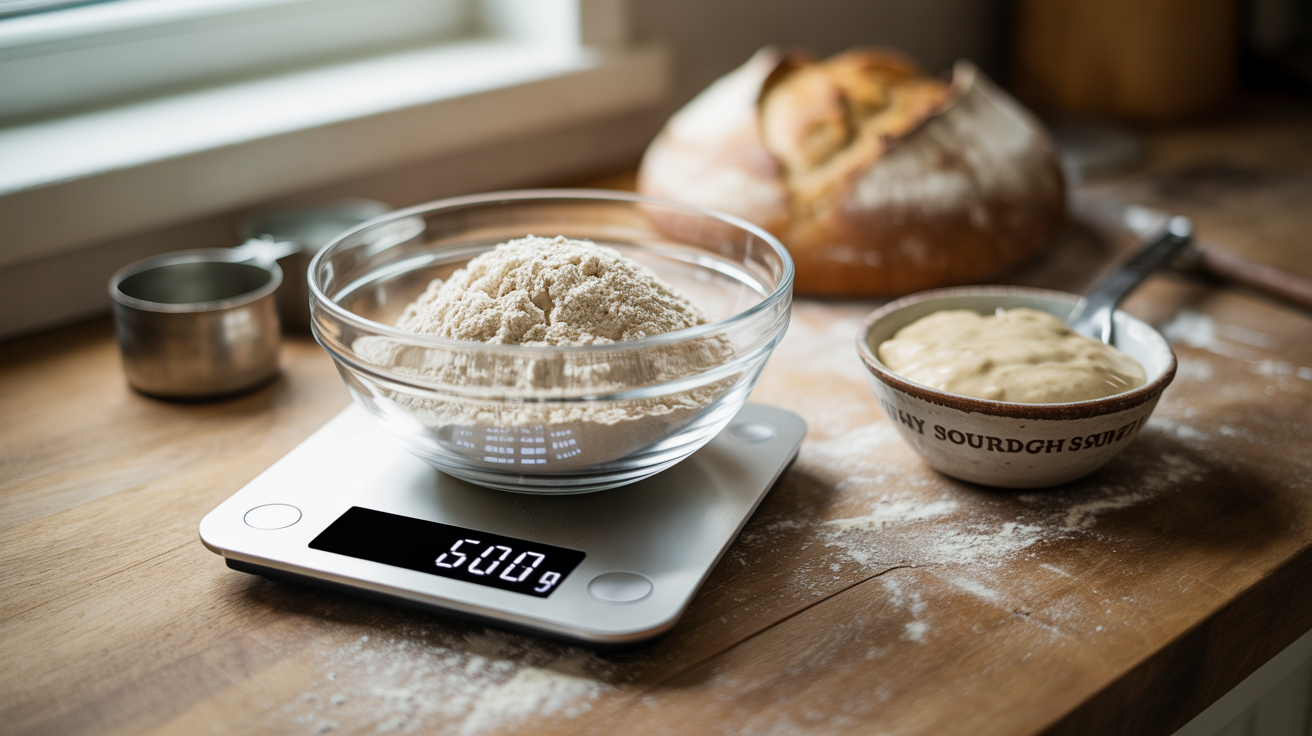
- Place empty mixing bowl on scale. Press tare to zero.
- Add flour until display reads target (e.g., 500g). Press tare again.
- Pour in water until display reads target (e.g., 375g for 75% hydration). Press tare.
- Scoop starter until display reads target (e.g., 100g). Press tare.
- Sprinkle salt until display reads target (e.g., 10g).
- Mix.
No measuring cups, no multiple bowls, no math. This is why weighing wins.
Scale Maintenance and Troubleshooting
- Replace batteries when the display flickers. Low batteries cause drift before the warning appears.
- Calibrate quarterly if your scale supports it. Use a known weight (a can of beans labeled 454g works in a pinch).
- Clean the platform daily. Dried flour under the platform messes with the sensor.
- Keep on a flat, solid surface. Uneven counters throw off readings.
- Replace every 2–4 years. Load cells drift over time, especially with heavy daily use.
Can You Use a Smart Scale or Coffee Scale?
Smart scales: Mostly unnecessary. The Apple Watch-connected scale doesn’t weigh more accurately than a $25 scale. Skip.
Coffee scales (Acaia Pearl, Hario V60): These are 0.1g precision but usually capped at 2kg, too small for full sourdough bowls. Great for starter feedings, useless for main dough.
Stick to kitchen-scale specifications: 1g precision, 5kg capacity, reliable tare.
Investment vs. Return
A $30 scale lasts 2–4 years of daily use. Over those years, it enables:
- Hundreds of successful sourdough bakes
- Accurate recipe scaling (see double sourdough recipe)
- Confident hydration math (see convert 65 to 75 hydration)
- Reliable starter management
$30 for 1,000+ loaves of better bread. Best investment in your baking kit.
Final Word
Don’t overcomplicate this. Buy an Escali Primo, Etekcity EK6015, or OXO Good Grips scale. Skip smart features. Add a pocket scale if you feed starter daily. Use our calculator for the math, and let your scale handle the measurements. That’s the complete setup.
For temperature precision (the other pillar of sourdough math), see thermometer and desired dough temperature.