Desired Dough Temperature (DDT) Explained: The Math Pros Actually Use
Why does your sourdough ferment faster on some days than others? Room temperature drifts, flour temperature changes with seasons, cold water from the tap in winter, warm water in summer. All these variables converge on one number: the temperature of your dough after mixing. Master that number, and every bake becomes predictable.
Professional bakers call this Desired Dough Temperature (DDT) and use a simple formula to nail it every time. This guide walks you through the math, the tools, and how to apply DDT to home sourdough. Once your dough temperature is consistent, our sourdough ratio calculator becomes even more powerful because your timing becomes predictable.
Why Dough Temperature Matters
Sourdough fermentation is an enzymatic process, and enzymes respond exponentially to temperature. A few degrees transform your timing:
- 22°C / 72°F dough: Bulk takes 6–7 hours
- 24°C / 75°F dough: Bulk takes 5 hours
- 26°C / 78°F dough: Bulk takes 4 hours
- 28°C / 82°F dough: Bulk takes 3 hours
If your dough is 22°C when you expected 26°C, you’ll underproof it. If it’s 28°C when you expected 24°C, you’ll overshoot and collapse. DDT eliminates this variability.
The DDT Formula
For hand-mixed sourdough:
Water Temp = (DDT × 3) − (Flour Temp + Room Temp + Friction Factor)
Where:
- DDT: Your target dough temperature (usually 24–26°C / 75–78°F for sourdough)
- Flour Temp: Temperature of your flour (probably same as room temp if it’s in a bin on the counter)
- Room Temp: Ambient kitchen temperature
- Friction Factor: Heat added by mixing. For hand-mixed sourdough, 0. For a stand mixer, 2–5°C depending on mix time.
A Worked Example
It’s a cool spring evening. Your kitchen is 20°C / 68°F. Flour is stored in the kitchen, so flour temp is also 20°C. You want a DDT of 25°C / 77°F for a standard 5-hour bulk.
Plug into the formula:
Water Temp = (25 × 3) − (20 + 20 + 0) = 75 − 40 = 35°C / 95°F
So: heat your water to 35°C / 95°F before mixing. Without this calculation, you’d use tap water at maybe 15°C — giving you a 20°C dough and a bulk ferment that takes 7 hours instead of 5.
Summer Example
Hot July afternoon, kitchen at 28°C / 82°F, flour at 28°C, same DDT target of 25°C.
Water Temp = (25 × 3) − (28 + 28 + 0) = 75 − 56 = 19°C / 66°F
Use ice water (or refrigerated water) to cool the mix. Without this, a summer kitchen gives you 28°C+ dough that overproofs in 3 hours.
For more on summer vs winter timing, see bulk fermentation summer vs winter.
Where to Measure
Three thermometer readings drive DDT math:
- Flour Temperature: Insert thermometer into the flour in its bin. Wait 30 seconds for a stable reading.
- Room Temperature: Kitchen thermostat is fine, or a thermometer on the counter.
- Water Temperature: The number you’re controlling. Set your tap/kettle to this.
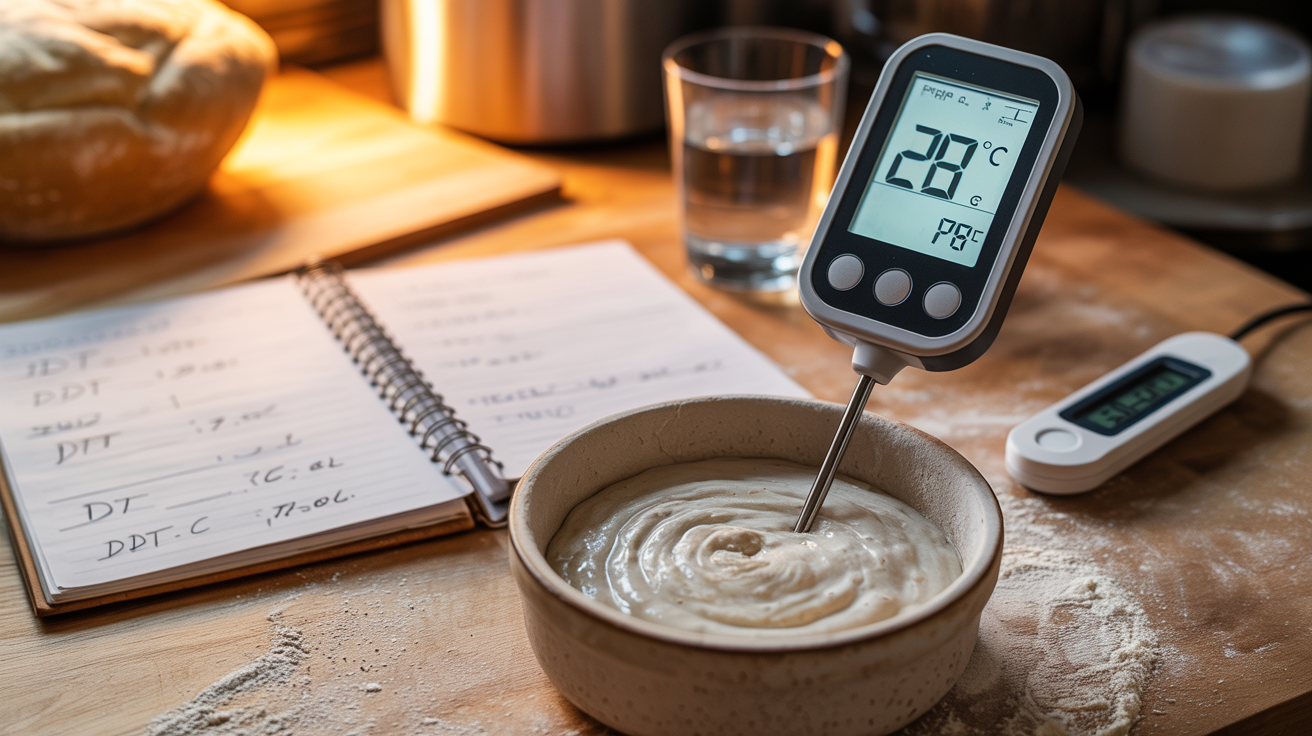
After mixing, measure the dough temperature to verify you hit DDT. If you’re off, adjust next time (add or subtract from water temp).
The Thermometer You Need
An instant-read digital thermometer is the standard. Look for:
- Read time: 3–6 seconds (not 30)
- Precision: ±0.5°C or better
- Probe length: 10–15cm for easy insertion
- Auto-off: Saves battery
Top picks:
- ThermoWorks ThermoPop ($35): The home-baker standard. Fast, accurate, durable.
- ThermoWorks Thermapen One ($105): Professional grade. Overkill for most but beloved by enthusiasts.
- Escali DH3 ($20): Budget option. Good accuracy, slower read time.
- Inkbird IHT-1P ($25): Cheaper alternative, decent quality.
Avoid strip thermometers (stickers on the side of a container). They respond too slowly and give inaccurate readings.
Friction Factor: Do You Care?
Friction factor is the heat your mixing method adds to the dough. For sourdough:
- Hand mixing / slap-and-fold: Friction factor ≈ 0–2°C. Usually ignored.
- Stand mixer, low speed, 5 min: Friction factor ≈ 2–3°C.
- Stand mixer, medium speed, 10+ min: Friction factor ≈ 4–6°C.
- Commercial spiral mixer: 5–8°C (bakery math).
For home sourdough, set friction factor to 0 to start. If your dough is consistently 2°C warmer than DDT, bump friction factor to 2°C next time and recalculate.
DDT in Practice: The Checklist
Before you mix:
- Measure room temp.
- Measure flour temp.
- Pick DDT target (typically 25°C for standard 5-hour bulk).
- Apply formula → get water temp.
- Heat (or chill) water to target temp.
- Mix.
- Measure dough temp immediately after mix to verify.
After a few bakes, you’ll internalize typical water temps for your kitchen and season.
DDT and Starter Math
Note: starter temperature also matters but is usually close to room temp. If your starter is refrigerator-cold when mixing, adjust the formula:
Extended formula (4-factor): Water Temp = (DDT × 4) − (Flour + Room + Starter + Friction)
But in practice, if you take your starter out 2–3 hours before mixing (which you should for an active feed, see how much starter per loaf), starter temp converges with room temp and the 3-factor formula works fine.
Choosing the Right DDT for Your Goal
DDT isn’t always 25°C. Adjust based on your schedule and recipe:
| DDT Target | Bulk time at this temp | Use case |
|---|---|---|
| 22°C / 72°F | 7–8 hours | Overnight bulk ferment |
| 24°C / 75°F | 5–6 hours | Standard daytime bake |
| 26°C / 78°F | 4–5 hours | Faster bulk, same-day bake |
| 28°C / 82°F | 3–4 hours | Rushed bake (not recommended for flavor) |
Match DDT to your schedule and the flavor you want (slower bulk = more flavor). See also overnight bulk fermentation.
Common DDT Mistakes
1. Forgetting to measure flour temp. Assuming it equals room temp — usually true, but not when flour is in a cold pantry.
2. Ignoring seasonality. Winter tap water is 5–10°C; summer tap water is 15–20°C. DDT math adjusts for this automatically.
3. Measuring dough temp 30 minutes after mix. Always measure immediately after mixing. The temp drifts toward room temp quickly.
4. Heating water to scalding. If DDT math says you need 40°C+ water, you might want to reconsider your DDT target. Very hot water stresses starter and can weaken gluten.
DDT Works Without Math: Thermal Intuition
After 20–30 bakes using DDT math, you’ll internalize patterns:
- “On a cool morning, I use lukewarm water”
- “On a hot day, I use ice water”
- “Overnight bulk needs cool water and a cool kitchen”
But the math gets you there faster. Beginners should calculate every time; experienced bakers check the thermometer and adjust by intuition.
Final Word
DDT is the single biggest technique for making your sourdough consistent. A $30 thermometer + 30 seconds of math transforms your baking from “why was today different?” to “exactly like last time.” Combined with a good scale (see best kitchen scale), you’ve got the two essential tools for precision sourdough.
Our ratio calculator handles the flour/water math; DDT handles the thermal math. Together, they’re your complete precision toolkit.