Banneton Sizing Guide: Match the Basket to Your Dough Weight
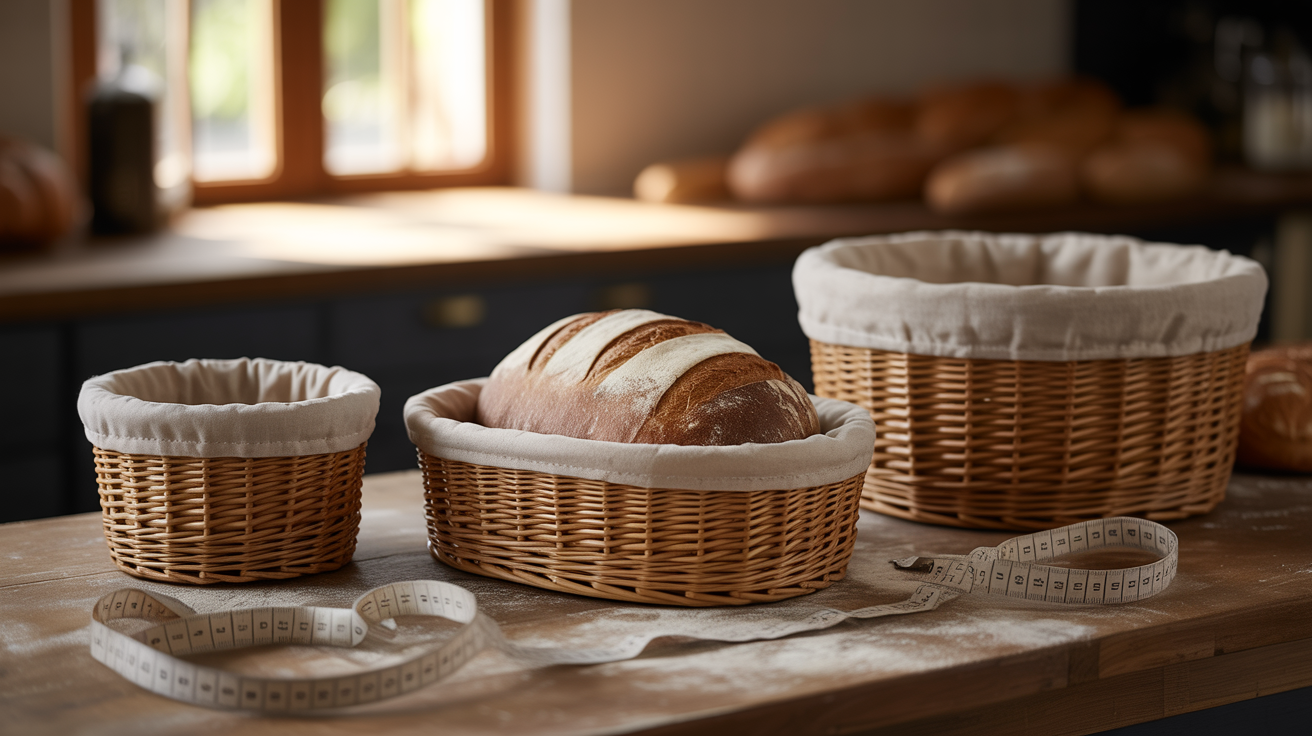
The #1 reason sourdough loaves come out flat or misshapen isn’t shaping — it’s wrong banneton sizing. An oversized banneton lets the dough spread outward instead of holding its shape during proof; an undersized one overflows and sticks. Neither gives you the tall, domed boule you see on Instagram.
This guide tells you exactly which banneton size matches your dough weight, and how to build a minimal two-basket setup that handles 90% of home baking. Use our sourdough ratio calculator to calculate total dough weight, then match it to a banneton using the tables below.
Dough Weight vs Flour Weight: What Actually Matters
Most online banneton listings say “fits 500g dough” or “750g loaf” — but the numbers refer to total dough weight after mixing, not flour weight. Total dough = flour + water + starter + salt.
Quick math for a typical 75% hydration recipe:
- 500g flour → ~900g total dough
- 400g flour → ~720g total dough
- 350g flour → ~630g total dough
- 600g flour → ~1080g total dough
Always shop bannetons by total dough weight. Our calculator gives you this number in one click.
Round Banneton Size Guide
Round bannetons produce classic boules. Standard sizes:
| Banneton diameter | Best for dough weight | Typical flour weight |
|---|---|---|
| 18cm (7 in) | 450–550g | 250–300g flour |
| 20cm (8 in) | 550–700g | 300–400g flour |
| 23cm (9 in) | 750–900g | 420–500g flour |
| 25cm (10 in) | 1–1.1kg | 550–620g flour |
| 28cm (11 in) | 1.2–1.4kg | 680–780g flour |
The 9-inch / 23cm round is the most versatile size for home bakers — it fits standard 500g flour recipes, which are the default in most sourdough books.
Oval Banneton Size Guide
Oval bannetons produce batards (elongated loaves) that are easier to slice for sandwiches. Standard sizes:
| Banneton length | Best for dough weight | Typical flour weight |
|---|---|---|
| 22cm (8.5 in) | 650–800g | 360–450g flour |
| 25cm (10 in) | 850–1kg | 480–560g flour |
| 28cm (11 in) | 1.1–1.3kg | 620–720g flour |
| 32cm (12.5 in) | 1.4–1.6kg | 780–900g flour |
The 10-inch / 25cm oval is the pro choice for standard batards. Pairs perfectly with a 500g flour recipe for 900g dough.
The Minimal Two-Banneton Home Setup
You don’t need five bannetons. For most home bakers, two cover 95% of recipes:
- 9-inch / 23cm round: Everyday boules, 500g flour recipes
- 10-inch / 25cm oval: Batards, sandwich-loaf style, 500g flour recipes
Add a 7-inch round for half-size recipes, and an 11-inch round for double recipes. That’s it.
What Happens When Banneton Is Too Big
A common mistake: buying an oversized banneton because “bigger is safer.” It’s not.
When dough proofs in an oversized banneton:
- It spreads outward (laterally) instead of up (vertically)
- The final loaf comes out flatter and wider
- You get a pancake shape instead of a tall dome
- Surface tension is lost during proof, so oven spring is poor
A 500g dough in an 11-inch banneton proofs into a flat disk. The same dough in a 9-inch banneton stays tall and proud.
What Happens When Banneton Is Too Small
The opposite mistake:
- Dough overflows during final proof
- Sticks to the rim, deforming during transfer
- Top surface loses tension
- Transfer to baking vessel becomes messy
When in doubt, size up slightly. A small-side banneton for a given dough weight is better than a big-side one.
Cloth-Lined vs Bare Rattan
Bannetons come in two main styles:
Bare rattan (no liner)
- Pros: Produces the iconic spiral flour ring on the finished loaf. More attractive presentation. Flour adheres better.
- Cons: Dough can stick to rattan. Requires more flour on the surface. Higher-hydration doughs benefit from cloth.
Cloth-lined (linen or cotton)
- Pros: Nearly impossible to stick. Beginners’ best friend. Easier to clean.
- Cons: No spiral ring on the loaf. Slightly less visual drama.
Many bakers own both — cloth for high-hydration doughs (above 80%), bare rattan for standard hydration. See 85% hydration technique for sticky-dough strategies.
Seasoning a New Banneton
A new bare rattan banneton will stick until properly seasoned:
- Mist the inside with water (or rub with a damp cloth).
- Dust liberally with rice flour (preferred) or regular flour.
- Use the banneton normally for 3–4 bakes. Each bake adds a thin flour layer.
- After 5–10 bakes, the banneton develops a natural non-stick patina.
Once seasoned, bannetons need only a light dusting before each use.
Rice Flour: The Secret Weapon
Rice flour doesn’t absorb moisture the way wheat flour does, so it stays on the basket surface as a physical non-stick layer. Home bakers who switch from wheat flour to rice flour in their bannetons stop having sticking issues almost immediately.
Use rice flour for dusting the banneton. Use regular flour for the dough and bench. Keep a small jar of rice flour next to your banneton storage.
Banneton Care
- Clean rarely: Don’t wash with soap or water. Just shake out loose flour after each use and let dry.
- Scrub gently when needed: Use a dry brush to remove stuck flour bits every 10–20 bakes.
- Store dry: Moisture causes mold. Keep bannetons in an open cupboard, not in a sealed container.
- Replace every 2–3 years for heavy use, longer for occasional bakes.
Substitutes When You Don’t Have a Banneton
Beginners and budget bakers can proof without a dedicated banneton:
- Mixing bowl + clean kitchen towel: Line a medium glass bowl with a linen tea towel dusted with flour. Works well.
- Colander + linen liner: Ventilation is a bonus. Line with cloth to prevent sticking.
- Pyrex bowl: Works but doesn’t breathe, so dough might get wet spots on the surface.
These work, but a proper banneton is worth the $20–$30 investment once you’re baking regularly.
Premium Banneton Brands
If you want a banneton that lasts decades:
- Brotform (Germany): The gold standard. Hand-woven, premium rattan. $25–$40.
- King Arthur Baking: Reliable mid-range. Cloth-lined options widely available.
- Breadtopia: Quality with good sizing variety.
- Sassafras / Bakeware Pro: Budget-friendly, adequate quality.
Final Word
Banneton sizing is one of those small details that separates amateur from artisan results. Match the basket to the dough weight, not the flour weight. Start with a 9-inch round and a 10-inch oval — those two cover most recipes. Add rice flour to your arsenal. Season properly. Care minimally.
For the other critical piece of equipment — your baking vessel — see Dutch oven vs stone vs steel.