Dutch Oven vs Baking Stone vs Baking Steel: Which Is Best for Sourdough?
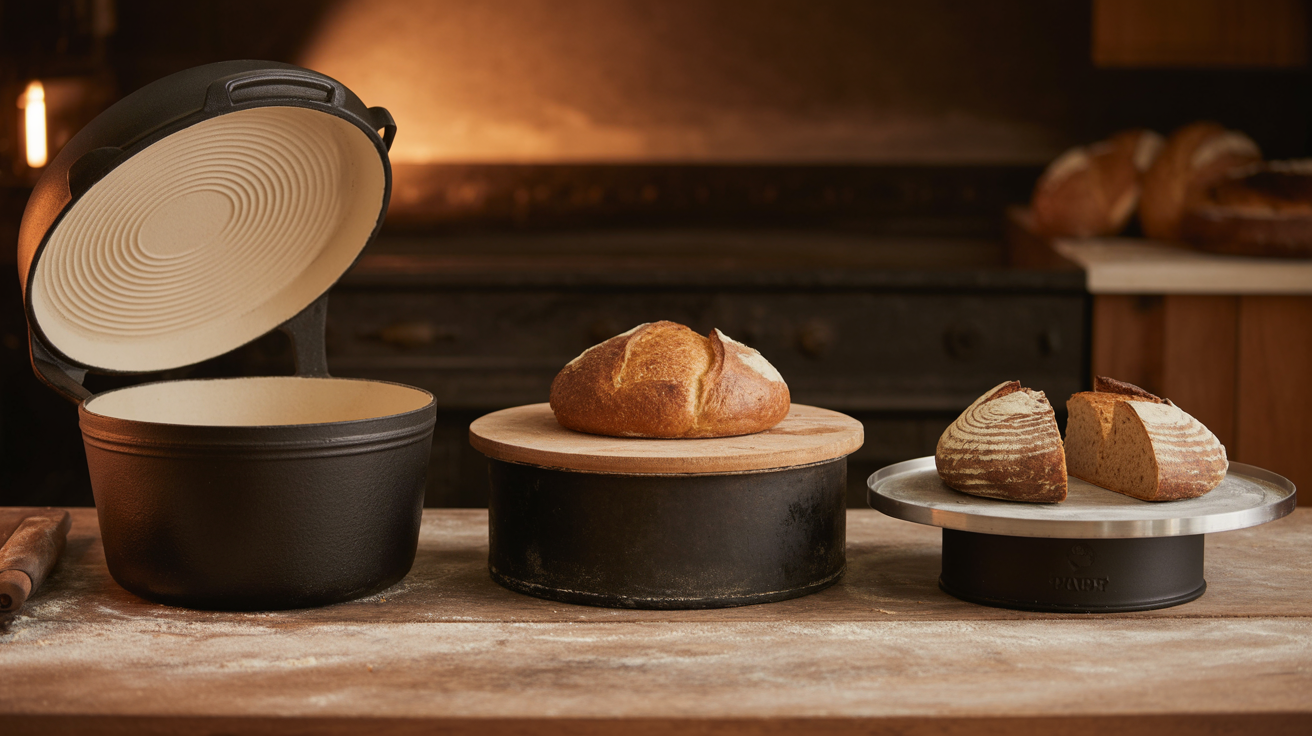
Your baking vessel affects oven spring, crust quality, and crumb structure more than any single technique. The three main options — Dutch oven, baking stone, and baking steel — each have real pros and cons, and choosing the wrong one for your baking style leads to flat, pale, or tough loaves.
This guide breaks down each vessel honestly: what they do well, where they fall short, and which one matches your baking goals. Pair the right vessel with our sourdough ratio calculator and you’ve got the structural foundation for great bread.
Why Your Baking Vessel Matters
Professional steam-injected deck ovens produce the crust and oven spring sourdough is famous for. Home ovens don’t have steam injection — so you need to generate steam some other way. The baking vessel is how.
Three jobs the vessel needs to do:
- Retain heat: The vessel needs to be hot when the dough goes in — hotter than the ambient oven — to drive oven spring.
- Generate/trap steam: Steam keeps the crust soft during the first 15–20 minutes of baking so the loaf can expand. Without steam, the crust sets too early and oven spring is killed.
- Release heat evenly: For a crisp crust in the second half of baking.
Each vessel handles these differently.
Dutch Oven: The Gold Standard
What it is: A heavy cast iron or enameled cast iron pot with a tight-fitting lid. 5–7qt capacity typical.
Pros
- Perfect steam, every time: The dough’s own moisture evaporates and gets trapped by the lid. No tray, no spray bottle needed.
- Incredible oven spring: The concentrated heat around the loaf drives the biggest, tallest rise you can get at home.
- Blistered crust: The humid environment during the covered stage produces the signature blistered, crackly crust.
- Beginner-friendly: It’s almost foolproof. Load dough, close lid, bake.
- Double duty: Great for stews, braises, everything else.
Cons
- Single loaf at a time. Two loaves requires two Dutch ovens.
- Heavy: A 7qt enameled Dutch oven weighs 14–16 pounds empty, more with hot dough.
- Expensive: Premium enameled versions are $200–$400 (Staub, Le Creuset).
- Thermal mass limit: Takes time to recover heat between bakes.
Size matters
- 5qt: fits 500g flour dough (about 900g dough total)
- 6–7qt: fits 600–700g flour dough (1–1.3kg dough total)
- 9qt+: for larger loaves but oven spring suffers — too much empty space dilutes steam
For most home bakers, a 5–7qt Dutch oven is the sweet spot.
Budget pick: Lodge Cast Iron Combo Cooker (7qt)
$70–$90, bare cast iron, oven spring rivals $400 enameled Dutch ovens. The downside is bare cast iron needs seasoning (occasional oil treatment) and can rust if stored wet. But for pure baking performance, the Lodge Combo Cooker is arguably the best sourdough value on the market.
Mid-range pick: Challenger Bread Pan
$300, purpose-built for sourdough. Wider oval footprint for batards, lower profile, recessed handles. Beloved by serious home bakers.
Premium pick: Le Creuset 5.5qt Round French Oven
$350–$450. Enameled, beautiful, heirloom-quality. Works for stews, bread, everything.
Baking Stone: Traditional and Crispy
What it is: A ceramic or cordierite slab (roughly 14×16 inches) that sits on an oven rack. The dough bakes directly on it.
Pros
- Multiple loaves: Two or three small boules fit at once.
- Excellent crust: Direct contact with hot stone gives thick, crisp crust.
- Affordable: $30–$80 for good quality.
- Versatile: Great for pizza, flatbreads, baguettes.
Cons
- Steam is manual: Requires a boiling water tray on the lower rack, or ice cubes thrown in, or aggressive spray bottle. Multiple steam-generating rounds during the first 15 minutes.
- Inconsistent results: Steam production depends heavily on oven sealing and your timing.
- Fragile: Thermal shock (cold dough on very hot stone) can crack cheap stones.
- Slower recovery: Temperature drops when you open the oven door, and stones don’t recover as fast as a Dutch oven that’s closed.
Steam strategy for stone baking
- Place a cast iron skillet on the lower rack during preheat.
- Boil 1 cup of water in a kettle.
- Load dough onto stone.
- Immediately pour boiling water into the cast iron skillet and close oven.
- Spray oven walls (not the dough) with water 3 times in the first 5 minutes.
- Remove skillet after 20 minutes; continue baking to finish the crust.
This works but requires fast movements and careful timing. More moving parts = more ways to go wrong.
Best picks
- FibraMent-D 15×20: Gold standard for bread/pizza stones. $70–$90.
- Emile Henry Flame Top: More forgiving, ceramic. $60–$80.
- Old Stone Oven 14×16: Budget option. $30–$45.
Baking Steel: Pizza’s Best Friend
What it is: A flat steel slab (often 1/4” thick) that sits on an oven rack. Conducts heat far faster than ceramic stone.
Pros
- Fastest heat transfer: Steel conducts heat 5–10× faster than ceramic. Crust sets quickly.
- Exceptional for pizza: Unrivaled for Neapolitan-style pizza at home.
- Durable: Virtually indestructible.
- Multiple loaves: Like a stone, fits 2–3 loaves at once.
Cons
- Same steam problem as stones. Manual steam setup required.
- Overbakes the bottom: Because steel heats so aggressively, the bottom crust can go from perfect to burnt quickly.
- Heavy: A full-size steel weighs 15–20 pounds.
- Expensive: $80–$160 for quality.
Best picks
- Baking Steel Original (1/4”): The company that popularized them. $95–$120.
- NerdChef Steel Stone: Similar quality, slightly cheaper. $80–$100.
For pizza and flatbreads (see pizza dough hydration and focaccia ratios), steel is superior. For pure sourdough boule work, Dutch oven wins.
Head-to-Head Summary
| Criterion | Dutch Oven | Baking Stone | Baking Steel |
|---|---|---|---|
| Single loaf performance | 🏆 Excellent | Good | Good |
| Multiple loaves | Requires 2+ pots | 🏆 Easy | 🏆 Easy |
| Steam management | 🏆 Built-in | Manual | Manual |
| Crust quality | Thick, blistered | 🏆 Crisp | Crisp |
| Oven spring | 🏆 Maximum | Good | Good |
| Budget option | $70 (Lodge) | $30 (stone) | $80 (steel) |
| Premium option | $300 (Challenger) | $90 (FibraMent) | $120 (Baking Steel) |
| Best for pizza | No | Good | 🏆 Best |
My Recommendation
If you can only own one baking vessel for sourdough, get a Dutch oven. Specifically:
- Start with a 7qt Lodge Cast Iron Combo Cooker ($70–$90)
- Upgrade to a Challenger Bread Pan ($300) if you get obsessed
Add a baking steel ($80–$120) when you also want to make pizza regularly. Skip baking stones for sourdough — steel is better if you’re going non-Dutch-oven.
Preheating: Non-Negotiable
Whatever vessel you choose, preheat it aggressively:
- Dutch oven: 45 minutes at 260°C / 500°F with lid on
- Baking stone or steel: 60 minutes at 260°C / 500°F
A hot vessel drives oven spring. A cold vessel gives you bread bricks.
Bake Times and Temperatures
Standard sourdough bake:
- Preheat to 260°C / 500°F
- Drop to 240°C / 465°F when you load the dough
- Cover/steam for 20 minutes
- Uncover/stop steaming, bake 20–25 more minutes until deeply browned
- Internal temp 98°C / 208°F when done
Final Word
Your baking vessel matters more than most home bakers realize. Dutch oven for sourdough, steel for pizza — cover most of home artisan baking with those two pieces. Get the preheating right, the rest falls into place.
For the other precision foundation, see thermometer and DDT.