Overnight Bulk Fermentation: Cold-Slow vs Warm-Fast — Which Works?
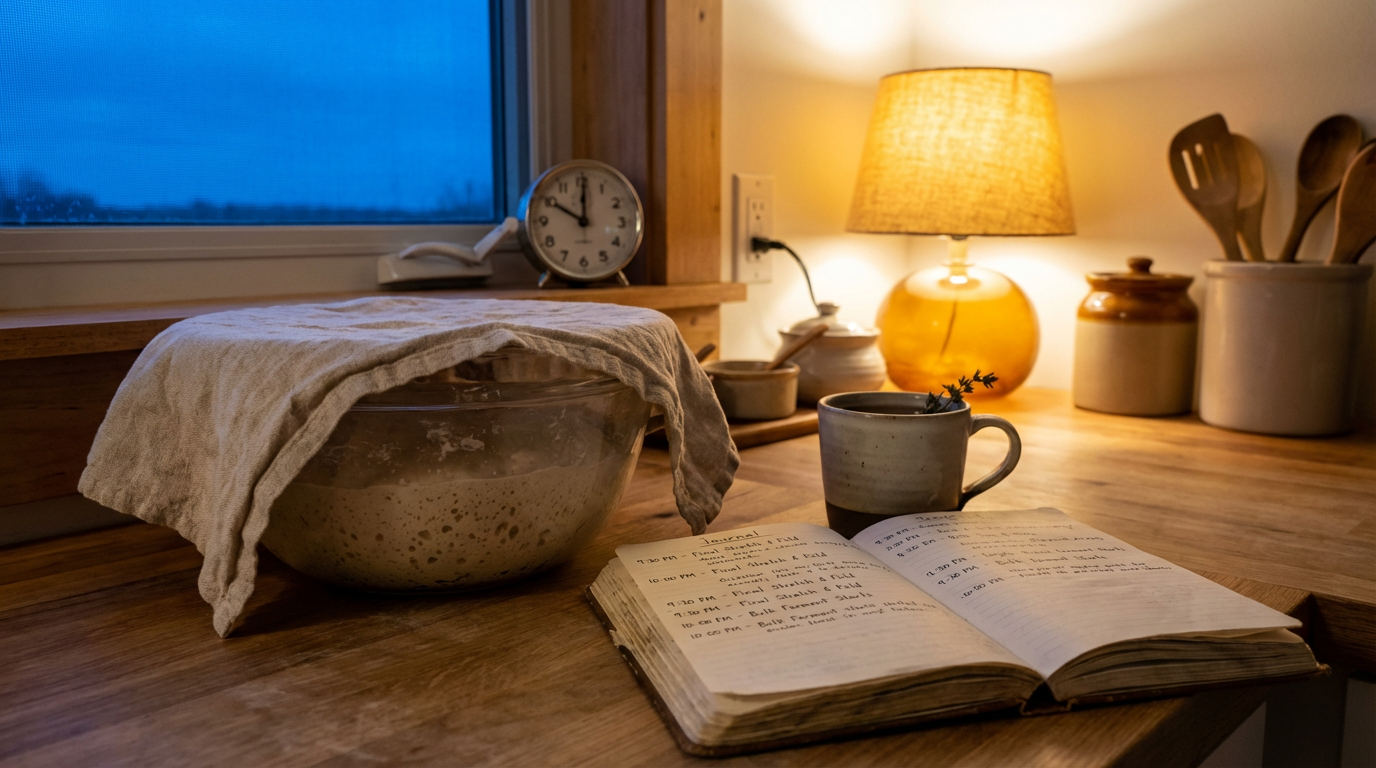
Why Overnight Bulk Makes Sense
Most people don’t have 6 free daytime hours to babysit a dough. If you can mix before bed and shape at breakfast, you’ve just unlocked sourdough as a weekday bake — no more Saturday-only schedules. The trick is matching three variables: inoculation (starter %), temperature, and time. Get those right, and overnight bulk is genuinely easier than daytime bulk.
There are two reliable paths: cold-slow and warm-fast. Both work. Which one you choose depends on your kitchen temperature, schedule, and flavour preference.
Path 1: Cold-Slow (16–18°C / 60–65°F)
This is the classic Tartine-style overnight bulk: cool environment, low starter %, long time. It develops the deepest flavour and most complex crumb.
The formula
- Starter/inoculation: 8–10% baker’s percentage (40–50g starter per 500g flour).
- Environment: 16–18°C (60–65°F) — cool basement, unheated back room, garage (in winter), or wine fridge.
- Time: 10–12 hours.
- Inoculation reduction is critical — don’t skip it. A normal 20% starter at 16°C still ferments faster than you think.
Sample schedule
- 9:00 PM: mix dough, 30-minute rest.
- 9:30–10:30 PM: 3 coil-folds at 20-minute intervals.
- 10:30 PM: cover, place in 16–18°C space. Go to bed.
- 8:00 AM: dough is ~75% risen. Shape.
- 9:00 AM: into fridge for final proof OR counter-proof 1 hour.
- 11:00 AM–1:00 PM: bake.
Flavour profile
- Clearly tangy with lactic yogurt notes.
- Complex, slightly fruity crumb aroma.
- Golden, caramelised crust.
- Moderate open crumb.
Path 2: Warm-Fast (22–24°C / 72–75°F)
If your kitchen stays at normal room temperature overnight, go with standard inoculation and a shorter window. You’ll finish bulk earlier in the morning.
The formula
- Starter: 15–20% baker’s percentage.
- Environment: 22–24°C (72–75°F) — typical room temperature.
- Time: 5–7 hours.
Sample schedule
- 11:00 PM: mix dough, 30-minute rest.
- 11:30 PM–12:30 AM: 3 coil-folds.
- 12:30 AM: cover, leave on counter at 22°C. Go to bed.
- 6:00 AM: bulk is ~75% risen. Shape.
- 6:30 AM: into fridge 4–8 hours.
- 12:00–2:00 PM: bake.
Flavour profile
- Mild tang, light acetic notes.
- Cleaner wheat flavour, less complex.
- Open airy crumb with larger bubbles.
- Golden crust, slightly paler than cold-slow.
The Inoculation × Temperature Math
The simplified rule: bulk time doubles for every 5°C drop in temperature, and bulk time halves when you double the starter %.
A few worked baselines:
- 20% starter, 24°C → 5 hours bulk.
- 20% starter, 19°C → 10 hours bulk.
- 10% starter, 24°C → 10 hours bulk.
- 10% starter, 19°C → 20 hours bulk (too long; drop to 15–16 hours).
- 10% starter, 16°C → 12 hours bulk.
Use these as starting points, then tune across 2–3 bakes to match your kitchen.
Choosing Between Them
Pick cold-slow if:
- You have a cool space (basement, garage winter, spare room).
- You love tangy, complex bread.
- You want bread by 11am or early afternoon.
- You don’t mind the reduced-inoculation recipe adjustment.
Pick warm-fast if:
- Your kitchen sits at normal 22–24°C overnight.
- You prefer milder, cleaner bread flavour.
- You can shape at 6–7am.
- You want to use your existing recipe with no inoculation changes.
Common Overnight Bulk Mistakes
- Full 20% inoculation in a warm room — wake up to a puddle: over-fermented. Drop to 10–12% next time.
- 10% inoculation in a cold garage — bulk never finishes: 16°C target assumes ~16–18°C. Below that, move to a warmer spot.
- Skipping coil-folds because it’s late: reduces structure. Do them before bed.
- Setting no morning alarm: sleeping an extra hour past readiness loses a loaf.
- Changing both temperature and inoculation at once: you can’t debug what went wrong.
Cold-Slow in a Cooler (No Basement)
If you live in an apartment with no cool space: use a hard-sided cooler (like a beach cooler) with 2 frozen water bottles. Add water bottles at bedtime, check temp in the morning. Most coolers hold 16–18°C for 10–12 hours reliably.
Warm-Fast in a Cold Kitchen
If your kitchen drops below 20°C overnight in winter: place the bulk container on top of the fridge (warmest spot), or use a proofing box at 24°C. Alternatively, switch to cold-slow path which suits cool environments naturally.
FAQ
Can I do 14–16 hour bulks?
Only with very low inoculation (5–7%) in cold environment (14–15°C). This is the artisan “long-cold-slow” method. Flavour is deeply complex, bordering on acidic.
Is overnight bulk stronger or weaker than daytime bulk?
Equal, if timed correctly. Overnight bulk often produces better flavour because of the longer fermentation window.
Can I skip cold retard after overnight bulk?
Yes — shape and proof 1–1.5 hours at room temp, then bake. The trade-off: less pronounced flavour, but simpler timing.
What if my bulk is under-risen in the morning?
Move to a warmer spot (top of fridge) and wait another 1–3 hours before shaping. The dough will recover.
Next Steps
Try the warm-fast path first — it requires no changes to your existing recipe. Once comfortable, experiment with cold-slow for richer flavour. Pair this with our bulk fermentation signs guide so you can read dough reliably at 6am before coffee. Use the sourdough ratio calculator to dial in the inoculation percentage.