Sourdough in Summer vs Winter: How to Adjust Bulk Fermentation by Season
The Same Recipe, Different Seasons, Different Bread
Every experienced home baker has had this moment: you nail a recipe in spring — perfect open crumb, golden crust, balanced tang. You repeat it in July and end up with a flat, sour puddle. Or you try it in January and pull out a dense brick of under-fermented dough. Same flour, same starter, same procedure. What changed?
Temperature. Between winter and summer, most home kitchens swing a full 10°C (18°F). Because fermentation doubles in speed for every 5°C rise, a July bulk can be four times faster than a January bulk. If your recipe is tuned to spring conditions, both extremes will fail.
This guide covers the three main levers you can pull — inoculation, water temperature, and bulk duration — to keep your bread consistent year-round.
The North Star: 24–25°C Dough Temperature
The professional target for most sourdough is a desired dough temperature (DDT) of 24–25°C (75–77°F). At this temperature, fermentation is predictable, flavour is balanced, and the timing charts in recipes apply. Your job each season is to keep the dough in that target, regardless of room temperature.
The DDT formula (simplified):
Water temp = (3 × target DDT) – (flour temp + room temp + friction)
Friction is 1–2°C for hand mixing, 3–5°C for stand mixers. Flour temperature usually equals room temperature if stored in the kitchen.
Summer Adjustments (Ambient 26–32°C / 79–90°F)
1. Chill the water
If your kitchen is 30°C and target DDT is 25°C, the math says water = (3×25) – (30+30+1) = 14°C. That’s tap water straight from a cold tap in most countries, or refrigerated water if your tap runs warm.
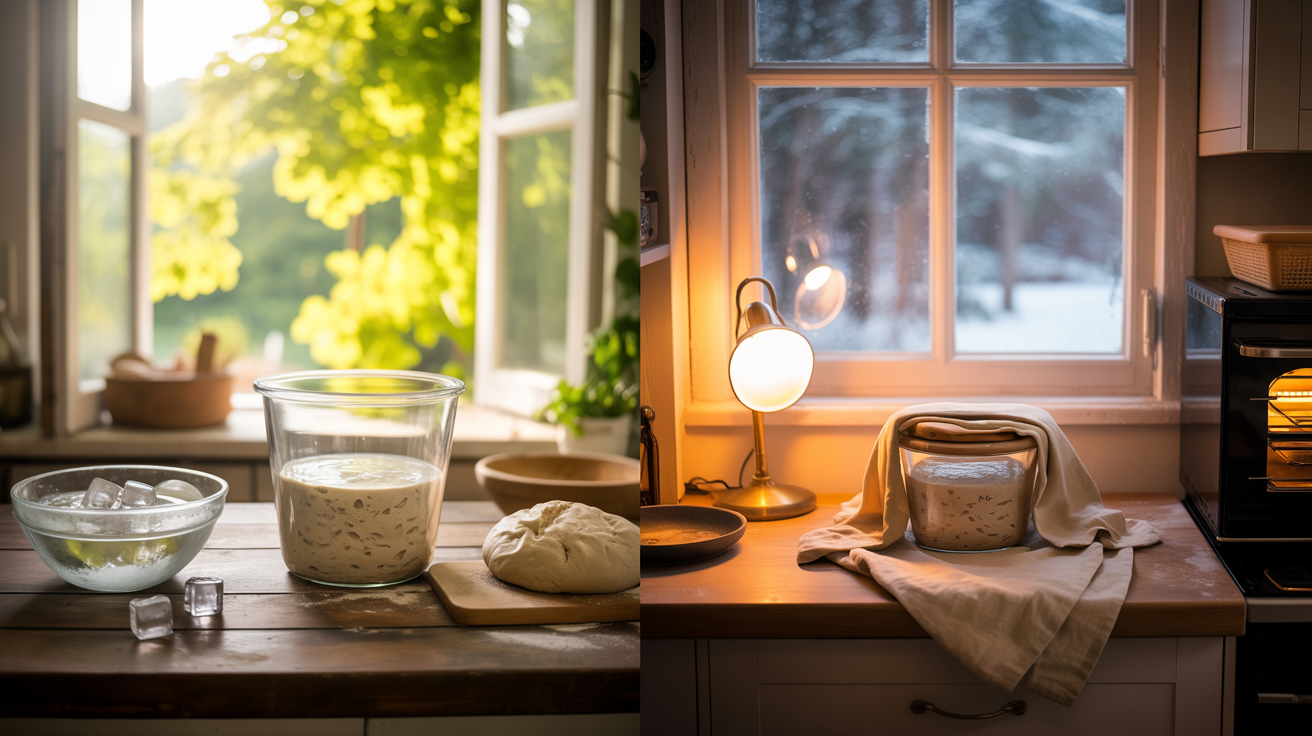
If your kitchen is 32°C+: use a few ice cubes in your water and chill the flour in the fridge for 30 minutes before mixing.
2. Reduce inoculation
Summer heat accelerates starter activity. Drop inoculation from a standard 20% to 10–15% to give yourself a timing window. With a 20% starter in 30°C ambient, bulk can finish in 2 hours — no time to stretch-and-fold properly.
3. Shorten bulk target
Summer bulk still targets 75% rise, but you reach it faster. Expect 2.5–4 hours instead of 5. Always use visual signs, not the clock.
4. Retard earlier
Instead of 5-hour bulk + 12h retard, run 3.5h bulk + 18–24h retard. The long cold phase develops flavour without rushing fermentation past the window.
5. Consider early-morning baking
Many summer bakers start at 5–6 AM when the kitchen is coolest. Bulk in the morning, retard in afternoon, bake next morning.
Sample summer schedule (ambient 30°C)
- 6:00 AM: mix with 12°C water + 12% starter.
- 6:30–7:30 AM: 3 coil-folds.
- 9:00 AM: bulk done at 75% rise.
- 9:30 AM: shape.
- 10:00 AM–10:00 AM next day: cold retard 24 hours.
- 10:30 AM: bake.
Winter Adjustments (Ambient 16–19°C / 60–66°F)
1. Warm the water
Kitchen at 18°C, target DDT 25°C: water = (3×25) – (18+18+1) = 38°C. Warm (not hot) tap water is ideal — above 45°C damages starter, avoid.
2. Increase inoculation
Cold slows starter. Compensate by running 25–30% inoculation. This is standard for “winter sourdough” recipes.
3. Find a warm spot
Even with warm water, 18°C room temp drags bulk long. Park your dough somewhere warmer:
- Top of the fridge (usually 22–24°C).
- Near a radiator (not directly on, test first).
- Inside a cold oven with just the light on (23–26°C).
- A dedicated proofing box set to 24°C.
- Inside a styrofoam cooler with a bottle of hot water (refresh every 2 hours).
4. Longer bulk
If you can’t warm the dough, accept longer bulk. At 18°C with 20% starter, expect 10–12 hours. Works great for overnight schedules (see our overnight bulk guide).
5. Shorter cold retard
Your fridge in winter may actually be cooler than in summer. 12-hour retard is plenty — don’t push to 24+ unless you’ve short-bulked.
Sample winter schedule (ambient 18°C)
- 10:00 AM: mix with 35°C water + 25% starter.
- 10:30–11:30 AM: 3 coil-folds on top of the fridge.
- 4:00 PM: bulk done at 75% rise.
- 4:30 PM: shape.
- 5:00 PM–5:00 AM: cold retard 12 hours.
- 5:30 AM: bake.
The Shoulder Seasons: Spring & Autumn
Spring and autumn sit in the sweet spot: ambient 20–23°C. Most recipes are tuned for this. Use 20% starter, room-temp water, standard 5-hour bulk at 75% rise, 12-hour retard.
Be aware: early spring and late autumn can drop to winter conditions overnight. Check your kitchen temperature before each bake.
Practical Tools for Temperature Control
Digital probe thermometer ($10–20)
Essential. Measure dough temperature right after mixing, not room temperature.
Proofing box ($50–150)
Transforms winter baking. Set and forget at 24°C. Doubles as a final-proof chamber.
Ice cubes + warm water
Free summer tool. Chill water with 2–3 cubes for 5 minutes, remove before mixing.
Styrofoam cooler + hot water bottle
Free winter tool. Hot water bottle at one end, dough at the other.
Kitchen thermometer (bimetal or digital)
Mount near your bulk area. Readings near a window or oven differ from wall thermostats.
Seasonal Flour Considerations
Flour itself changes seasonally. Stone-milled or freshly-milled flour may behave slightly differently in very dry winter conditions vs humid summer conditions. Commercially-milled flour is more consistent.
If you buy flour in bulk: store it in a cool, dry cupboard. In summer heat, consider the fridge for long-term storage.
Flavour Profile by Season
- Summer: chilled water, shorter bulk, long retard → clean, complex, mild tang.
- Winter: warm water, long bulk, shorter retard → fuller yeasty flavour, golden crust.
- Shoulder seasons: balanced flavour, easiest baking.
Common Seasonal Mistakes
- Using the same recipe all year: expect different bread each season.
- Ignoring water temperature: the #1 untapped variable.
- Summer: bulk too long “by the clock”: dough over-ferments 2–3 hours in.
- Winter: skipping the warm spot: 10+ hour bulks, under-fermented results.
- Ignoring dough temperature after mixing: measure and adjust next bake.
The Year-Round Baker’s Notebook
Keep a simple log per bake:
- Date, outside and kitchen temperature.
- Water temperature used, final dough temperature.
- Starter percentage.
- Bulk duration and final rise percentage.
- Retard duration.
- Notes on crumb and flavour.
After 10–15 bakes, your notebook becomes the most valuable sourdough reference you own — tuned exactly to your kitchen.
FAQ
Should I change recipes or just adjust timing?
Adjust timing first. Most recipes work year-round if you manage dough temperature, inoculation, and duration.
What if my kitchen fluctuates 5°C during bulk?
Normal. Pick your starting DDT to land in the middle of the day’s range, or move the dough to a more stable spot.
Do I need air conditioning in summer?
No. Most summer sourdough issues are solved with chilled water, lower inoculation, and early-morning mixing.
What about tropical climates year-round?
Treat as permanent summer. Use 10–12% starter, cold water, and cold retard as the main fermentation driver. See our wet-dough handling guide.
Next Steps
Measure your next dough’s temperature with a probe thermometer. Compare it to 24°C. Use the DDT formula to calculate water temp for your next bake. Combine this with our proofing time chart and aliquot jar method for objective timing. Use the sourdough ratio calculator to scale inoculation.