What Ratio Should I Feed My Sourdough Starter? (Beginner Guide)
The Short Answer: 1:1:1 by Weight
If you are new to sourdough and looking for a safe, tested default, feed your starter 1:1:1 by weight. That means equal grams of mature starter, flour, and water. For example: 30 g starter + 30 g flour + 30 g water.
This is the ratio used by nearly every beginner-friendly resource and the one most starter recipes assume unless stated otherwise. It peaks in roughly 4–6 hours at 72°F (22°C) and is forgiving of small measurement errors.
For a deeper look at the three common ratios, see our complete feeding ratio guide.
Why Ratios Matter (Even for Beginners)
A feeding ratio is just the recipe for refreshing your starter. The three numbers are always read as starter : flour : water. The higher the flour and water numbers, the longer your starter takes to peak — because the fixed population of yeast and bacteria has more food to chew through.
- 1:1:1 — peaks in 4–6 hours. Great for same-day use.
- 1:2:2 — peaks in 6–8 hours. Great for feed-before-dinner, bake-in-morning.
- 1:5:5 — peaks in 10–14 hours. Great for overnight levains.
Pick the ratio whose peak window lines up with when you want to bake. If you want to bake at 2 PM and it is 8 AM now, 1:1:1 is a good fit.
Step-by-Step: How to Do a 1:1:1 Feed (Beginners)
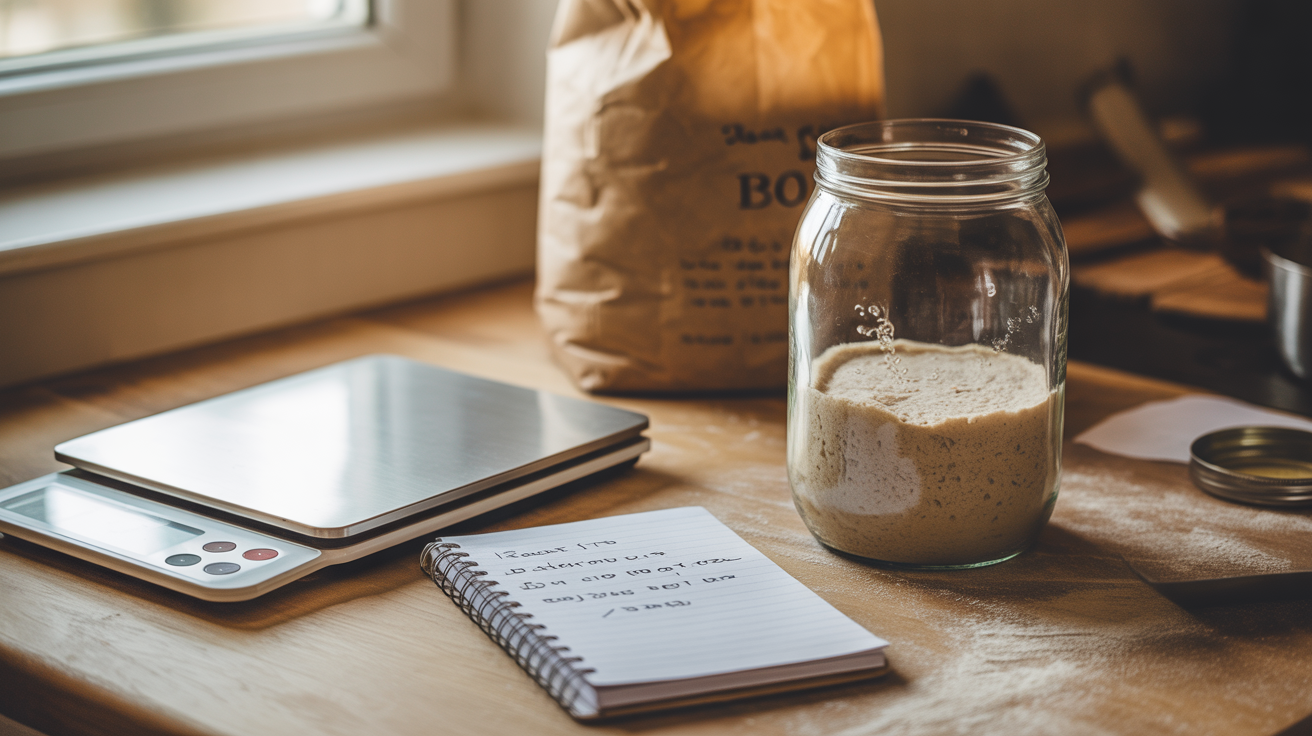
- Put a clean jar on a kitchen scale and zero it.
- Scoop out 30 g of mature starter from your existing jar. Discard the rest or save it for sourdough discard recipes.
- Add 30 g of room-temperature water (around 75°F / 24°C). Stir until the starter dissolves into a slurry.
- Add 30 g of flour — bread flour or a 50/50 bread + whole-wheat blend works well.
- Stir until smooth, scrape down the sides, and cover loosely with a lid or cloth.
- Mark the jar with a rubber band at the starter level so you can see when it has doubled.
- Wait 4–6 hours at room temperature. When the starter is domed, smells tangy-fruity, and passes the float test, it is ready to bake with.
Float Test (Optional but Helpful)
Drop a teaspoon of starter into a glass of water. If it floats, it has enough gas to leaven bread. If it sinks, wait 30 more minutes. The float test is not perfect but is a good sanity check for new bakers.
Troubleshooting: Common Beginner Issues
Problem: My Starter Is Not Rising
If your 1:1:1 feed barely moves in 6 hours:
- Age: New starters (under 14 days) are often sluggish. Keep feeding twice daily.
- Temperature: Below 65°F, fermentation crawls. Move the jar on top of the fridge or to a warm pantry.
- Flour: Low-protein all-purpose flour ferments slower than bread flour. Try adding 10 g whole wheat to the feed.
- Water: Chlorinated tap water can inhibit yeast. Use filtered or let tap water sit overnight.
Problem: My Starter Peaked in 3 Hours and Collapsed
Your kitchen is probably above 78°F. Switch to 1:2:2 to slow things down, or move the starter to a cooler spot. At temperatures over 82°F, 1:1:1 can peak in under 3 hours, which makes timing very tight.
Problem: My Starter Smells Like Nail Polish Remover
That is acetone. It means the starter is hungry and has over-fermented. Feed it right away. If it happens repeatedly, feed more often or switch to a higher dilution like 1:2:2 so the food lasts longer.
Problem: I Keep Throwing Away So Much Discard
Two fixes:
- Shrink your feeds. 10 g + 10 g + 10 g is still a 1:1:1 feed — just a smaller one. Most single-loaf bakers only need 50–75 g of ripe starter.
- Use a higher ratio. Switching to 1:5:5 means less frequent feeds and less discard per day.
When Should You Change Your Ratio?
You do not need to stick with 1:1:1 forever. Try a different ratio when:
- Your schedule changes. Night shift baker? 1:5:5 lets you feed at 4 PM and bake at 6 AM.
- Your kitchen changes temperature. Winter may call for 1:1:1; summer may need 1:3:3.
- You want a different flavour. Milder loaves come from more dilution (1:5:5); tangier from less (1:1:1).
- Your starter is mature. After 3–4 weeks of healthy activity, your starter can handle any of the common ratios.
Quick Reference Table
| If you want to bake in... | Feed your starter... |
|---|---|
| 4–6 hours | 1:1:1 at 72°F |
| 6–8 hours | 1:2:2 at 72°F |
| 8–12 hours | 1:3:3 at 72°F |
| 10–14 hours (overnight) | 1:5:5 at 72°F |