Best Ratio for Feeding Sourdough Starter (Optimization Guide)
There Is No One Best Ratio
Ask three experienced sourdough bakers for the “best” feeding ratio and you will get three different answers. That is because the optimal ratio depends on the variables you cannot change quickly: your kitchen temperature, when you want to bake, and how active your starter already is.
What you can do is choose the ratio that makes your life easiest. This guide walks through how to pick the best ratio for your situation — and when to switch as conditions change.
For the underlying ratio math, see our complete feeding ratio guide.
The Single Best Default: 1:2:2
If you are looking for one ratio that will work for roughly 80% of home bakers, it is 1:2:2 (one part starter, two parts flour, two parts water by weight).
Why 1:2:2 wins as the default:
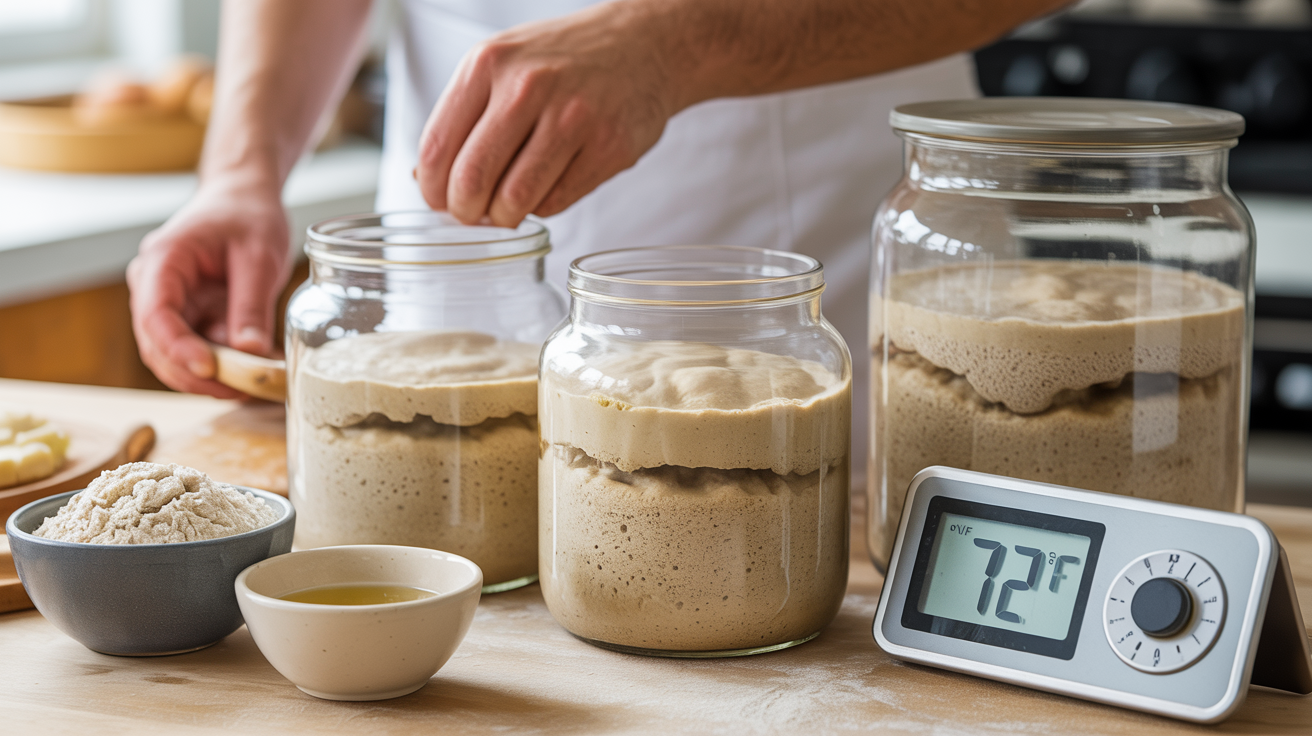
- Forgiving peak window. 6–8 hours at 72°F gives you margin for life events.
- Balanced flavour. Milder than 1:1:1 but still clearly sour.
- Less discard. Fewer feeds per day mean less waste.
- Schedule-friendly. Feed at 7 PM, bake at 9 AM — the math just works.
Best Ratio by Kitchen Temperature
Temperature is the biggest single lever. Yeast activity roughly doubles for every 10°F (5.5°C) warmer and halves for every 10°F cooler. Pick your ratio based on the temperature your starter actually lives at — not what the thermostat says.
| Kitchen Temp | Best Ratio | Approx Peak | Notes |
|---|---|---|---|
| 60–65°F (16–18°C) | 1:1:1 | 8–10 hrs | Warm the jar or use warmer water (80°F). |
| 66–72°F (19–22°C) | 1:2:2 | 6–8 hrs | The sweet spot. |
| 73–78°F (23–25°C) | 1:2:2 or 1:3:3 | 5–7 hrs | Watch for rapid peak in summer. |
| 79–84°F (26–29°C) | 1:3:3 or 1:5:5 | 4–6 hrs | 1:1:1 may collapse in under 3 hours. |
| >84°F (>29°C) | 1:5:5 | 4–7 hrs | Or refrigerate between feeds. |
Best Ratio by Schedule
The second variable is when you want to use the starter.
Same-Day Baking (feed & bake within 6 hours)
Best ratio: 1:1:1. Feed in the morning, bake in the early afternoon. The short peak window is not a problem because you are right there.
Evening Feed, Morning Bake (8–10 hrs between)
Best ratio: 1:2:2 or 1:3:3. Feed at 9–10 PM, mix dough at 7–8 AM. The starter peaks somewhere overnight and is still acceptable in the morning.
Overnight Levain (10–14 hrs)
Best ratio: 1:5:5. Feed at 10 PM, build the levain at the same time as the feed, mix dough at 9 AM. This is how most professional bakeries work.
Long Gaps Between Bakes (3–7 days)
Best ratio: 1:5:5 then refrigerate. Feed the starter 1:5:5, let it start activity at room temperature for 1 hour, then move to the fridge. Pull out 12–24 hours before your next bake to warm up and activate.
Best Ratio by Flavour Goal
Acidity in sourdough comes from two distinct acids:
- Lactic acid (yogurt-like, mild, rounded). Produced most at cooler temperatures and with more dilution.
- Acetic acid (vinegar-like, sharp). Produced at warmer temperatures, in stiffer starters, and with less dilution.
If you want a milder, creamier sourdough, lean toward 1:5:5 at 70°F. If you want a classic tangy San Francisco-style bite, stick to 1:1:1 at 75°F.
What About Stiff Starters?
Stiff starters change the hydration but not the feeding ratio terminology. A “1:2:1 stiff feed” means 1 part starter, 2 parts flour, 1 part water — which gives a 50% hydration starter. Stiff starters produce more acetic acid (sharper flavour) and ferment more slowly at any given temperature.
For most home bakers, a 100% hydration starter is easier to work with. If you want to explore stiff starters, read our stiff vs liquid starter guide.
How to Rotate Your Ratio Through the Year
One of the advanced moves is rotating your ratio with the seasons:
- Winter (kitchen 60–65°F): 1:1:1 daily, maybe twice daily.
- Spring / Fall (kitchen 68–75°F): 1:2:2 once daily.
- Summer (kitchen 76–85°F): 1:3:3 or 1:5:5 with overnight rests.
Watch how long your starter takes to peak. If your “usual” 1:2:2 suddenly peaks in 3 hours because the kitchen warmed up, step up to 1:3:3 or 1:5:5 without hesitation.
Signs You Have the Right Ratio
- Starter doubles and domes within the ratio’s expected peak window.
- Bread dough passes the windowpane test within a reasonable bulk ferment.
- Flavour matches what you expect (mild or tangy depending on ratio).
- You are not babysitting the jar or missing the peak window regularly.
- Discard volume is tolerable for your household.
If any of those is off, adjust one variable — ratio, temperature, or feeding frequency — and observe for 2–3 feed cycles before changing again.