Stretch-and-Fold vs. Coil Fold: When to Use Each (with Hydration Thresholds)
Ask five sourdough bakers to describe a bulk fermentation schedule and you’ll get five different answers. One does four stretch-and-folds every 30 minutes. One does two stretch-and-folds plus a lamination plus two coils. One just pokes the dough and calls it done. The confusion isn’t random — it’s because these folds do fundamentally different jobs, and most tutorials teach them as interchangeable.
They are not interchangeable. Using the wrong fold at the wrong hydration or time point is one of the top three reasons home bakes come out tight or uneven. This guide gives you the decision rules.
The mechanical difference
Stretch-and-fold
Wet your hand. Reach under one corner of the dough, lift it high, stretch until it resists, then drape it back over the center. Rotate the bowl 90° and repeat three more times.
What it does: The stretching elongates gluten strands, and the fold compresses the dough back into a parcel. Any gas bubbles that formed get squeezed and redistributed — usually flattened against the sides of the bowl. It builds strength aggressively but at the cost of gas retention.
Coil fold
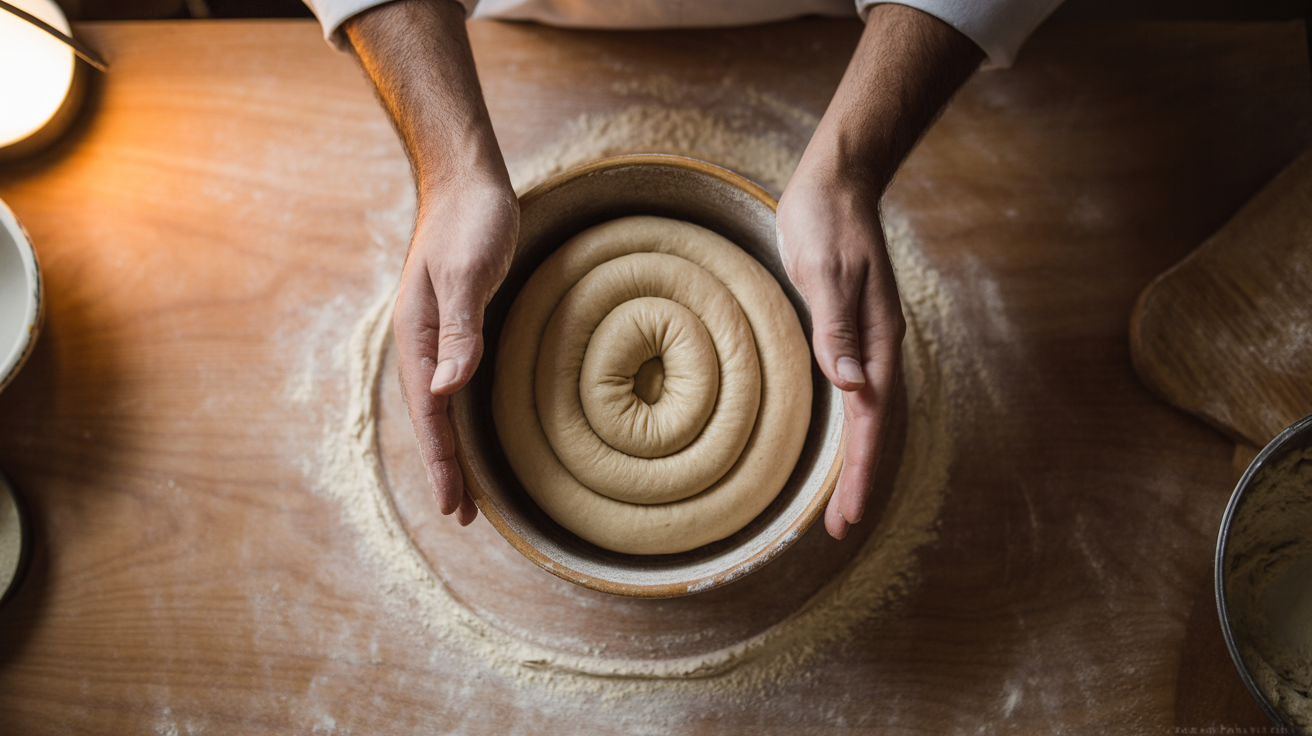
Wet both hands. Slide them under the middle of the dough. Lift the entire mass until only the ends touch the bowl, then let it coil back on itself as you lower it — the ends tuck under as you set it down. Rotate bowl 90° and repeat once.
What it does: The dough folds onto itself from underneath without ever being stretched flat or compressed against a surface. Gas pockets stay intact. Gluten gets reorganized, but no flattening occurs. It builds organization rather than raw strength — which is what you want once the base structure is already there.
The hydration decision tree
| Hydration | First 60 min | 60–120 min | After 120 min |
|---|---|---|---|
| Under 68% | Stretch-fold × 2 | Stretch-fold × 1 | Rest |
| 68–75% | Stretch-fold × 2 | Coil fold × 1 | Rest |
| 75–82% | Stretch-fold × 1 | Lamination × 1, Coil × 1 | Coil × 1, rest |
| Over 82% | Stretch-fold × 1 | Lamination × 1, Coil × 1 | Coil × 1–2, rest |
The pattern: the higher the hydration, the earlier you switch to coils, and the fewer total manipulations the dough can tolerate. A 65% sandwich loaf happily takes four stretch-and-folds. An 85% open-crumb loaf collapses if you try the same approach.
Why the hydration threshold matters
Dough at 70% hydration has enough structural rigidity that a stretch-fold redistributes gas without permanently crushing it. The gas pockets reform quickly in the next 30 minutes.
Dough at 80% hydration is much more slack. Stretch-folds at this hydration don’t compress the gas — they burst it. The extensibility that gives high-hydration bread its open crumb works against you during folds. A coil fold, by contrast, preserves the pockets because you never compress the dough against a surface.
Our guide to converting hydration levels walks through how doughs change physically as you push water content — that same physics explains why the fold strategy has to shift.
When to use each — concrete examples
Low-hydration sandwich loaf (65%, 22°C)
- 0:30 — Stretch-fold 1
- 1:00 — Stretch-fold 2
- 1:30 — Stretch-fold 3
- 2:00 — Stretch-fold 4 (optional)
- 2:00–5:00 — Rest to 75% rise
No coils needed. The dough is tight enough that gas preservation isn’t the bottleneck — strength is. Keep folding.
Classic country loaf (75%, 24°C)
- 0:30 — Stretch-fold 1
- 1:00 — Stretch-fold 2
- 1:30 — Coil fold 1
- 2:15 — Coil fold 2
- 2:15–5:00 — Rest to 50–70% rise
Build strength with stretches first, then preserve structure with coils.
Open-crumb loaf (82%, 25°C)
- 0:30 — Stretch-fold 1
- 1:15 — Lamination
- 2:00 — Coil fold 1
- 2:45 — Coil fold 2
- 2:45–5:00 — Rest to 50% rise
Minimum stretch-folds, lamination to redistribute, then coils to protect. See the full walkthrough in our lamination guide.
The over-folding problem
There is a point where another fold stops helping and starts hurting. For most doughs, that ceiling is 3–4 total manipulations across bulk fermentation. Past that, you’re degassing faster than fermentation can replace the gas, and your final loaf will have tight, uneven crumb no matter how good your starter is.
Signs you’ve crossed the line:
- Dough feels tense and rubbery instead of relaxed-but-strong
- You see fewer bubbles on the surface than you did two folds ago
- Final proof takes 30+ minutes longer than your baseline
- Oven spring underwhelms despite a strong poke test
The fix isn’t more folds — it’s fewer. When in doubt, do one fewer fold than you think you should. Dough rewards restraint more than it rewards intervention.
Do coil folds work on low-hydration dough?
Technically yes, but you lose their main benefit. Below 68% hydration the dough is stiff enough that lifting it off the counter doesn’t change its internal structure much — you’re basically just rotating it. The gas preservation edge disappears because low-hydration doughs don’t accumulate the same volume of gas during bulk.
For sandwich bread, bagel dough, pizza dough, or anything in the 60–68% range, stretch-and-folds are the right tool. See our pizza dough hydration guide for how this looks in practice with 60–65% doughs.
The rule of thumb
Low hydration wants strength. High hydration wants preservation.
Stretch-and-folds give you strength at the cost of gas. Coil folds preserve gas at the cost of how much they reorganize structure. Pick your fold based on what the dough lacks at that moment in bulk — early it lacks strength, so stretch; later it has strength and lacks volume, so coil.
Get the timing right and most loaves work themselves out.