Levain vs. Starter: When to Build a Separate Levain (and the Exact Ratios)
In most home sourdough recipes, the instructions go something like “add 100 g of active starter.” That works. But if you want to bake like a professional — or if you’ve ever been frustrated by unpredictable proof times or loaves that were too sour, not sour enough, or inconsistent week to week — you need to understand the difference between a starter and a levain, and start using them as the separate tools they actually are.
A mother starter is maintenance culture. A levain is a purpose-built, single-use offshoot designed to hit your dough at exactly the strength, acidity, and timing you want. Once you internalize the distinction, a lot of advanced sourdough techniques stop feeling mysterious.
The core difference in one sentence
A mother is a long-lived population you keep alive between bakes. A levain is a batch you grow on purpose for one specific bake, then use up or discard.
Both contain the same yeast and bacteria. The difference is in how you treat them:
- Mother: Fed regularly (once or twice a day, or weekly in the fridge) to stay healthy. Volume stays relatively small — often 40–120 g total. Goal: keep the microbiome alive and balanced.
- Levain: Built fresh from a small amount of mother, at a specific ratio and flour blend, timed to peak at the exact moment you mix dough. Volume is whatever your recipe needs (usually 100–300 g for a single loaf). Goal: deliver the right fermentation power and flavor profile to one dough.
Why you should use a levain (even at home)
1. Timing control
Your mother might peak at 9 PM when you’re asleep. A levain built at 9 PM peaks around 9 AM — perfect for a morning mix. You can time fermentation to your schedule instead of the starter’s.
2. Protecting the mother
Every time you use your mother directly, you risk depleting it, forgetting a feed, or accidentally over-acidifying it. A levain is expendable — mistakes stay contained.
3. Flavor and acidity control
Build a levain cool (20–22°C / 68–72°F) for a longer, sweeter development. Build it warm (26–28°C / 79–82°F) for a faster, tangier profile. Use 100% whole wheat in the levain while mixing white dough — you’ll get whole-wheat flavor without the whole-wheat texture.
4. Recipe consistency
When your recipe calls for “100 g of starter at peak,” two different bakers will produce different doughs because their mothers differ. A levain built to spec (say, 10 g mother + 45 g water + 45 g flour) is reproducible across kitchens.
The classic levain-build ratios
A levain is defined by its inoculation ratio: mother : water : flour.
1:3:3 levain (faster, 6–8 hours)
- 20 g mother
- 60 g water
- 60 g flour
- Total: 140 g levain at 100% hydration
Use when you need a fast turnaround — morning bake from a previous-day mix.
1:5:5 levain (balanced, 8–12 hours)
- 15 g mother
- 75 g water
- 75 g flour
- Total: 165 g levain at 100% hydration
The home baker’s default. Overnight build, peaks at breakfast. Our 1:5:5 starter feeding guide covers the same ratio applied to the mother — the math is identical.
1:10:10 levain (slow, 12–16 hours)
- 10 g mother
- 100 g water
- 100 g flour
- Total: 210 g levain at 100% hydration
For overnight-plus-morning builds or cool kitchens. Produces a cleaner, less sour flavor.
How much levain to use in your dough
Replace the “starter amount” line in your recipe with “levain amount.” Most recipes use 15–25% of total flour weight as the levain’s contribution.
Example: 500 g flour loaf, 20% levain = 100 g levain added. Plug this into our sourdough calculator — set starter percentage to 20% and it handles the math.
Check our how much starter per loaf guide for the full percentage logic — it applies to levain identically.
How to know your levain is ready
Three tests:
- Volume: Has doubled (or slightly more). Rubber band on the jar at the start helps.
- Float test: A teaspoon of levain floats in water. Not required, but confirms gas is trapped.
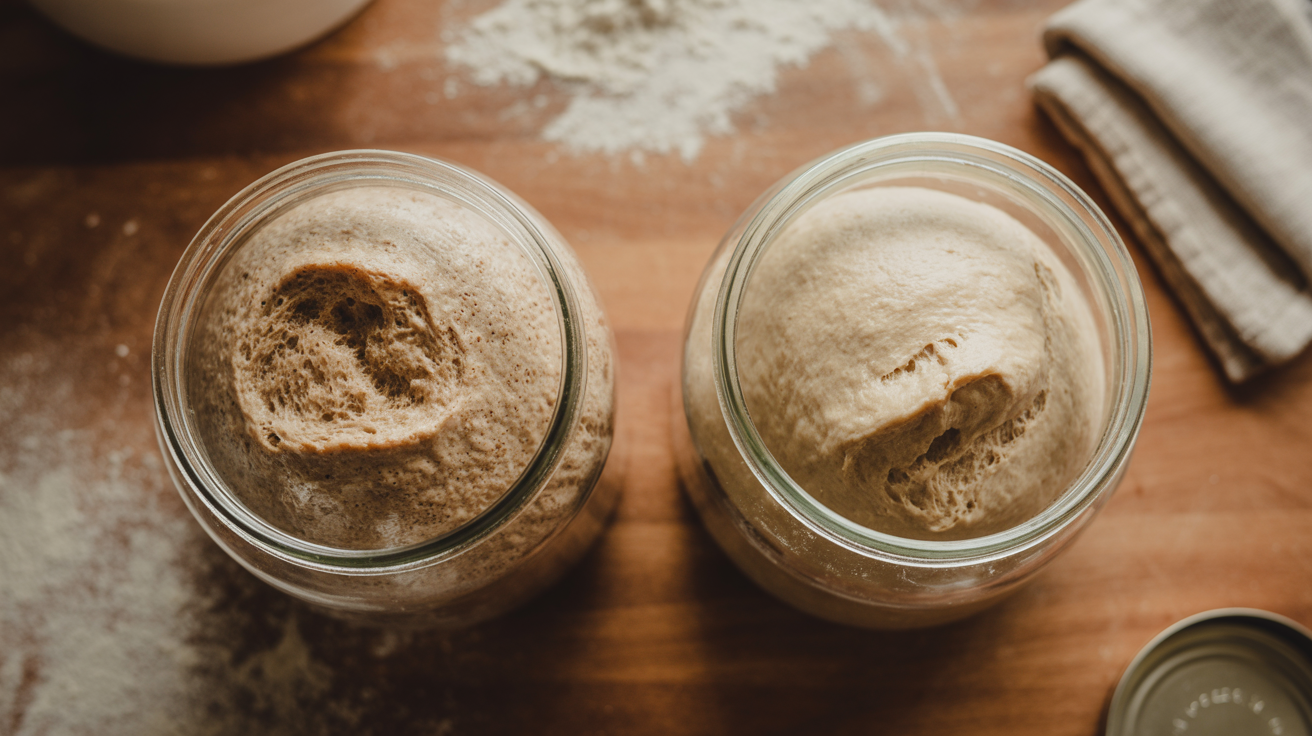
- Surface: Dome-shaped, slightly rounded top, lots of bubbles. If the dome has collapsed and the surface is flat or concave, you’re past peak — fermentation will be weaker and flavor more acidic.
Use levain at or just before peak — not after. Past peak means your acids are building while yeast activity drops, which is the opposite of what you want mixed into a fresh dough.
Matching levain flour to your dough
The flour in your levain becomes part of your final dough. A 500 g loaf with 100 g of levain has 50 g of levain flour baked in, which is 10% of total flour. That 10% can shift flavor noticeably.
Match the levain to the dough
Same flour in both. Neutral choice. Good for consistent, repeatable loaves.
Use a flavor-forward levain
Whole wheat or rye in the levain; bread flour in the dough. The levain’s bran contributes deeper flavor and faster fermentation, but the dough’s texture stays airy. A favorite technique for pro bakers — see our whole wheat ratios guide for the math.
Use a cleaner levain
White flour levain feeding a whole-wheat dough. Less acidity buildup, letting the whole wheat’s own flavor come through. Popular for 100% whole wheat and rye loaves where you want the grain, not the sour, to dominate.
Temperature as an acidity lever
Levain temperature is one of the cleanest ways to control final loaf flavor:
| Build temp | Time to peak | Flavor profile |
|---|---|---|
| 18–20°C (64–68°F) | 12–16 hr | Mild, sweet, lactic |
| 22–24°C (72–75°F) | 8–12 hr | Balanced, classic sourdough |
| 26–28°C (79–82°F) | 6–8 hr | Tangy, acetic, sharper |
If your kitchen is a fixed 22°C and you want a sweeter loaf, build in the cool pantry (18–20°C). Want more tang? Build in the proofer or a warm cupboard. Your mother keeps on its usual rhythm; you just shift the levain to reshape the bake.
Leftover levain — what to do
Most levain builds make slightly more than a single loaf needs. You have three options:
- Feed it back to your mother — if it’s at peak and uses compatible flour, stir some into your mother jar and feed as normal. Free backup.
- Refrigerate for 24–48 hours as an emergency mother or a pancake/waffle base.
- Bake a smaller secondary loaf or flatbread with the remainder. Leftover levain + 1:1 water + 1:1 flour + salt = discard-style flatbread in 2 hours.
The advanced move: tiered levains
Once you’re comfortable with single-stage levains, you can build tiered levains — feeding the levain itself once or twice before the final build. Each feeding “refreshes” the culture, producing a milder, more active levain. This is what most competitive bakers do for show loaves.
For most home bakers, a single-stage 1:5:5 overnight build is plenty. But the option is there when you’re ready.
The practical bottom line
Switching from “100 g of starter” to “100 g of a purpose-built levain” is the single most impactful change an intermediate baker can make. It gives you timing control, flavor control, and recipe consistency — and it protects your mother from the wear and tear of constant direct use.
Start with a 1:5:5 overnight build at room temperature, using the same flour as your dough. Once that’s reliable, start playing with cooler temps, different flours, and stronger inoculations. That’s where the “why is this loaf so good” moments come from.